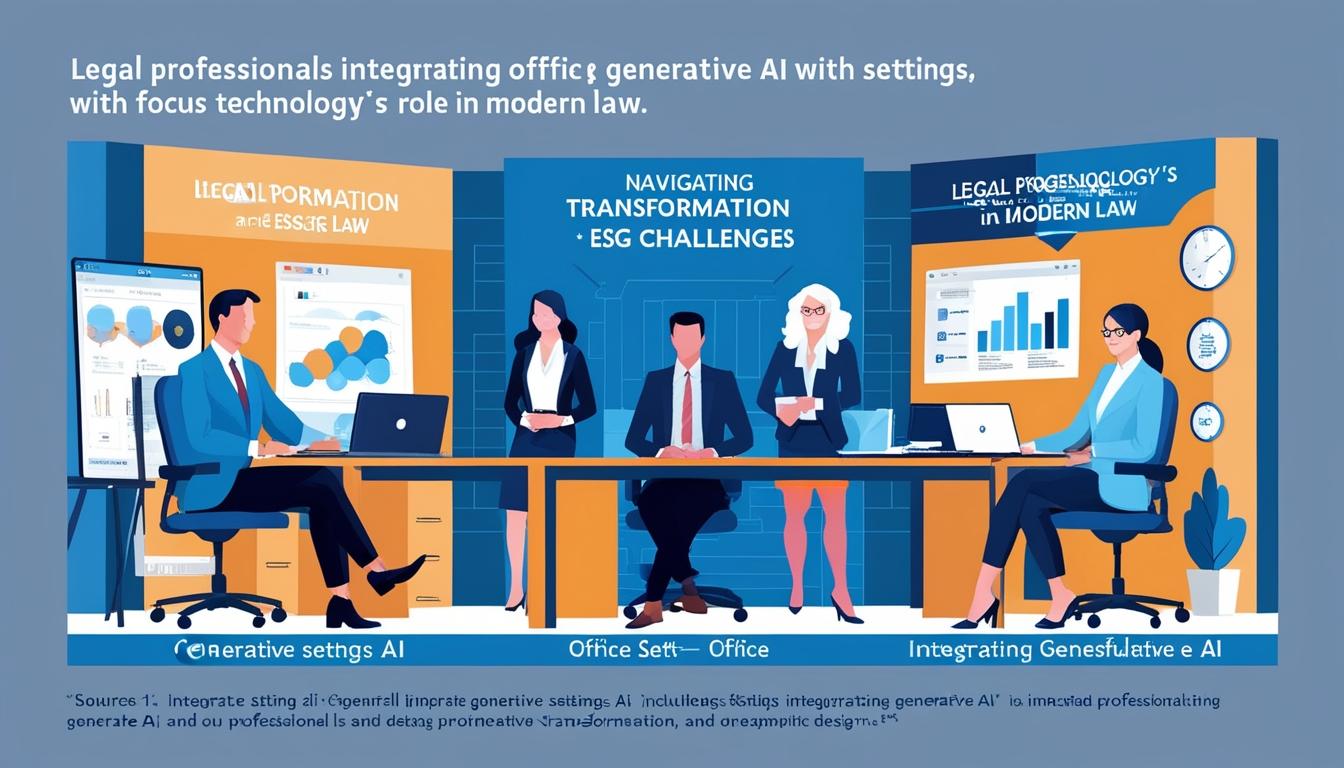
Wolters Kluwer, a renowned entity in professional information and software solutions, has unveiled the findings of its 2024 Future Ready Lawyer Survey. This study, which is now in its sixth year, is a comprehensive examination of the views of 700 legal professionals from both law firms and corporate legal departments across the United States and nine European countries, including Germany, the United Kingdom, and France.
The survey illustrates a legal industry grappling with significant transformation driven by the integration of new technologies. At the forefront of this shift is the adoption of generative AI (GenAI). The results show that 76% of legal professionals within corporate legal departments and 68% in law firms use GenAI at least weekly. Additionally, a notable portion, 35% and 33%, respectively, incorporate GenAI into their daily routines. The primary application of this emerging technology has aimed at creating new operational efficiencies by automating manual tasks related to managing extensive volumes of legal data.
Despite the favourable outlook on AI, challenges remain. Martin O’Malley, CEO of Wolters Kluwer Legal & Regulatory, observed that while there is confidence in the legal community's ability to manage technological advancements, adapting processes to accommodate AI is still crucial. A significant percentage of respondents, 37% from law firms and 42% from corporate legal sectors, noted difficulties in integrating GenAI with existing systems.
Another important aspect of the survey is the return to traditional office settings. Over 73% of legal professionals indicated a requirement to work in offices for four or more days a week. This shift is more noticeable in corporate legal departments (77%) compared to law firms (69%). Across various regions, this trend holds, with countries like the U.S. (56%), Italy (54%), and Poland (51%) reflecting a strong preference for full-time office presence.
In light of the evolving regulatory landscape, the survey highlights challenges related to Environmental, Social, and Governance (ESG) demands. A notable 68% of respondents acknowledge growing demands for ESG-focused legal expertise. However, only a minority, 29% of law firms and 41% of corporate departments, consider themselves "very prepared" for this surge in demand. To address this discrepancy, 56% of corporate legal departments and 45% of law firms are implementing ESG training programmes for their personnel.
In summary, Wolters Kluwer's 2024 Future Ready Lawyer Survey suggests a sector poised for change, leveraging AI advancements, and adapting to heightened ESG requirements, while also returning to more traditional work environments. The survey provides a crucial lens into how the legal profession is preparing to navigate the challenges and opportunities of the future.
Source: Noah Wire Services