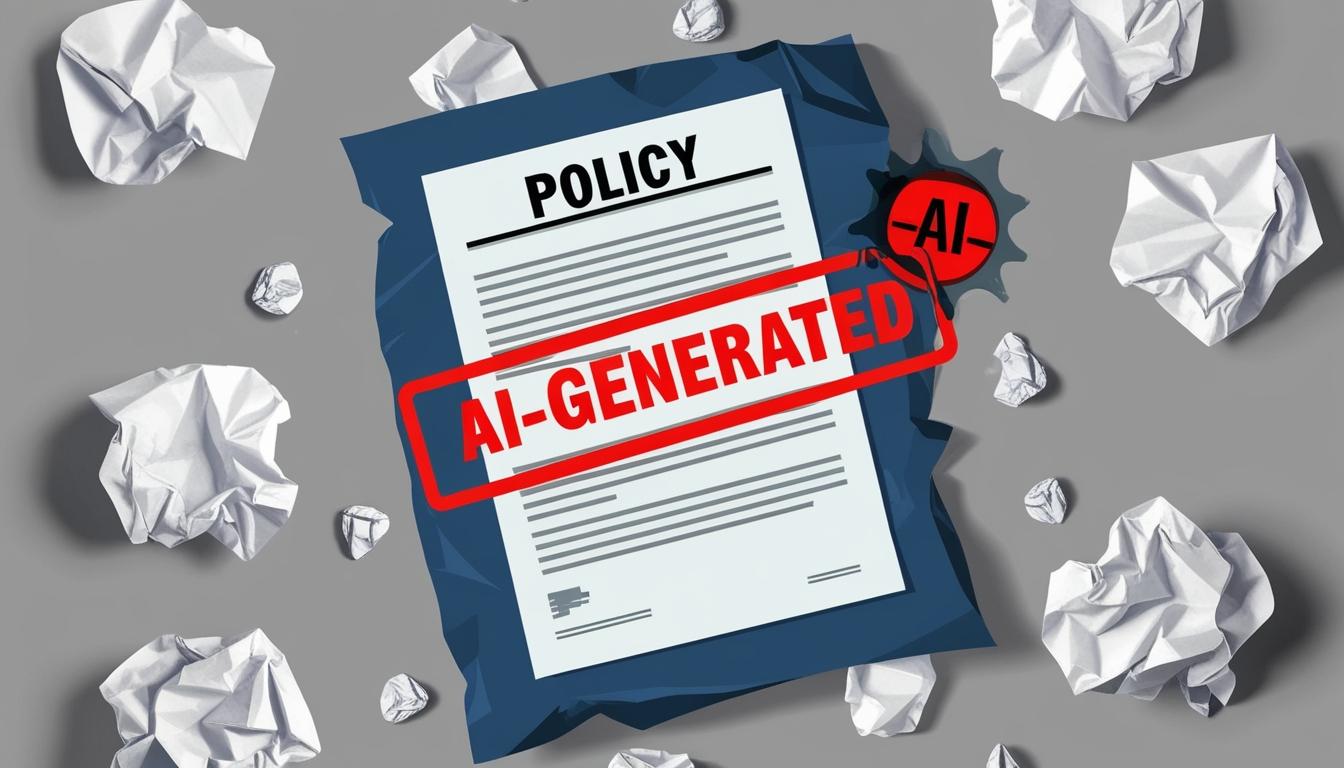
In a recent development, Alaska's top education official has come under scrutiny for using generative artificial intelligence to draft a proposed policy on cellphone use in state schools. The AI-generated draft, presented as a resolution, included citations of non-existent academic studies, thereby raising concerns about the reliability of sources used in public policymaking.
The document, drafted by Alaska's Education Commissioner Deena Bishop, was posted online ahead of a state Board of Education meeting earlier this month in the Matanuska-Susitna Borough. It was later revealed that the draft contained fabricated citations, attributed to fictitious studies and misplaced within real journals, sparking a debate on the state's oversight of AI tool usage in official documents.
The issue surfaced when members of the Board of Education and Early Development, responsible for endorsing such policies, were presented with this AI-generated content. Although the false citations were initially labelled as "placeholders," they were not accurately disclosed as AI-generated, prompting expert Ellie Pavlick from Brown University to identify them as typical "AI-hallucinated citations." Such hallucinations occur when AI models generate plausible-looking yet incorrect data, often due to insufficient information.
Commissioner Bishop later acknowledged the usage of AI in drafting the resolution and indicated that the erroneous document was accidentally posted in its preliminary form. After realising the inaccuracies, Bishop claimed to have shared the corrected references with board members before the vote. However, remnants of AI-generated errors remained in the version circulated post-approval.
The document initially cited six sources, four of which were entirely fabricated. It even included a purported study titled "Banning mobile phones improves student performance: Evidence from a quasi-experiment," supposedly in the journal Computers in Human Behavior. The actual link directed users to an unrelated article. Similar inconsistencies were found with citations from the Journal of Educational Psychology.
Upon request from the Alaska Beacon for evidence of these studies, the state department updated the document, replacing a nonexistent article with a legitimate one from a different journal. Bishop insisted that there was no malicious intent, emphasising that no tangible harm was done by these errors.
This incident highlights broader challenges regarding the integration of AI tools in government processes. The absence of state policies governing AI usage in document creation, coupled with the reliance on AI-generated content, can pose risks to the credibility of government documents and influence public trust.
As AI technology becomes more prevalent, the accuracy of its output becomes critical. Experts like Pavlick suggest that increased AI literacy among policymakers is essential to mitigate misuse and maintain public confidence. This issue echoes previous incidents, such as a legal case where an attorney faced consequences for citing fake cases produced by an AI chatbot, reflecting a need for better understanding of AI's capabilities and limitations.
The Alaska education department's use of AI-generated "placeholders" demonstrates the potential pitfalls of adopting such technologies without sufficient oversight. As policymakers grapple with these challenges, the situation underscores the importance of verifying information before it informs public decisions, ensuring that academic integrity and trust in government communications remain intact.
Source: Noah Wire Services