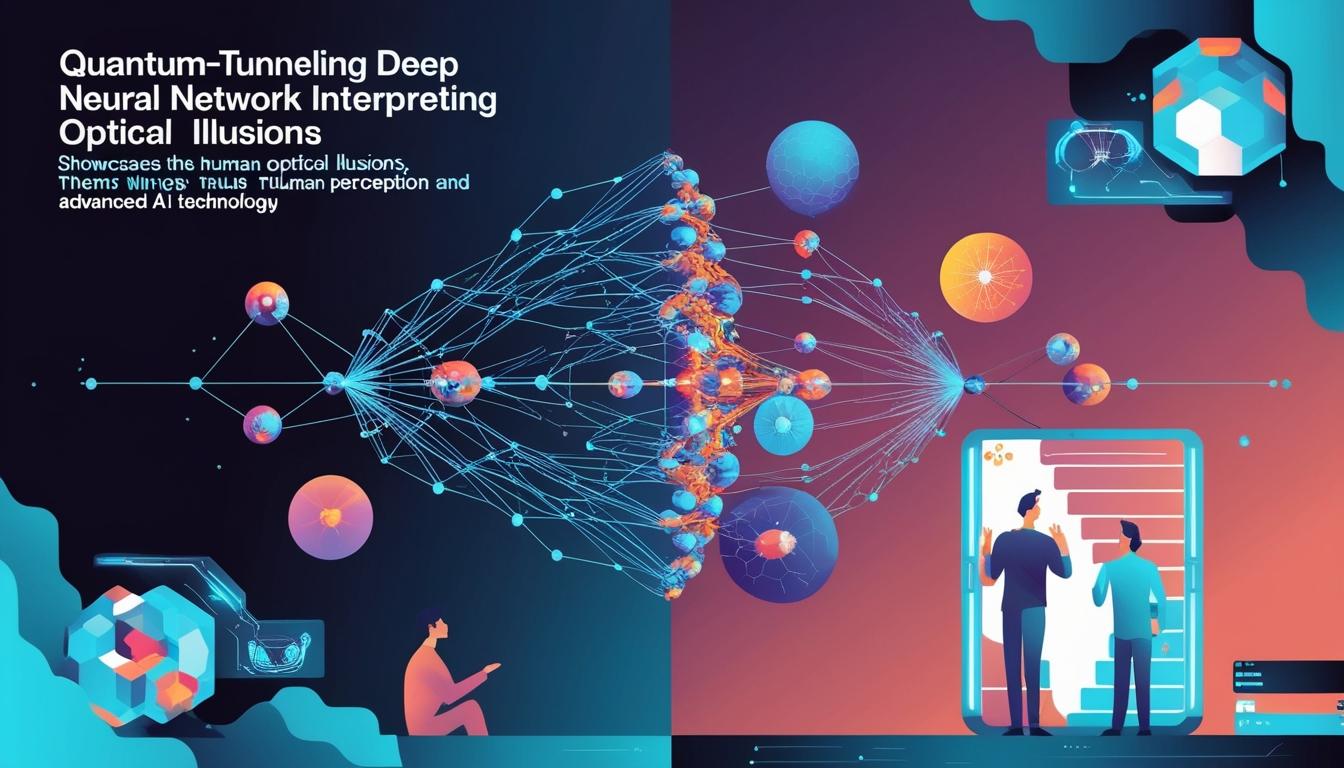
A groundbreaking artificial intelligence system has been developed to emulate the human brain's unique ability to interpret complex optical illusions, building on principles derived from quantum mechanics. This new AI model, introduced in a study published on 22 August in the journal APL Machine Learning, marks a significant advancement in computer vision, which has struggled to replicate the intricate psychological and neurological processes humans use to perceive illusions.
Optical illusions, such as the Necker Cube and Rubin's Vase, are well-known for playing tricks on human perception, allowing viewers to see one interpretation of an image and then another as they continue to observe it. These illusions exploit the brain's proficiency in switching between different interpretations, despite the image itself remaining unchanged. However, replicating this capability in artificial intelligence systems has been a formidable challenge until now.
The newly devised AI model, called a "quantum-tunneling deep neural network," integrates neural networks with the quantum mechanical phenomenon known as "quantum tunneling." Deep neural networks are inspired by the human brain's structure and function, comprising multiple layers of nodes to model intricate non-linear relationships. Unlike conventional neural networks that feature only a single layer, deep neural networks boast numerous hidden layers, enabling more complex data representation and processing.
Quantum tunneling itself is a fascinating phenomenon where subatomic particles like electrons or photons traverse barriers that appear impenetrable. These particles, which also possess characteristics of waves when unobserved, have a finite probability of appearing on the opposite side of such barriers, effectively "tunneling" through them if enough particles are present.
In this breakthrough AI system, images of optical illusions undergo a quantum tunneling stage that introduces slight alterations to the data. The modified image is then processed by the deep neural network, which assesses multiple variations of the illusion and determines which perspective to adopt. This mimics the way human brains toggle between different perceptions of an optical illusion.
Speaking on the development, Ivan Maksymov, a principal research fellow in AI at Charles Sturt University in Australia, explained in an article on TechXplore that this dual interpretation ability of the human brain resonates with the quantum-mechanical thought experiment known as Schrödinger’s cat. In this scenario, an entity holds two states simultaneously until a decision is made on which to observe. Maksymov highlighted that the AI was trained specifically to identify the Necker Cube and Rubin's Vase illusions, producing one of the two potential interpretations when presented with these illusions as input.
This innovation could have practical implications across various fields. Maksymov suggests that it could enhance safety in aviation and space exploration by helping airline pilots and astronauts manage disorientation and correctly interpret flight instruments. Additionally, this AI approach could contribute to medical applications, such as diagnosing mild cognitive impairments and dementia, by analysing ambiguous images.
The development of this AI system could usher in new possibilities for both technological and healthcare advancements, providing a unique intersection between artificial intelligence and quantum mechanics to solve complex perceptual challenges.
Source: Noah Wire Services