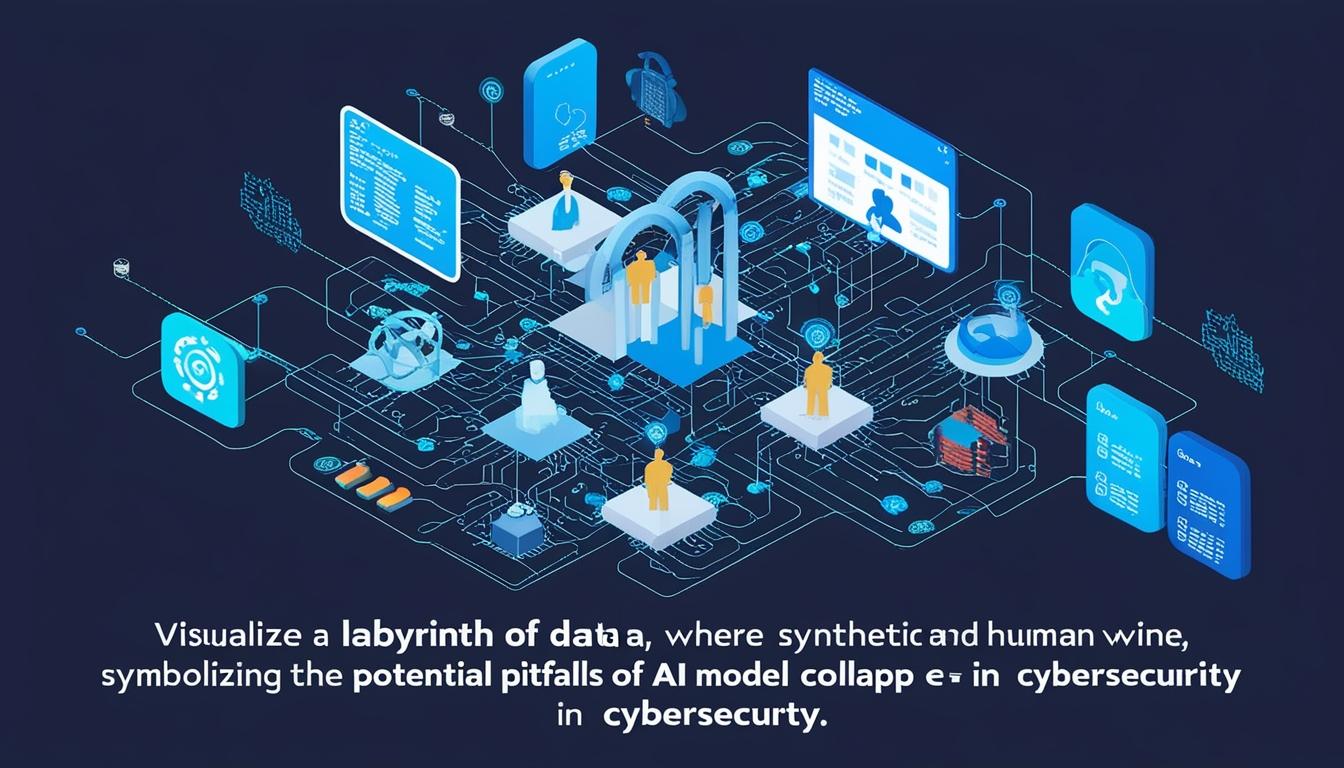
In recent developments within the realm of artificial intelligence and cybersecurity, a new concern has surfaced, dubbed "Model Collapse" or "Model Autophagy Disorder (MAD)." This refers to a potential degradation in the performance and reliability of AI systems caused by over-reliance on AI-generated, or synthetic, data. This phenomenon is becoming increasingly problematic as organizations and researchers continue to feed machine learning models with copious amounts of synthetic data.
Synthetic data, while not a novel concept, is employed extensively to train AI models. However, when these models are continually trained on data derived from prior AI iterations, they risk entering a harmful feedback loop. This cycle can precipitate the amplification of errors and noise, compromising the AI's effectiveness and its ability to emulate human-like comprehension and precision. The proliferation of AI-generated content on the internet exacerbates this issue as it infiltrates datasets, posing a challenge for developers striving to segregate AI-produced data from organic human input.
Rob Gurzeev, CEO and Co-Founder of CyCognito, highlights several consequences of model collapse: the erosion of nuanced understanding, a limitation of diversity in AI outputs due to echo-chamber effects, the exacerbation of existing biases, and the generation of nonsensical outputs.
This issue also extends to cybersecurity. As AI models deteriorate, the reliability of outputs essential for security operations diminishes. This degradation can manifest as false positives or negatives in threat detection systems, inaccurate risk assessments, and compromised decision-making within security operations. Furthermore, these compromised models could become more susceptible to adversarial attacks, offering new opportunities for malicious actors to exploit vulnerabilities.
In response to these challenges, experts recommend several mitigation strategies. These include maintaining a repository of "clean" datasets unaffected by AI, regularly re-training models on such datasets, and ensuring a continuous influx of new, human-generated content into training data. Moreover, robust monitoring and evaluation systems are crucial for early detection of model degradation.
Concurrently, another trend in AI, General Artificial Intelligence (GenAI), is influencing business strategies globally. Sheila Rohra, CEO of Hitachi Vantara, explores how companies are navigating the implementation of GenAI. With an increase in GenAI proofs of concept, businesses are keenly investing in AI. However, less than 18% of these projects advance to production due to the high costs outweighing perceived benefits.
To successfully integrate GenAI, Rohra suggests a focused approach. Defining the problems to be addressed with GenAI and specifying expected outcomes are pivotal. She emphasizes leveraging high-quality data and robust infrastructure, as outlined by the regulatory frameworks like the European Union’s AI Act. This Act mandates risk mitigation strategies for high-risk AI systems, underlining the importance of data accuracy, cybersecurity, and human oversight.
While the potential of AI to transform business processes is widely acknowledged—facilitating automation, reducing costs, and enabling product differentiation—these advancements are creating additional demands on data storage and infrastructure. As businesses strive to remain competitive, establishing a strong data foundation to innovate becomes critical.
In tandem with these developments, cybersecurity remains an area of focus, as highlighted by a report from Fortinet. The rise in AI-aided cyber threats has amplified the necessity for a knowledgeable workforce equipped to recognize and respond to these sophisticated attacks. The report notes that nearly three-quarters of business leaders are concerned about their employees' basic cybersecurity awareness.
To combat this, companies are increasingly implementing training programmes, with many reporting improved security postures after conducting targeted, engaging training for their employees. Fortinet advocates for a comprehensive approach to cybersecurity training encompassing awareness initiatives for all employees, technical training for IT personnel, and the deployment of advanced security solutions.
These concurrent developments in AI and cybersecurity underscore the dual challenge and opportunity presented by rapid technological advancement. As AI becomes increasingly integral to business operations and decision-making, the importance of maintaining data integrity and bolstering cybersecurity measures cannot be overstated.
Source: Noah Wire Services