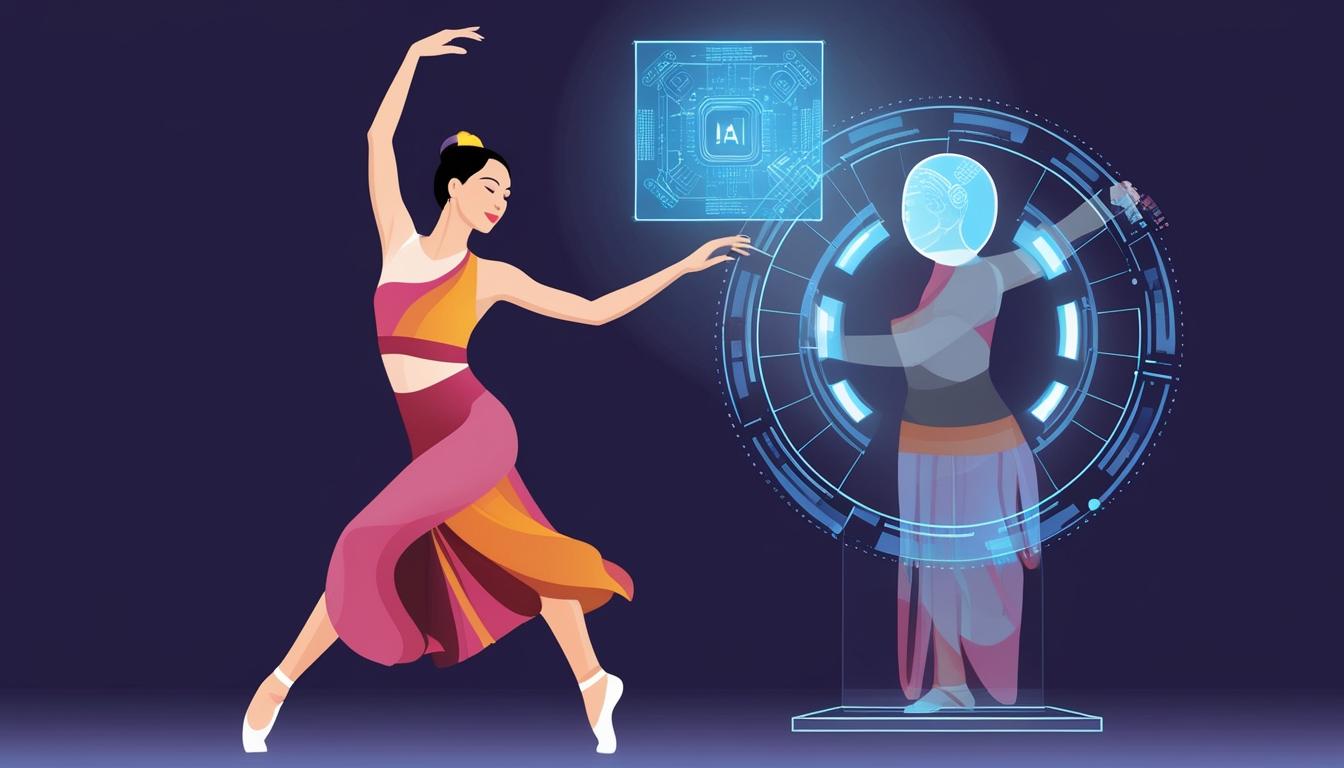
In the realm of performing arts, the confluence of traditional dance and cutting-edge technology is forging new pathways for creativity. This surge is exemplified by recent endeavours from renowned figures and collaborations pushing the boundaries of choreography and storytelling.
Helen Pickett, celebrated choreographer and former dancer with Ballet Frankfurt, along with actor and director Bonas, have been exploring narrative dance adaptations since 2019. Their collaborations have brought iconic literary works to the ballet stage, with adaptations like "The Crucible" for Scottish Ballet and "Madame Bovary" for the National Ballet of Canada. Currently, they are working on a "Macbeth" adaptation for the Dutch National Ballet's 2025 season. Susan Jaffe, the artistic director of the Ballet Theatre, has been a long-time supporter of Pickett's work. She took a calculated risk commissioning a full-length ballet from Pickett, confident in its potential for success, though specifics on the production budget have not been disclosed.
In a parallel development, choreographers Aoi Nakamura and Esteban Lecoq, operating under the moniker AΦE, are at the forefront of integrating artificial intelligence into dance. Their latest venture, "Lilith.Aeon," is hailed as the world’s first AI-driven dance production. Unlike using AI simply for its novelty, Nakamura and Lecoq aim to enrich their narrative storytelling. Inspired by transhumanism, "Lilith.Aeon" was co-created with an AI entity 'Lilith' who performs, triggered by audience movement around an LED cube. The piece began as a script generated by an AI bot, subsequently enhanced through a multitude of multimedia research inputs. The AI entity learned a set of steps created by Nakamura and Lecoq, evolving them into a unique choreography that aligns with their aesthetic vision.
The intersection of AI and dance is not confined to Nakamura and Lecoq. Wayne McGregor, another influential choreographer, has been a proponent of using AI in dance for over two decades. In collaboration with Google, McGregor developed AISOMA, an AI tool that generates choreographic ideas by analysing his extensive archive, allowing improvisational suggestions akin to those made in a dance studio. His current project, "On the Other Earth," slated to premiere next year, explores audience interactivity on a 360-degree screen developed with technology that enables personalised viewer experiences.
Choreographer Alexander Whitley is similarly exploring AI’s potential by integrating audience interactions into his choreography. In a VR adaptation of "The Rite of Spring," he's enhancing audience movements to blend seamlessly with his trained choreographic database, akin to musical Auto-Tune but for dance.
The fast-paced evolution of technology offers both potential and challenges. Issues of intellectual property and dancer rights are emerging as hot topics. Motion capture, now easily accessible via apps, has prompted concerns similar to those seen during the 2023 actors' strike regarding AI replacing human roles. As technology becomes more ingrained, there’s a call within the industry to address the implications of its use, ensuring dancers can benefit financially from AI using their movements.
Artists are increasingly collaborating with tech giants such as Nvidia and Amazon, while some remain wary of their role. Wayne McGregor emphasised the importance of artists being active contributors to technological conversations, rather than passive adopters, seeking to harness technology's possibilities to further understand human complexity.
Despite technological advances, industry leaders like McGregor and Whitley remain assured that digital cannot replace live performance. The essence of dance lies in the human body’s ability to transcend its limitations, a feat yet unmatched by digital counterparts. AI in the arts holds exciting potential, yet it remains a tool to enhance, not overshadow, the irreplaceable human touch in live performance spaces.
Source: Noah Wire Services