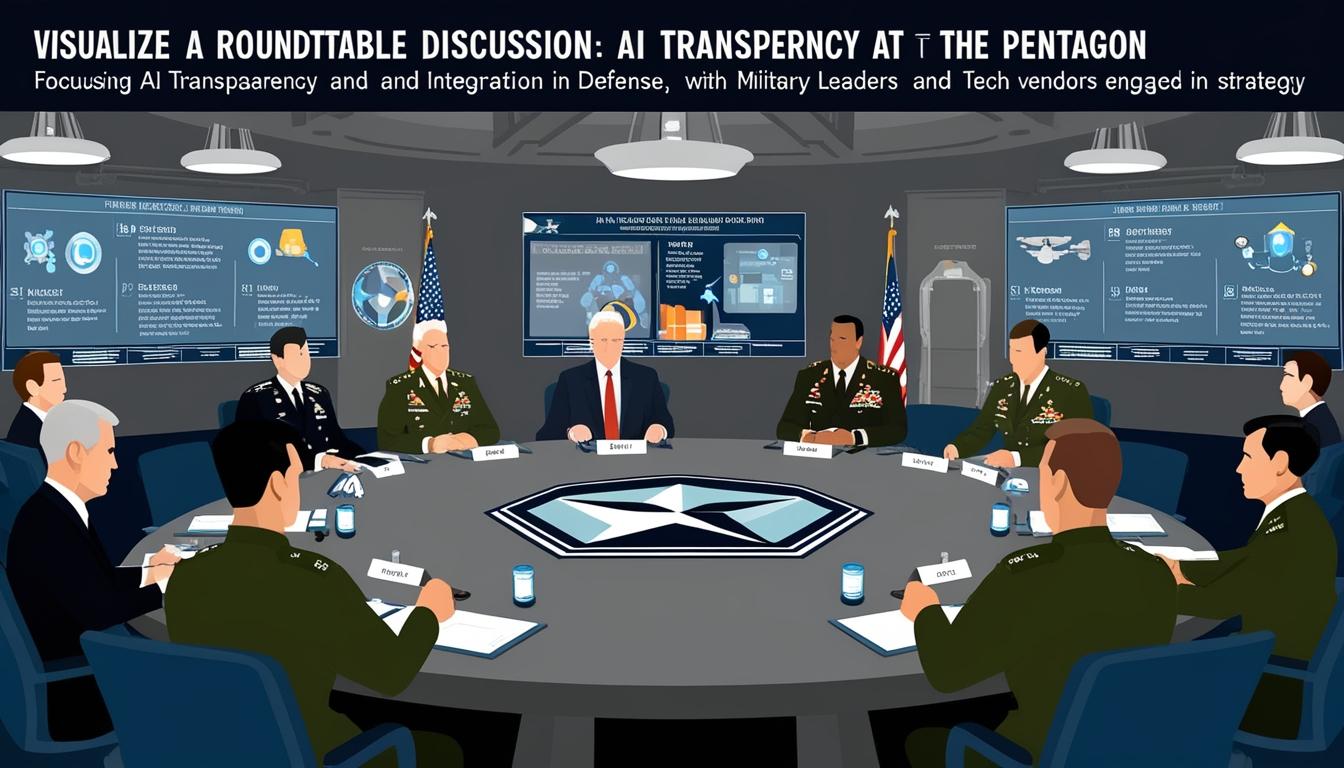
The Pentagon’s Defense Information Systems Agency (DISA) convened its annual Forecast to Industry event in Baltimore, where key issues surrounding the integration of Artificial Intelligence (AI) into defence operations took centre stage. Lieutenant General Paul Stanton, the newly appointed director of DISA, alongside the agency’s Chief Technology Officer, Steve Wallace, addressed vendors about the pressing need for transparency and specificity in AI functionalities.
At a roundtable discussion, Lt. Gen. Stanton conveyed that vendors must offer detailed explanations on the AI capabilities integrated into their offerings and elucidate the datasets used for training these systems. "AI requires context. You don’t just sprinkle AI on a problem," stated Stanton, highlighting the necessity for purpose-driven AI development tailored to specific Department of Defense missions and not just for the sake of technological novelty.
The agency expressed a clear disinterest in generic AI models, particularly those that replicate the functionalities of chatbots similar to commercially available platforms like ChatGPT. The Air Force has already developed NIPRGPT for internal use, so DISA is not looking to duplicate such capabilities. Steve Wallace noted, “We don’t need 60 GPTs running around the Department.” Instead, the focus is on AI systems strategically crafted to bolster Department of Defense missions, ensuring they are trained on relevant and authoritative data sets.
Central to the ongoing discussion is the issue of data rights in contract negotiations, as articulated by Douglas Packard, DISA’s Director of Contracting and Procurement. The agency prioritises securing data rights, recognising the necessity of sharing these rights to prevent vendor lock-in and facilitate healthy competition among contractors. Contract discussions frequently involve lengthy negotiations over data rights, Packard emphasised, as the agency often needs the flexibility to pass data to multiple vendors.
Lt. Gen. Stanton accentuated the importance of data integrity, stating the need for AI to be trained on well-curated data, contrary to indiscriminately sourced public internet data. The potential for significant errors arises when AI systems are built on unreliable or irrelevant data. Wallace illustrated this with an anecdote where a language model erroneously estimated that DISA had 1,700 directors, a mathematical implausibility given that the agency was established in 1991.
DISA’s internal testing of an AI "concierge" service revealed further challenges, where it provided inconsistent guidance due to its inability to discern between superseded and current policies. Wallace reiterated the importance of a thoroughly trained workforce that can critically assess AI outputs rather than accept them without scrutiny.
To mitigate AI-related errors and improve reliability, DISA officials advocated for industry advancements in devising robust algorithms. Wallace and Stanton emphasised the significance of employing techniques such as Retrieval Augmented Generation (RAG), ensuring that AI outputs are backed by verified and traceable sources. Such innovations might require increased computational resources but could streamline processes by limiting the focus to pertinent datasets, potentially lowering operational costs.
Lt. Gen. Stanton concluded by encouraging an understanding of relevant data for leveraging precise and mission-critical information. “Or else we’re going to be stuck in data centres we can’t afford, cranking away on datasets that have no relevancy to the problem we’re trying to solve,” he cautioned.
The event underscored the agency's commitment to responsible AI integration within the Department of Defense, ensuring that AI systems are not only innovative but also aligned with specific operational needs and built on credible and relevant data foundations.
Source: Noah Wire Services