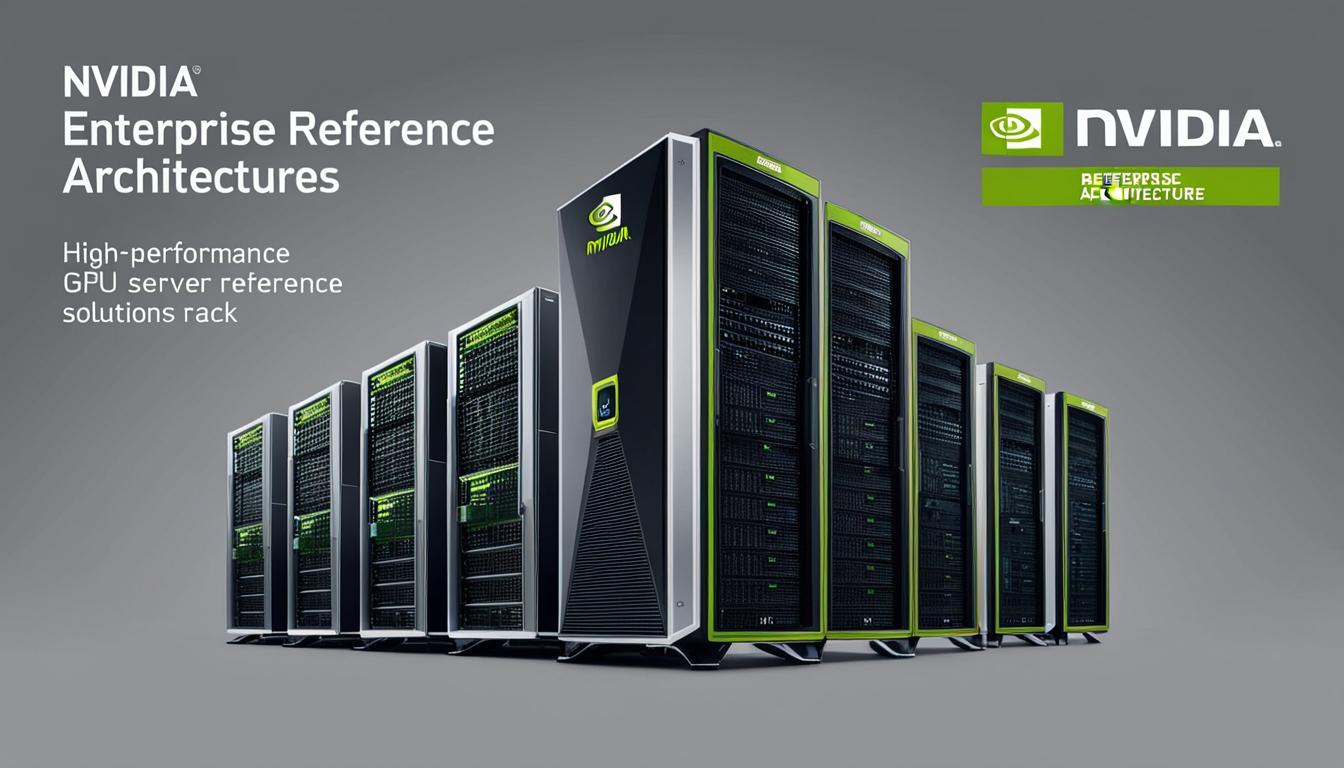
Nvidia, the globally renowned developer of graphics processing units (GPUs), has revealed a new initiative aimed at meeting the surging demand for accelerated computing driven by generative artificial intelligence (AI). The Enterprise Reference Architectures (ERA) program, launched in conjunction with key server partners, seeks to provide a structured blueprint to help companies expand their accelerated compute infrastructure in a more predictable and manageable way.
The release of the ERA program comes amidst a booming market for GPUs, largely spurred by the proliferation of large language models (LLMs) and other foundational AI models. Nvidia has been at the centre of this technological surge, having shipped 3.76 million data center GPUs in 2023 alone—a significant increase from the previous year. The demand shows no signs of abating in 2024 as businesses continue to seek the computational power necessary to drive AI innovations. This increasing demand has catapulted Nvidia to become the world's most valuable company, with its market value standing at an impressive $3.75 trillion.
ERA is Nvidia’s answer to the complexities of scaling high-performance computing (HPC) systems. The program is designed to help businesses develop HPC environments efficiently by providing standardised server configurations that minimise risks and enhance outcomes. Nvidia believes that the program will not only optimise performance and scalability but also improve security and simplify management for enterprises.
To implement the ERA program, Nvidia has secured partnerships with major industry players including Dell Technologies, Hewlett Packard Enterprise, Lenovo, and Supermicro. The reference architectures created through these collaborations are expected to reduce the complexity for customers looking to build AI-powered systems from scratch by offering predefined and tested configurations that are ready for deployment. Nvidia’s white paper articulates that the ERA leverages components and knowledge from the supercomputing domain, thereby streamlining the setup process and mitigating deployment uncertainties.
The reference architectures align server components such as GPUs, CPUs, and network interface cards (NICs) in certified configurations that are rigorously tested to ensure high performance. Key technologies incorporated in these architectures include the Nvidia Spectrum-X AI Ethernet platform and Nvidia BlueField-3 Data Processing Units (DPUs).
Nvidia’s ERA is specifically geared towards large-scale implementations that span from four to 128 nodes, with each deployment containing between 32 to 1,024 GPUs. This scope allows companies to effectively transform their data centres into what Nvidia refers to as "AI factories". Notably, this scale represents a more approachable entry point compared to Nvidia's existing NCP Reference Architecture, which caters to much larger deployments starting at a minimum of 128 nodes.
The ERA structures allow for different configuration patterns based on cluster size. For example, the "2-4-3" design involves a 2U compute node equipped with up to four GPUs, up to three NICs, and two CPUs, supporting clusters of eight to 96 nodes. Conversely, the "2-8-5" configuration uses 4U nodes, accommodating up to eight GPUs, five NICs, and two CPUs, and scales across four to 64 nodes.
Nvidia asserts that by collaborating with server manufacturers on these proven architectures, enterprises can more swiftly and securely realise their vision of establishing AI factories. This development is expected to reshape how businesses process and analyse data, with the integration of advanced computing and networking technologies addressing the extensive computational demands of AI applications.
In summary, Nvidia's introduction of Enterprise Reference Architectures represents a pivotal step in meeting the growing demand for efficient, scalable AI infrastructures. This initiative is set to redefine data centre operations, capitalising on the accelerating trend towards AI-driven computing prowess.
Source: Noah Wire Services