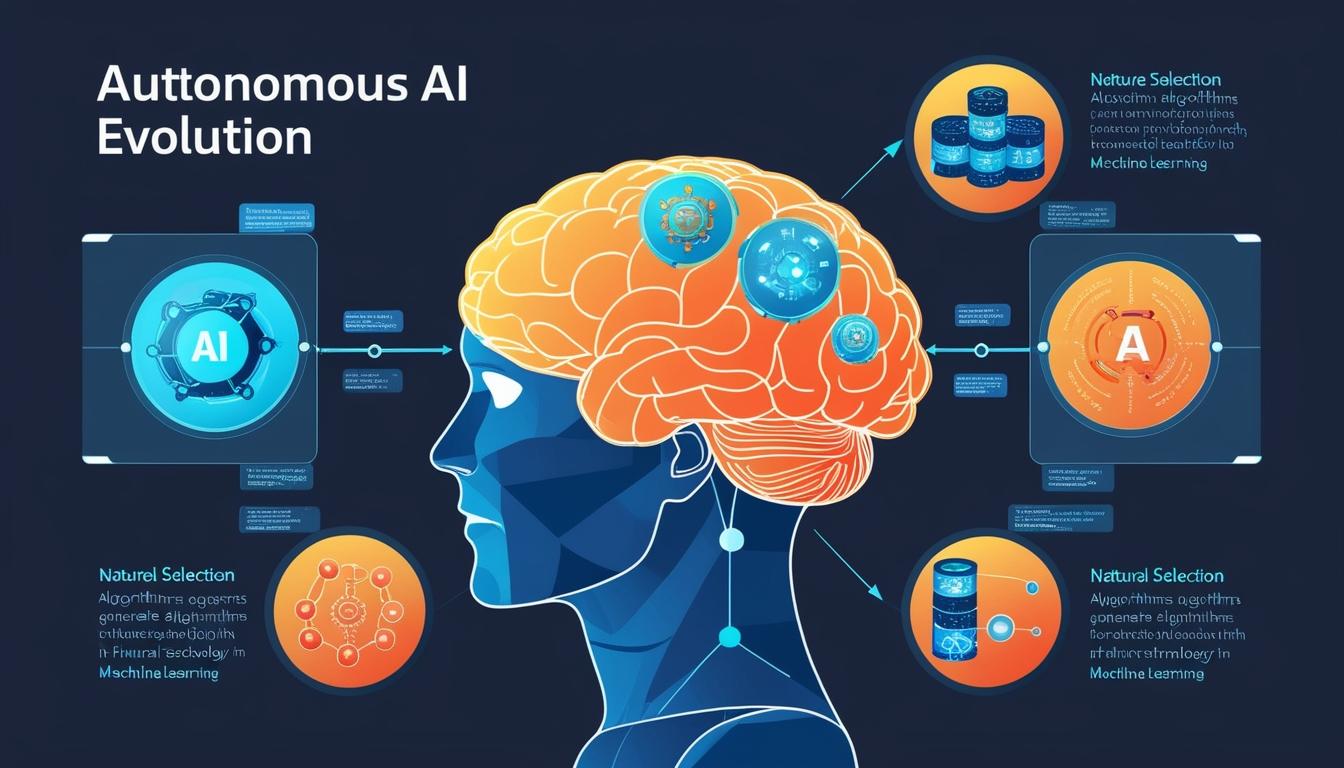
In a groundbreaking development that could revolutionise the field of artificial intelligence, researchers have engineered a programme capable of generating AI algorithms autonomously, using evolutionary principles akin to "survival of the fittest". This innovative technology has significant implications for the future of machine learning, allowing AI systems to evolve and refine themselves without human intervention.
Traditionally, the creation of complex algorithms, such as neural networks, has been a laborious process requiring substantial time and expertise. Neural networks, which are inspired by the intricate workings of the human brain, are foundational to numerous advanced technologies today, including self-driving cars and sophisticated speech recognition systems. The process involves engineers meticulously designing and connecting various smaller circuits into a unified and functional system, a task that can span several months. Despite advancements in automation, human involvement in AI development still injects potential biases and constraints into these systems.
A team of researchers, led by Google AI's Quoc Le, has developed AutoML-Zero, an experimental AI system that circumvents these human limitations. AutoML-Zero is designed to build AI architectures from scratch, entirely absent of predefined templates or constraints, effectively crafting its own solutions.
Utilising the principles of evolution, AutoML-Zero initiates multiple random algorithms and tests them through a process akin to natural selection. The programme iteratively improves these algorithms, discarding weaker designs and enhancing successful ones. Through this self-evolving mechanism, AutoML-Zero has demonstrated its ability to replicate achievements that have taken human engineers decades to accomplish, within a remarkably short span of less than 24 hours.
This self-evolutionary approach offers a profound leap forward in AI development, promising not only increased efficiency but potentially new AI architectures that might not occur to human engineers. By automating the algorithmic creation process, this technology could facilitate discoveries in AI that transcend current human capabilities and limitations.
As AI continues to push technological boundaries, the potential applications of AutoML-Zero are vast and varied. This breakthrough could herald a new era where machines autonomously generate sophisticated, robust AI systems at an unprecedented pace, potentially impacting numerous industries and scientific fields. However, while the technology harbours great promise, it also presents new challenges and considerations in the realm of AI ethics and safety, which researchers and policymakers will need to address as this exciting technology develops further.
Source: Noah Wire Services