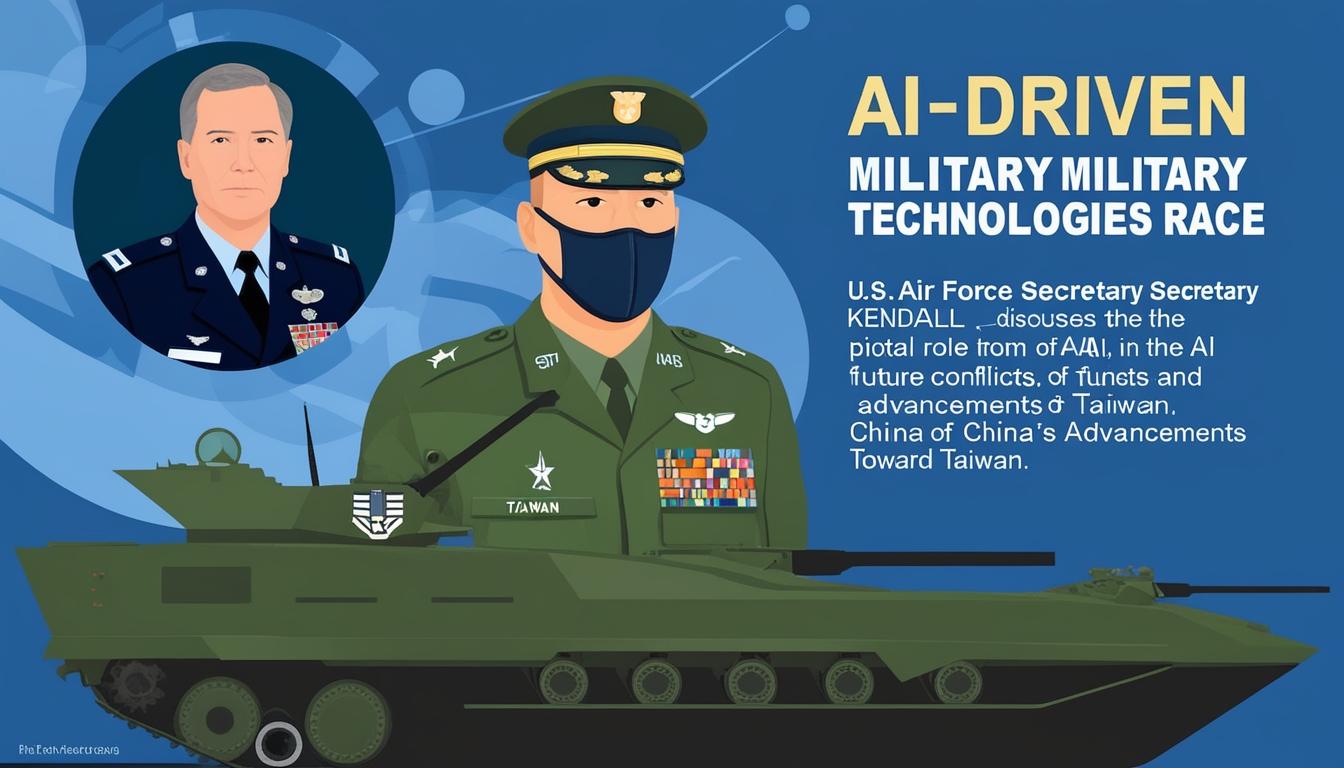
In a recent discussion held on 29 October at the Microelectronics Commons Annual Meeting and National Semiconductor Technology Center Symposium, U.S. Air Force Secretary Frank Kendall provided an insightful overview of the technological race between the United States and China, accentuating the potential pivotal role of artificial intelligence (AI) in future conflicts. The discussion shed light on China's accelerating military advancements and preparations, particularly with regard to Taiwan.
Kendall outlined that according to Chinese President Xi Jinping, the People's Liberation Army should be prepared by 2027 to potentially reclaim Taiwan and counteract U.S. intervention. He noted that while he could not predict Xi Jinping's definitive actions for 2027, he anticipated that the Chinese military would be prepared for any eventuality, marking a period of increased geopolitical tension.
China's military evolution has progressed far beyond its earlier structure characterised by a large but rudimentary standing army. Instead, the focus has shifted to technologies aimed at neutralising high-value strategic assets – such as satellites, major bases, and aircraft carriers. Significant investments in advanced technologies have resulted in a superior position in the realm of cruise missiles and hypersonic weapons. Partially attributing this to the acquisition of U.S. intellectual property, Kendall emphasised China's pursuit of even longer-range capabilities targeting American strategic and logistical forces.
The current dynamics between the two superpowers are less about traditional arms accumulation and more about the pursuit of technological superiority. Kendall urged the need for the U.S. to maintain its edge through technological advancements. The importance of microelectronics was underscored as it enables a plethora of advancements, including AI, which Kendall believes will significantly affect future battlefields.
AI's specific applications can enhance pattern recognition, automation, and decision-making processes, rendering new technologies integral to modern warfare. A key program within the U.S. Air Force is the Collaborative Combat Aircraft initiative, which tests AI-driven functions such as dogfighting through advanced AI agents, as tested in the modified X-62 VISTA F-16 flights that Kendall himself participated in earlier this year. The CCA program is advancing rapidly, earmarked for substantial investment reliant on microelectronics.
During the symposium, Kendall was joined by Arati Prabhakar from the White House Office of Science and Technology, who drew parallels between the AI revolution and the transformative technologies of the 1970s like stealth and the Global Positioning System. Prabhakar cautioned that the U.S. can no longer expect to enjoy prolonged technological supremacy, given the global access to advanced technologies, underscoring the need for swift translation of breakthrough research into practical application.
Kendall stressed the necessity of innovative breakthroughs anchored by deep, specialised knowledge and their subsequent translation into tangible applications by skilled generalists. This dual approach, he reasoned, is imperative to maintain a competitive edge and ensure that advanced technologies can be effectively realised and integrated into the fabric of national defence capabilities.
As the United States and China remain locked in a competitive pursuit for technological mastery, the integration and application of cutting-edge technologies like AI could prove determinative in future geopolitical landscapes.
Source: Noah Wire Services