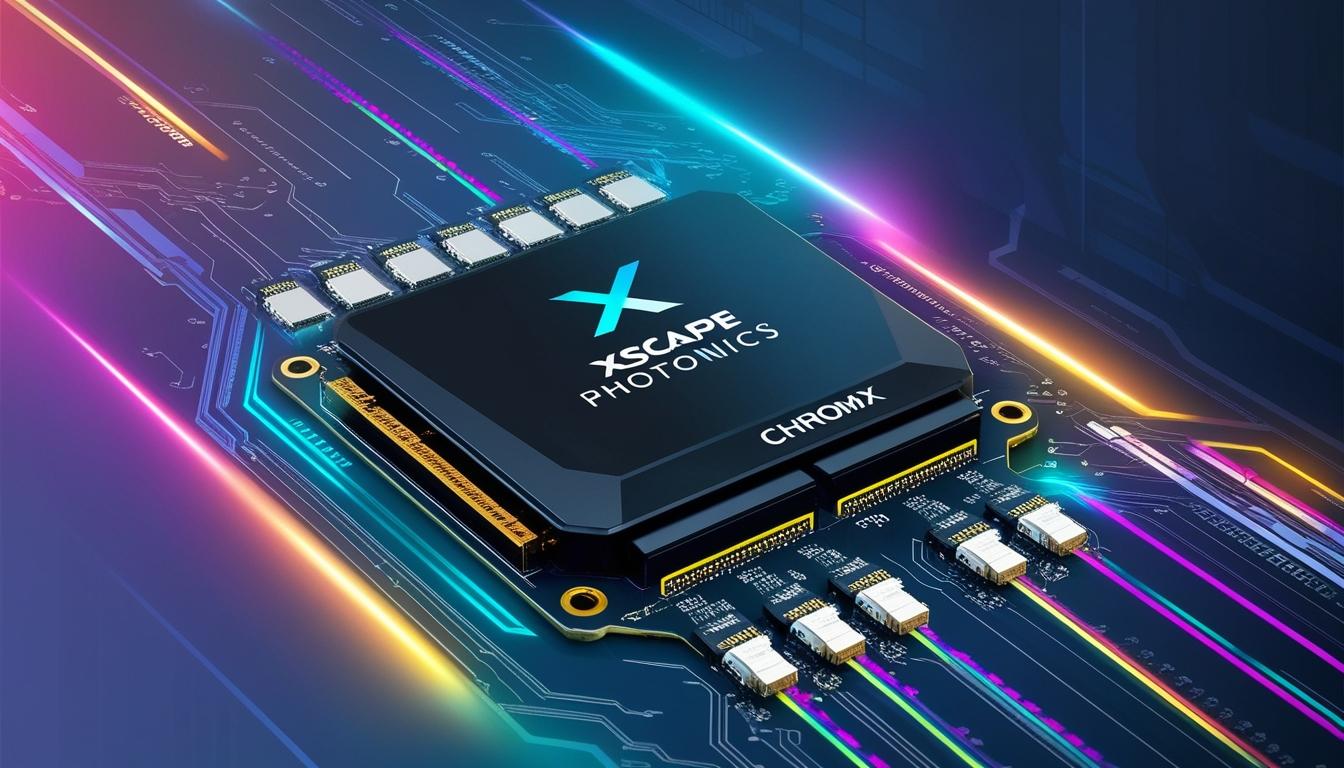
Bandwidth Bottleneck in AI and HPC: Xscape Photonics' ChromX Platform Offers New Solution
As the demand for Artificial Intelligence (AI) and High-Performance Computing (HPC) systems continues to grow, bandwidth limitations have emerged as a significant bottleneck, impeding the full utilisation of GPUs. Currently, these constraints result in nearly 50% of a GPU's computational power being underutilised, highlighting a critical inefficiency in the system.
Nvidia's optical interconnects for its NVLink protocol are anticipated to be released alongside the "Rubin Ultra" GPU compute engine in 2027. This delay has prompted hyperscale data centre operators and cloud service providers to search for alternative solutions that can leapfrog the expected advancements of Nvidia’s technology by adopting optical interconnects sooner than anticipated.
A New Contender in Optical Interconnects
Xscape Photonics, a company with roots in research conducted at Columbia University, is leveraging photonic technology to create solutions that offer scalability, high bandwidth, energy efficiency, and cost-effectiveness. This initiative aims to support the next wave of AI, machine learning, and simulation hardware innovations.
The potential benefits of these advancements are substantial. By addressing current inefficiencies in GPU systems, the AI industry could save billions of dollars in wasted capacity, while simultaneously enabling the development of more environmentally sustainable infrastructures.
Insights from Industry Leaders
Vivek Raghunathan, CEO of Xscape Photonics and a former researcher at MIT and Intel engineer, discussed the current limitations with The Next Platform. Raghunathan indicated that as technology scales, the issues transition from GPU device performance to a overarching network problem. This is where Xscape Photonics enters the picture with its innovative approach.
The ChromX platform developed by Xscape Photonics marks an evolution in this field. By converting electrical signals directly to optical signals within the GPU, the company predicts a substantial bandwidth increase while also cutting power consumption. The ChromX employs a laser to transmit multiple wavelengths of light concurrently via a single optical fibre, achieving up to 128 different wavelengths – a notable advancement from the traditional four-wavelength approach. This results in a bandwidth that is 32 times more expansive compared to existing technologies.
Furthermore, the ChromX employs more straightforward modulation schemes like NRZ (Non-Return-to-Zero), reducing latency relative to the higher-order schemes such as PAM-4, which are used by other technologies like InfiniBand and Ethernet. The flexibility of the ChromX platform is demonstrated by its programmability, allowing it to adjust wavelengths in line with the specific demands of AI workloads, whether they are focused on training or inference.
A Vision for a Unified Data Centre Network
Raghunathan envisions a future where in-package communication bandwidth is aligned with off-package escape bandwidth, suggesting that Xscape’s multicolour approach could facilitate this. He believes that this alignment could enable large-scale data centres, or even multiple centres, to function cohesively as a singular GPU unit.
The implications of Xscape Photonics’ development are significant, particularly in the context of the energy consumption required for AI workloads. With data centre demand predicted to triple by 2035, existing power grid infrastructures may face challenges meeting these requirements. The innovations from Xscape Photonics may provide an essential, energy-efficient path forward, supporting the continued expansion of AI capabilities.
As the industry continues to evolve, developments such as those spearheaded by Xscape Photonics will be crucial in overcoming current limitations and propelling technological advancement forward.
Source: Noah Wire Services