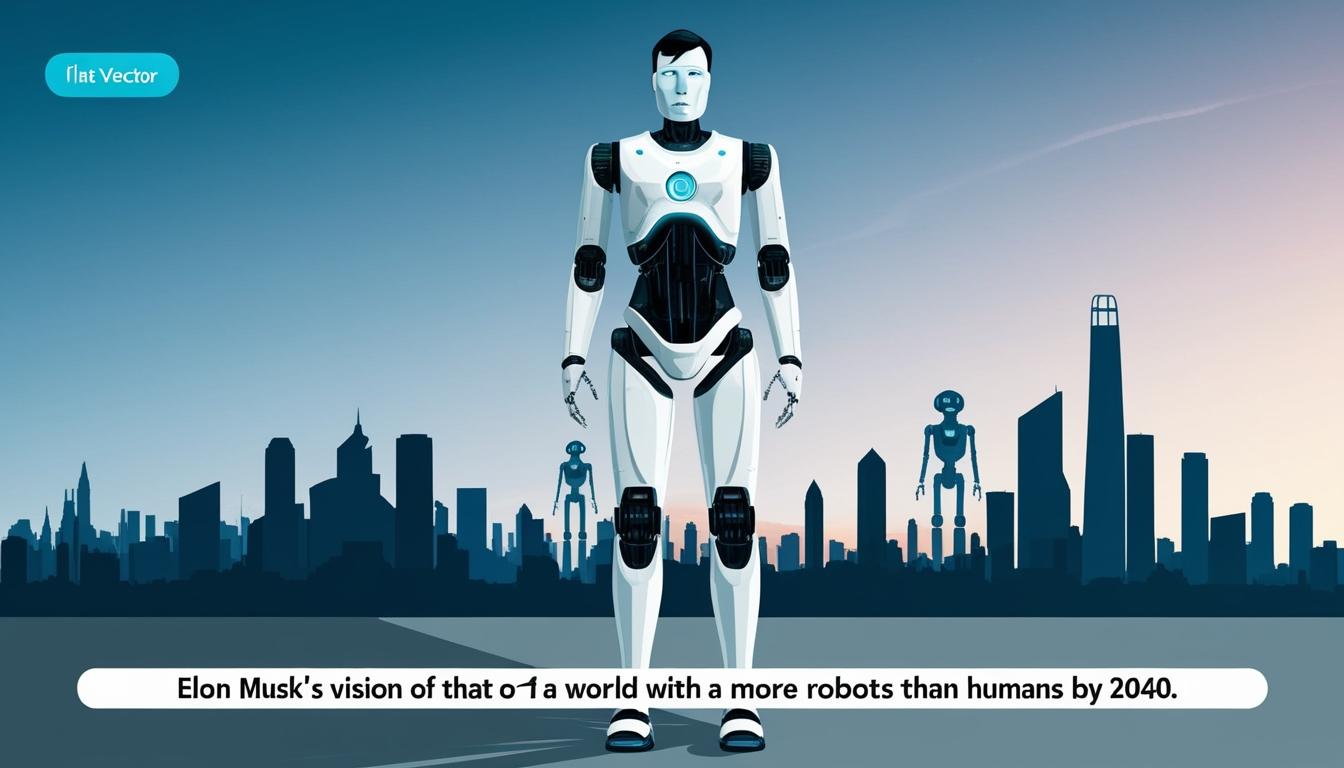
At the prestigious Future Investment Initiative event held in Riyadh, Saudi Arabia, Tesla CEO Elon Musk captivated attendees with his visionary predictions regarding the advancement of artificial intelligence and robotics. On Tuesday, Musk envisioned a future where robots might outnumber humans by 2040, asserting that every nation will eventually host advanced AI systems supplemented by a vast proliferation of robots.
Musk, who is at the forefront of the AI and robotics industries through his various enterprises, was enthusiastic about the burgeoning potential these technologies hold. He remarked, "I think by 2040 probably there are more humanoid robots than there are people. Every country will have an AI or multiple AIs, and there will be a lot of robots, way more robots than people." His statements echoed sentiments he shared earlier in September at the All-In Summit, where he discussed the limitless economic impact of intelligent humanoid robots.
However, his projections have drawn skepticism from several experts, notably Gary Marcus, a well-regarded author and AI scientist. Marcus cautioned against Musk's seemingly optimistic timelines, highlighting potential economic and safety challenges that such rapid advancements might entail. He pointed out the impracticality of Musk's vision by using current market parallels. Marcus noted, "Elon has a track record of overoptimistic predictions about AI, and this one is no different. There are only about 1.5 billion cars on the road; many people can’t afford one or don’t see the need. The same will be true for humanoid robots."
Furthermore, Marcus drew comparisons with the Roomba, a leading consumer robot. Despite its popularity, with around 50 million units sold, Marcus argued that Musk's vision of deploying hundreds of billions of humanoid robots remains fantasy due to the current technological constraints and consumer market dynamics. "It’s just fantasy to imagine selling 200 times as many humanoid robots in the nearish term when nobody knows how to build a single safe, reliable, generally useful humanoid right now, at any price," Marcus added.
While Musk's accomplishments, including his disruptive innovations in space exploration through SpaceX, validate his reputation as a transformative figure in technology, the feasibility of his predictions remains a topic of debate. His argument that robots could eventually induce a 'crisis of meaning' has also ventured into philosophical realms typically explored by academic scholars.
The dialog between Musk's optimistic forecasts and the circumspect views of critics like Marcus underscores an ongoing discourse in the tech community. As the world continues to witness rapid developments in AI and robotics, discussions about their societal implications, economic impact, and ethical considerations become increasingly significant. The conversation at the Future Investment Initiative has once again highlighted these pressing concerns, providing industry experts and the public much to ponder moving forward.
Source: Noah Wire Services