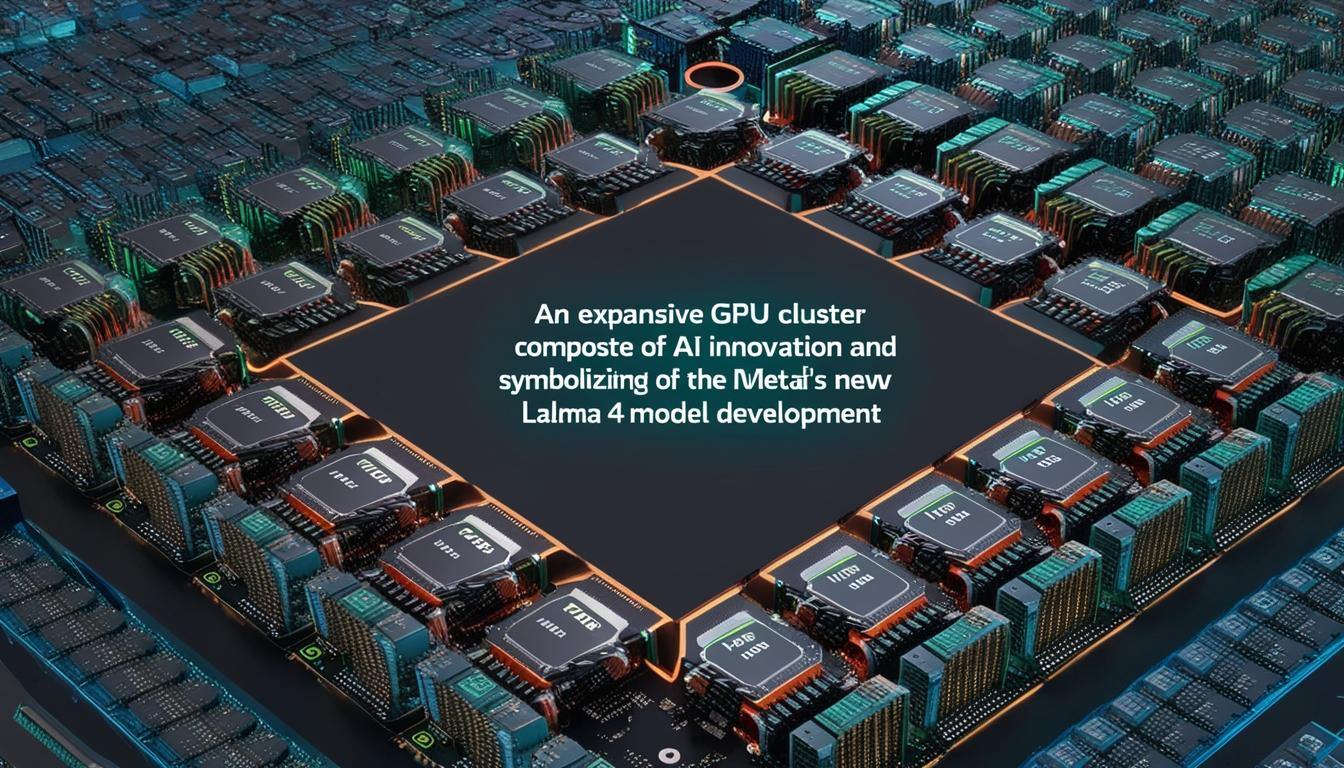
Meta CEO Mark Zuckerberg has announced that the company is significantly scaling up its efforts in the realm of generative artificial intelligence, with the forthcoming release of the Llama 4 model. In a recent earnings call with investors and analysts on Wednesday, Zuckerberg revealed that the new Llama model is being trained on a GPU cluster consisting of over 100,000 Nvidia H100 chips. This surpasses any previously reported training efforts by other tech giants in the AI space.
The development of Llama 4 is progressing steadily, with an anticipated launch slated for early next year. Zuckerberg expressed that the smaller versions of Llama 4 would likely be available first. He highlighted the scale of the undertaking by indicating that their current GPU cluster is unprecedented in size, setting a new benchmark in the training of AI systems. The focus on increasing computing power and data demonstrates the industry's belief that such resources are essential for crafting more capable and sophisticated AI models.
This announcement comes on the heels of previous reports in July when Elon Musk mentioned his venture, xAI, collaborating with X and Nvidia to establish a similar-sized setup of 100,000 H100s, claiming it to be the world's most powerful AI training cluster at that time.
Zuckerberg refrained from detailing the advanced capabilities expected from Llama 4 but alluded to enhancements such as "new modalities," "stronger reasoning," and a "much faster" operational capacity. These hints suggest that Llama 4 intends to build significantly upon the capabilities of its predecessor.
Meta is taking a different approach in the competitive field of AI, positioning its Llama models as freely downloadable, unlike models from OpenAI, Google, and other major companies that restrict access to an API. This strategy appeals to startups and researchers seeking full control over their models and associated costs. However, despite this open access, the Llama models come with certain licensing restrictions on commercial use, and Meta has not disclosed specific training details for the models, which means that external analysis of its workings is limited.
The AI landscape is gradually intensifying, with companies like Meta, Nvidia, and others continually pushing the envelope in technological advances. Llama first appeared on the scene in July 2023, and its most recent iteration, Llama 3.2, was released in September of the same year. As Meta and its competitors scale up their AI capabilities, industry observers are keenly watching these developments, anticipating the next innovations that will emerge.
Source: Noah Wire Services