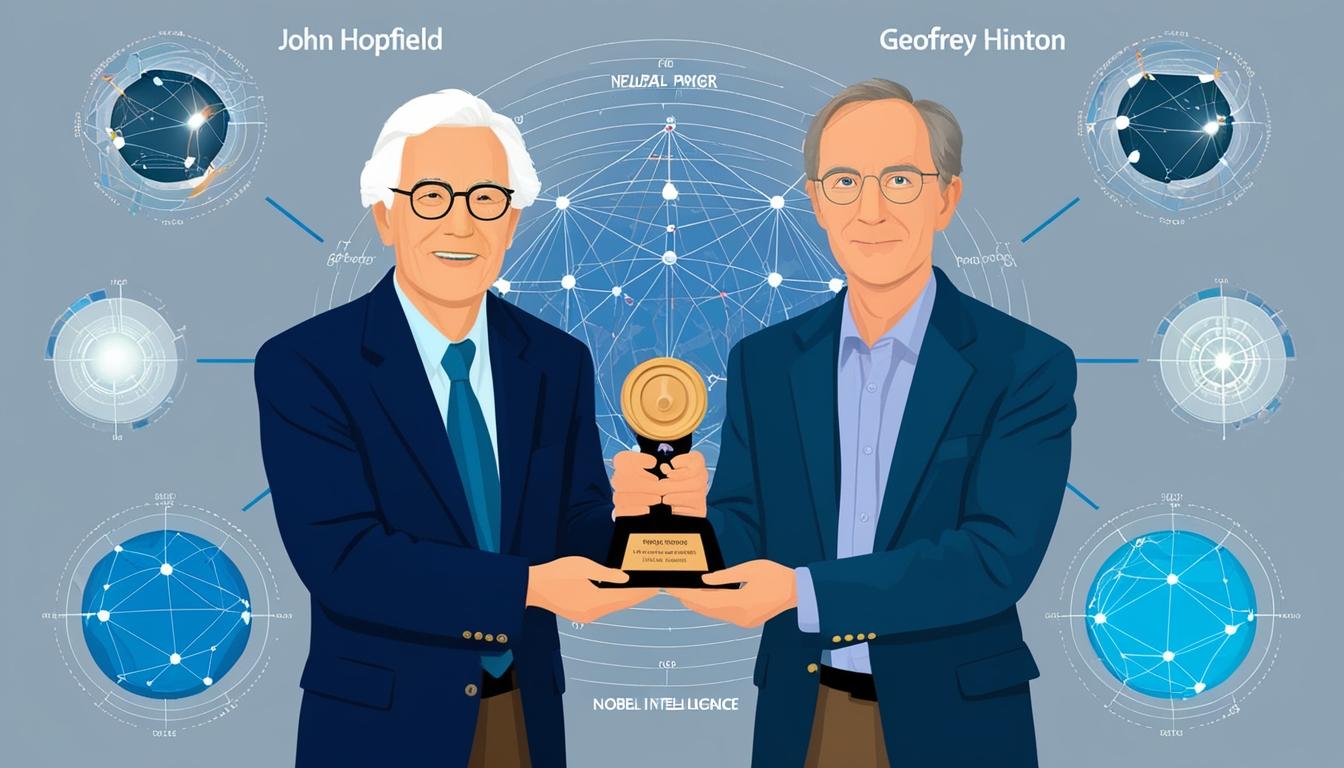
In a surprising turn of events, the Nobel Prize for Physics has been awarded to two pioneers in the field of artificial intelligence (AI) and machine learning, reflecting the vast interdisciplinary influence these technologies have across the sciences. The 2023 laureates, John Hopfield and Geoffrey Hinton, have been recognised for their foundational contributions, which have significantly shaped modern AI.
John Hopfield, a 91-year-old physicist, began his career in condensed-matter physics before venturing into the dynamics of biochemical reactions and their applications in neuroscience. During the 1970s, he explored how the physics of spin glasses could be utilised to create networks of neurons capable of storing and retrieving information. His groundbreaking concept of associative memories explained phenomena such as recalling vivid memories from hearing just a fragment of a song. The development of "Hopfield networks" from this work was pivotal in the advancement of AI technologies.
Geoffrey Hinton, often referred to as the "godfather of AI", extended Hopfield's work through his study of "Boltzmann machines", contributing immensely to deep learning methods that underpin contemporary AI. Hinton’s contributions have made substantial impacts on computer science and cognitive science, illustrating the multidisciplinary nature of AI, which draws from fields such as mathematics, neuroscience, and of course, physics.
In a podcast for Physics World, Anil Ananthaswamy, author of "Why Machines Learn: the Elegant Maths Behind Modern AI", emphasised the significant impact of Hinton’s work in the AI domain. The decision to award the Physics Nobel to figures predominantly associated with AI has stirred conversation around the boundaries of disciplines and their interrelation. Some argue that the influence of AI in fields like medicine or chemistry is equally profound.
The recognition of AI in the Nobel context comes amid increasing discussions around its future implications and ethical considerations. Notably, Geoffrey Hinton made headlines recently when he departed from Google, citing a desire to more freely discuss the potential risks and ethical concerns surrounding AI advancements.
This year's laureates underscore the integral role that physics has played in pioneering technologies like AI, which now permeate numerous areas of scientific research and practical application. It also highlights the increasing necessity for cross-disciplinary collaboration in advancing our understanding and utilisation of AI.
As AI continues to evolve, the recognition of its foundational figures by the Nobel Committee underscores the profound impact that interdisciplinary research can have in shaping the future of science and technology.
Source: Noah Wire Services