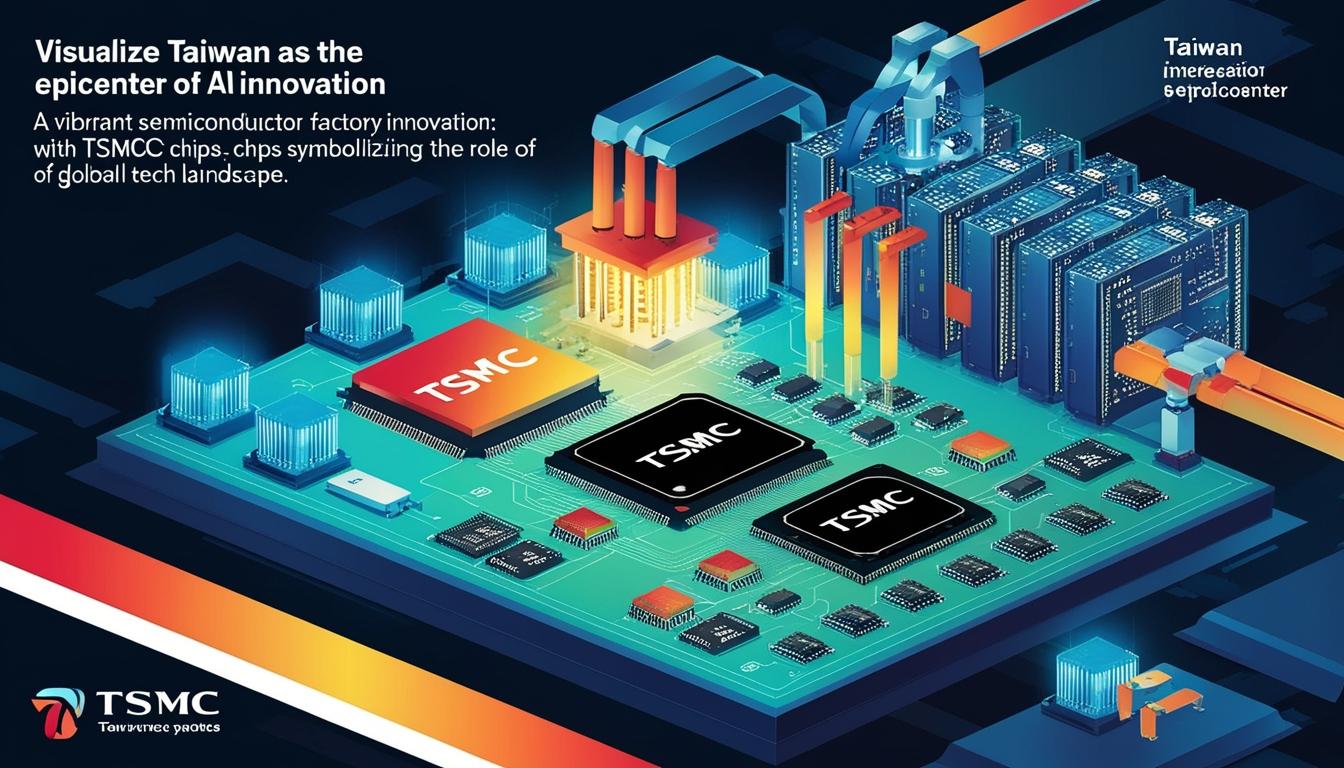
In a significant shift in the global tech industry, Taiwan has emerged as a critical player in the development and manufacturing of components essential to artificial intelligence (AI). Major international companies including Nvidia, Microsoft, and OpenAI have turned to Taiwanese firms for the production of chips, construction of servers, and cooling equipment. This trend has marked Taiwan's stock market as one of the hottest in Asia over the past year, with its success linked directly to the global race in AI advancements.
Some investors regard the market's surge beyond $400 billion (approximately NT$12.8 trillion) as merely the beginning. As the burgeoning AI landscape unfolds, Taiwan appears poised to enjoy significant benefits, particularly as the base for manufacturing in the ChatGPT era—a period characterized by rapid AI developments. The nation's role is seen as pivotal in steering the direction and pace of AI progress. Sean King, Senior Vice President of political consultancy Park Strategies and a former U.S. Department of Commerce official, has identified Taiwan as a key engine driving AI development.
Central to Taiwan's success in AI has been the semiconductor giant TSMC (Taiwan Semiconductor Manufacturing Company), which has further solidified its lead in advanced semiconductor production amidst ongoing struggles faced by competitors Intel and Samsung. TSMC's facilities are currently the only places capable of manufacturing the accelerators for AI that Nvidia, among other companies, relies upon.
While some Taiwanese companies may still have a relatively low profile internationally, they play indispensable roles in the global AI ecosystem. These include server manufacturer Quanta, power management leader Delta Electronics, and thermal solution provider Auras. Projections suggest the AI market will escalate to $1.3 trillion (approximately NT$41.7 trillion) by 2032, with Taiwanese enterprises expected to have a substantial impact on this growth.
Taiwan's stock market has surged by more than 40% in the past year, outperforming counterparts in China, Hong Kong, India, and Japan. First Financial Investment Advisory Chairman Chen Yi-kuang notes heightened optimism among Taiwanese firms, attributing this partly to TSMC’s integral role as a partner to companies like Nvidia, propelling Taiwan's tech industry to unprecedented levels.
This increased reliance on Taiwan comes in the wake of heightened U.S. trade restrictions on China, prompting businesses to seek alternative production bases and exclude China from many supply chains. Within less than two years, these restrictions have marginalized China's AI hardware industry. According to Bloomberg data, Taiwan's server and graphics card exports have more than doubled China's in the first nine months of this year, marking a significant shift from previous years.
Top global cloud service providers including Microsoft, Amazon, Meta, and Google are also engaging with Taiwanese assembly plants to construct their server farms, aiming to compete with OpenAI's ChatGPT. Research firm IDC forecasts that worldwide AI systems and services spending will more than double to $632 billion (approximately NT$20.2 trillion) by 2028.
Taiwan's advantage, according to Bloomberg, lies in its service-oriented strategy, which has cultivated repeat partnerships with tech giants like Amazon, Nvidia, and Apple. Taiwanese companies have adeptly pivoted their operations to meet evolving demands, as exemplified by major contract manufacturers such as Foxconn and Quanta, which have traditionally been recognized for assembling products like the iPhone and MacBook and are now vying for AI server orders. The burgeoning demand for AI is driving innovation and attracting a fresh wave of global clients seeking partnerships in Taiwan.
Rodrigo Liang, CEO and founder of Silicon Valley chip startup SambaNova Systems, emphasized that the world finds itself at a crucial juncture in AI's evolution, with Taiwan at the forefront. As AI technology becomes central to more industries, Taiwan is likely to see continued interest from companies worldwide eager to leverage the island's technological capabilities.
Source: Noah Wire Services