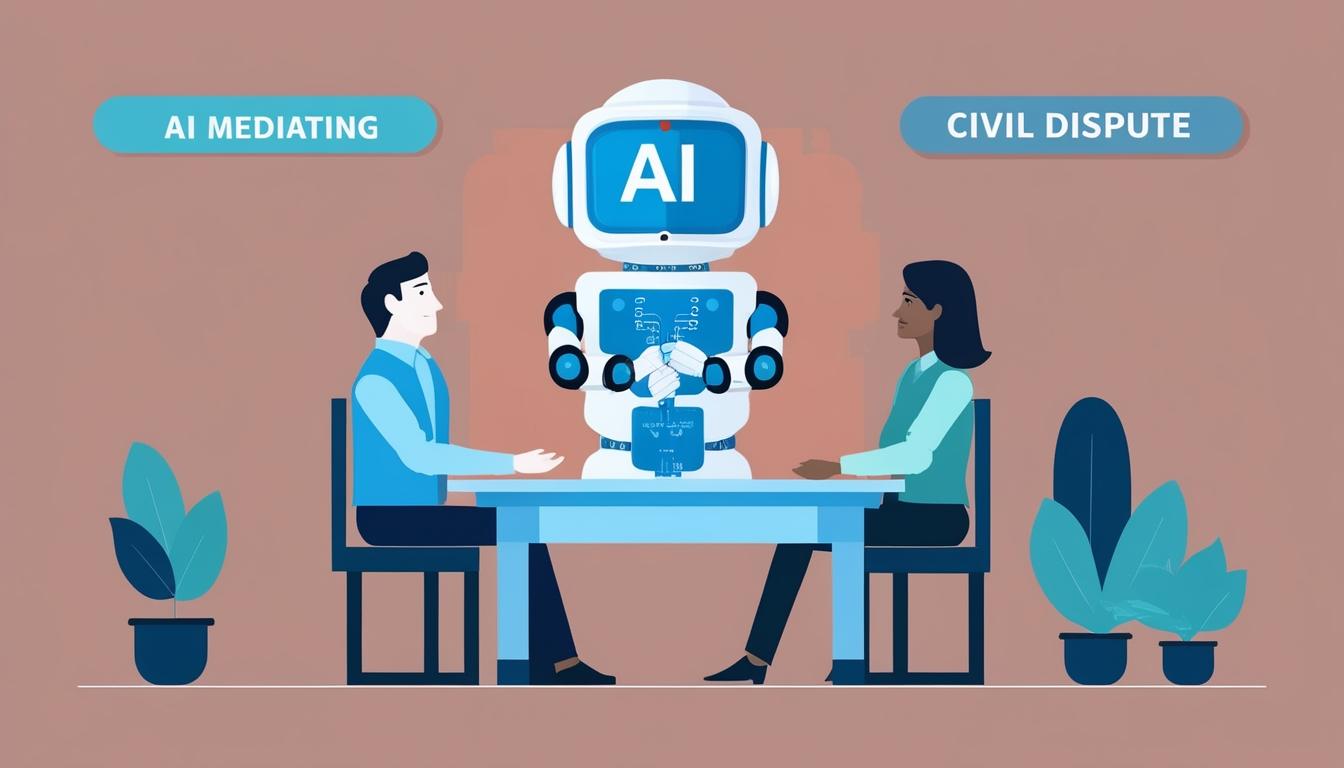
Artificial Intelligence (AI) is increasingly making inroads into fields traditionally regarded as necessitating human intervention, such as dispute resolution. This ascendancy of AI is largely due to its potential to alleviate the significant burden on the justice system, given that an estimated 92% of civil cases are resolved outside of the court system. A pivotal study titled “Robots in the Middle: Evaluating Large Language Models in Dispute Resolution” explores the evolving role of AI, particularly large language models like GPT-4, in mediating disputes.
The study was conducted by a team of seven academics specialising in law and technology, hailing from institutions like the University of Montreal, Maastricht University, and Carnegie Mellon University. Their research utilised fifty hypothetical dispute scenarios, ranging from consumer complaints to complex business disagreements. Both AI and human participants, the latter lacking professional mediation experience, engaged with these scenarios by choosing mediation types and drafting settlement messages. Their outcomes were evaluated without the judges knowing whether the responses originated from AI or humans.
The evaluation aimed to answer several key questions: How successfully could AI choose mediation types? How did AI perform vis-a-vis human mediators in drafting messages? Were the AI-generated responses devoid of errors or inappropriate content?
The findings indicated that AI could indeed handle routine cases efficiently. In 22 out of 50 cases, AI was preferred for choosing the mediation type, while human choices were favoured in 19 cases. AI's capacity to comprehend dispute contexts and suggest suitable actions was noted, with AI often providing clearer, smoother messages compared to human counterparts.
AI-generated messages outperformed human-generated ones in various facets, including clarity and neutrality. The absence of hallucinations or harmful errors in AI-generated content further underscores the model's potential in dispute mediation. However, it's important to acknowledge the experimental limitations, such as the absence of native English speakers among human participants and their lack of professional mediation experience.
While the notion of AI mediators is innovative, this study posits AI as an adjunct rather than a substitute for human mediators. The team highlighted a potential advantage in using AI for low-stakes, uncomplicated disputes, freeing human mediators to focus on more nuanced, emotionally intricate matters where human empathy and adaptability are irreplaceable. This hybrid approach, combining AI's analytical strength with human emotional intelligence, could optimize mediation processes effectively.
Further insights from professional mediator Lawrence Kolin affirm AI's potential benefits in mediation. Kolin points out AI's proficiency in cases requiring data analysis, though without replacing the nuanced human touch essential in high-stakes conflicts. His input highlights AI's limitations in capturing emotional intelligence—a crucial factor in building trust and understanding within mediation.
The study underscores the necessity of maintaining human oversight in AI-mediated processes, ensuring ethical standards, confidentiality, and fairness. As the technology progresses, integrating AI into mediation carries great promise in expanding access to justice while preserving essential human elements within dispute resolution. The potential applications in routine and small-scale disputes indicate a promising horizon for AI's function in legal systems worldwide, provided ethical considerations are continuously addressed.
Source: Noah Wire Services