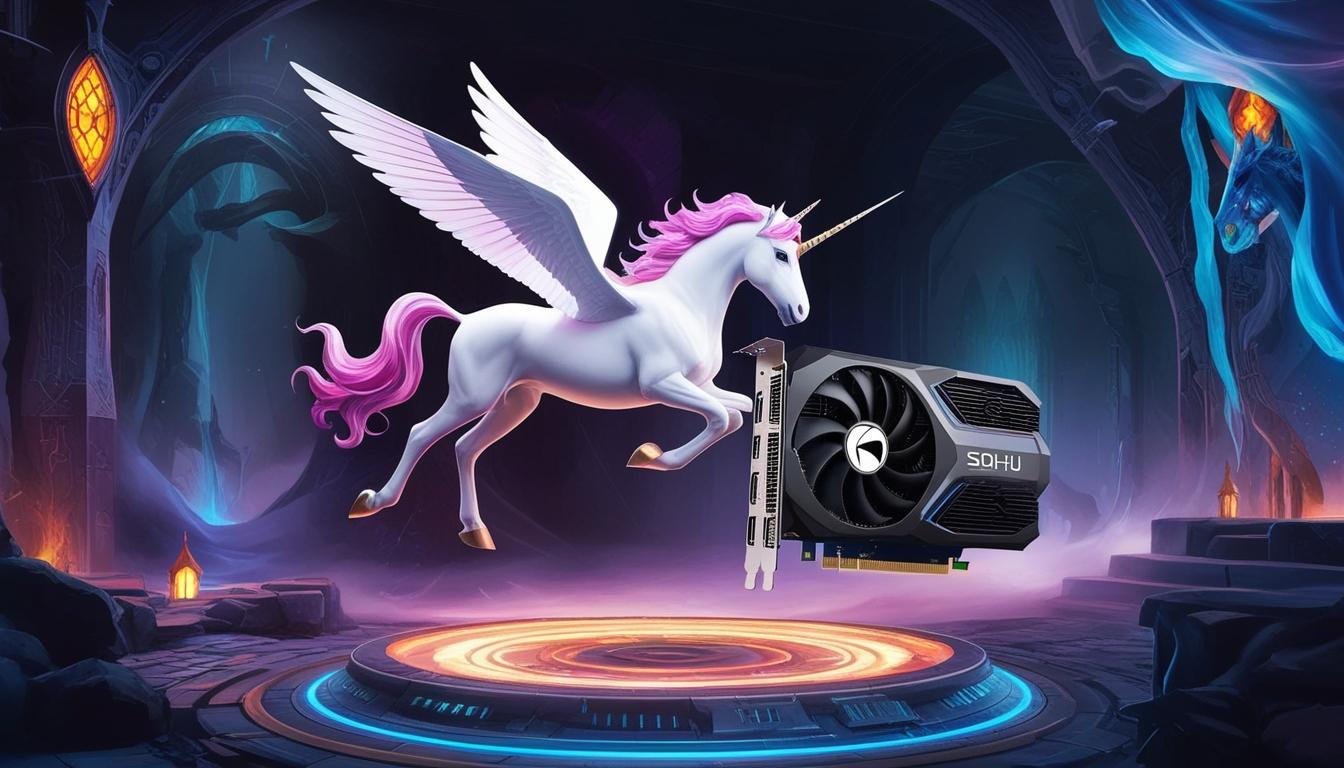
Etched and Decart, two innovative companies in the field of artificial intelligence and graphic rendering, are pioneering efforts to revolutionise interactive video through advanced hardware and software technologies. They envision a system that allows users to manipulate virtual environments with voice commands, introducing elements like flying unicorns or transforming scenes into settings from distinct thematic eras such as the medieval age or the Star Wars universe.
Currently, their efforts are limited by the reliance on existing Nvidia graphics cards, which, while powerful, may not fully support the scale of their ambitions. However, Etched is in the process of developing a new graphics card known as 'Sohu'. This specialised piece of hardware is purportedly designed to enhance performance by a factor of ten, which would significantly reduce the energy and cost requirements associated with rendering real-time interactive video.
The Sohu card is expected to offer substantial improvements over current technologies, notably by supporting longer game sessions and accommodating more players simultaneously. This would be achieved through a focus on inference—the ability of an AI to make predictions—rather than just training, enabling more efficient handling of complex mathematical tasks. The new chip’s architecture, utilising a single core, could lead to streamlined performance tailored specifically for AI applications, according to Robert Wachen, co-founder and COO of Etched.
This ambitious technological advancement is not without its sceptics. Among them is Siddharth Garg, a professor of electrical and computer engineering at NYU Tandon, who questions the feasibility of achieving such drastic improvements through design tweaks alone. The extent of AI specialization already prominent in top market GPUs leaves some experts doubtful about such claims.
Nevertheless, Etched and Decart are pressing forward, with plans to implement the Sohu chip in projects set for next year. If successful, this innovation could pave the way for real-time virtual services such as medical consultations or tutoring, further illustrating the transformative potential of their creations.
Until the new chip is fully tested and proven, the companies offer a tantalising glimpse into their work through a demo available for a version of Minecraft. This demo embodies the kind of dynamic and immersive gaming experience they aim to deliver, illustrating the possibilities of their envisioned technology.
As the promises of these custom AI chips await validation, the enthusiasm of the developers remains palpable. They continue to work towards their goal of crafting groundbreaking architectures and hardware, seeking to redefine interactive digital experiences for users worldwide.
Source: Noah Wire Services