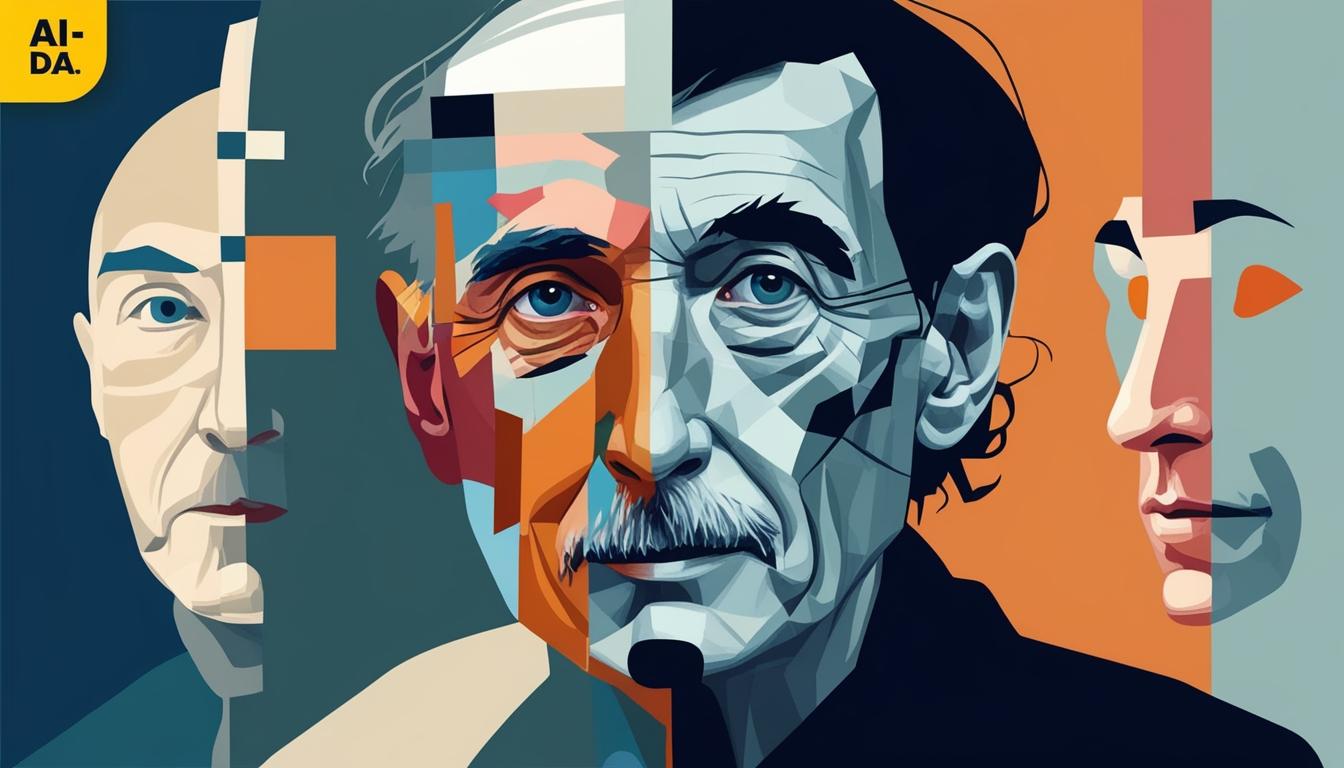
Ai-Da, a humanoid robot designed with the capability to create art, is making history by becoming the first of its kind to have artwork sold by the prestigious auction house Sotheby's. The centrepiece of this landmark event is an abstract painting entitled 'AI God', which portrays the famed mathematician and computer scientist Alan Turing. The auction commenced today, with expectations that the painting could achieve a sale price between $120,000 and $180,000. The proceeds from this sale will be reinvested into the ongoing development of Ai-Da.
Developed by a team of researchers led by Aidan Meller at Oxford University, Ai-Da was constructed in early 2019 with the intent of exploring the capabilities of artificial intelligence (AI) in the creative arts. The robot utilises a series of advanced AI algorithms, coupled with cameras and robotic arms, to generate its artwork.
Ai-Da's painting, 'AI God', draws inspiration from Alan Turing's immense contributions to modern computer science, notably his efforts in deciphering the Nazi codes during World War II. The painting is part of a five-panelled polyptych, which has already been showcased at a United Nations summit on AI in Geneva earlier in the year. The artwork has been noted for its haunting style, employing muted tones and fragmented facial planes, with a backdrop suggesting Turing's struggle with societal and technological challenges.
Alan Turing, revered as a pioneer of computer science, faced severe societal persecution as he was charged with “gross indecency” in 1952, following an admission of a homosexual relationship, which was criminalised at the time. He died in 1954, with his death officially recorded as a suicide.
The painting has sparked discussions around Turing's early speculations and warnings concerning the role and management of AI, adding an intriguing layer to Ai-Da's creation. "Ai-Da’s portrait hauntingly evokes Alan Turing, using muted tones and broken facial planes, and a background with shadowy forms of the Bombe machine," explained creator Aidan Meller.
Ai-Da has produced several paintings and portraits since its inception, and its foray into the auction world at Sotheby's has piqued interest across the art and technology sectors. The level of sophistication in AI-driven art has been growing, leading to debates over the impact of AI on human-centred creative endeavours.
Meller has expressed that using AI to produce art might serve as a vehicle to comprehend and discuss the sweeping changes technology brings to society. Although concerns persist that AI might take over creative spaces traditionally dominated by humans, Meller suggests that robots will eventually perform a variety of tasks, challenging and possibly expanding the conventional understanding of art and creativity.
Ai-Da's sale at Sotheby's could represent a step towards a future where machine-generated art finds its place alongside human efforts, reflecting the evolving interplay between technology and humanity.
Source: Noah Wire Services