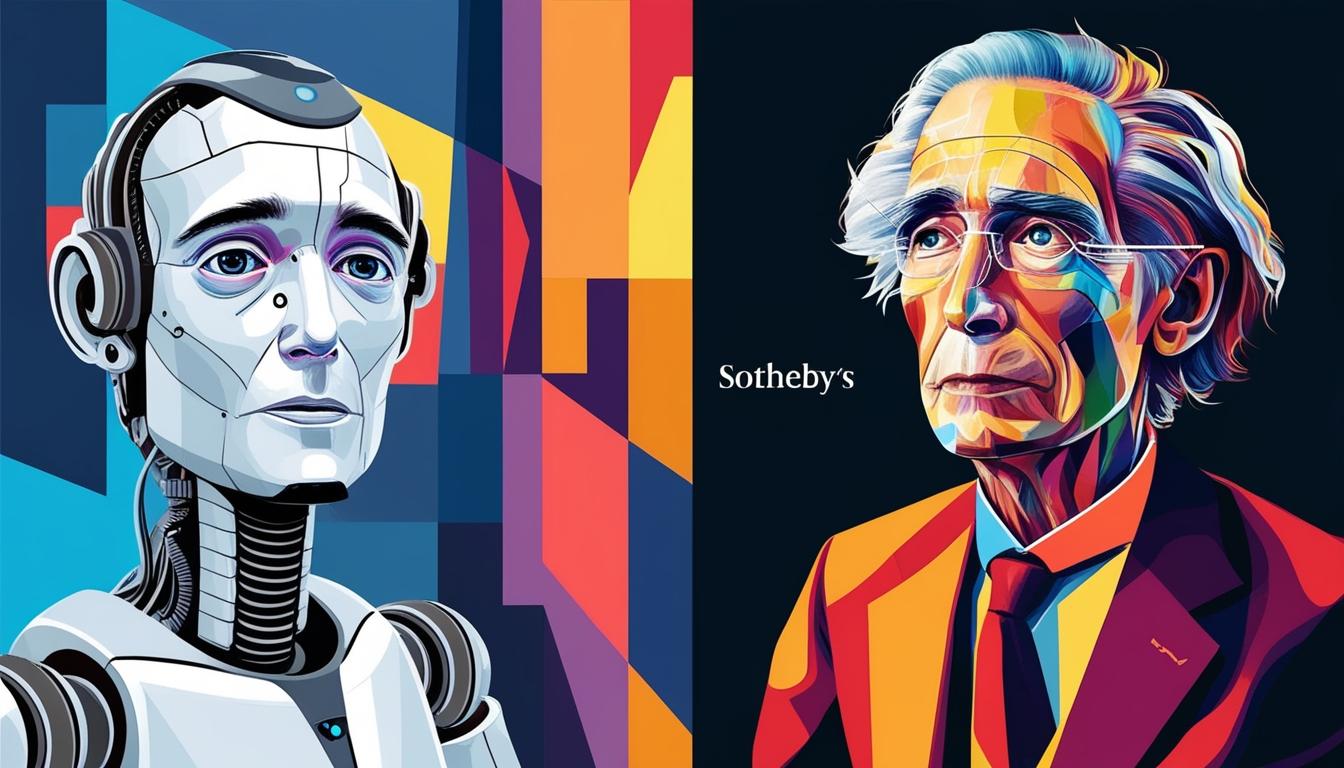
In an unprecedented event in the world of art and technology intersection, a humanoid robot named Ai-Da is set to have its artwork auctioned by the prestigious Sotheby's. This marks the first time a robot's painting will be sold at such an esteemed auction house. The piece in question is an abstract painting of Alan Turing, famously titled 'AI God'. It is anticipated to sell for between $120,000 and $180,000, with proceeds directed towards the continuation of Ai-Da's development.
Ai-Da, a brainchild of a team spearheaded by Aidan Meller at Oxford University, was developed in early 2019. Equipped with AI algorithms, cameras, and metal arms, Ai-Da is capable of creating intricate portraits, among other artworks. The humanoid's signature style is described as fractured and multilayered, a technique presented in its latest painting that aims to encapsulate the complex emotional and intellectual facets of Alan Turing, the father of modern computer science known for his critical codebreaking work during World War II.
Alan Turing, who played a pivotal role in defeating Nazi encryption, is celebrated in Ai-Da's artwork, which draws inspiration from his contributions to computer science. The piece, signed 'A', features muted tones, broken facial planes, and the shadowy forms of the Bombe machine. Turing's life was marred by tragedy; in 1952, he was prosecuted for homosexual acts, which were criminalised at the time, and he died in 1954, with the official cause determined as suicide.
The portrait is part of a larger five-panel polyptych that earlier this year reached audiences during a United Nations global summit on AI in Geneva. Meller articulated Ai-Da's artwork as having a profound narrative that resonates with the societal shifts around artificial intelligence, a dialogue bridging past and present technological evolutions. “All the greatest artists have responded to societal changes through their work,” Meller states, observing that Ai-Da’s creations could be seen as a futurist interpretation of these societal discourses.
Beyond the art world, Ai-Da’s work has sparked discussions about the role of AI in creative fields, an area traditionally dominated by human endeavour. The sophistication of AI art generators is rapidly increasing, leading some to speculate about the potential replacement of human creativity with automated processes. Differing opinions exist on whether AI should handle creative tasks, which are typically perceived as the domain of human emotion and intellect.
As technology continues to permeate various aspects of life, Ai-Da’s artwork raises pertinent questions over the future interaction between human creativity and artificial intelligence, demonstrating that discussions around these topics are likely to grow in complexity as AI capability continues to expand.
In sum, Ai-Da's debut at Sotheby's not only highlights the technical bravado achieved through merging art and AI but also invites observers to ponder the implications of such cross-disciplinary innovations. The auction, widely observed, might set in motion a broader recognition and acceptance of AI-generated art in prestigious outlets, thereby reshaping the artistic landscape of the future.
Source: Noah Wire Services