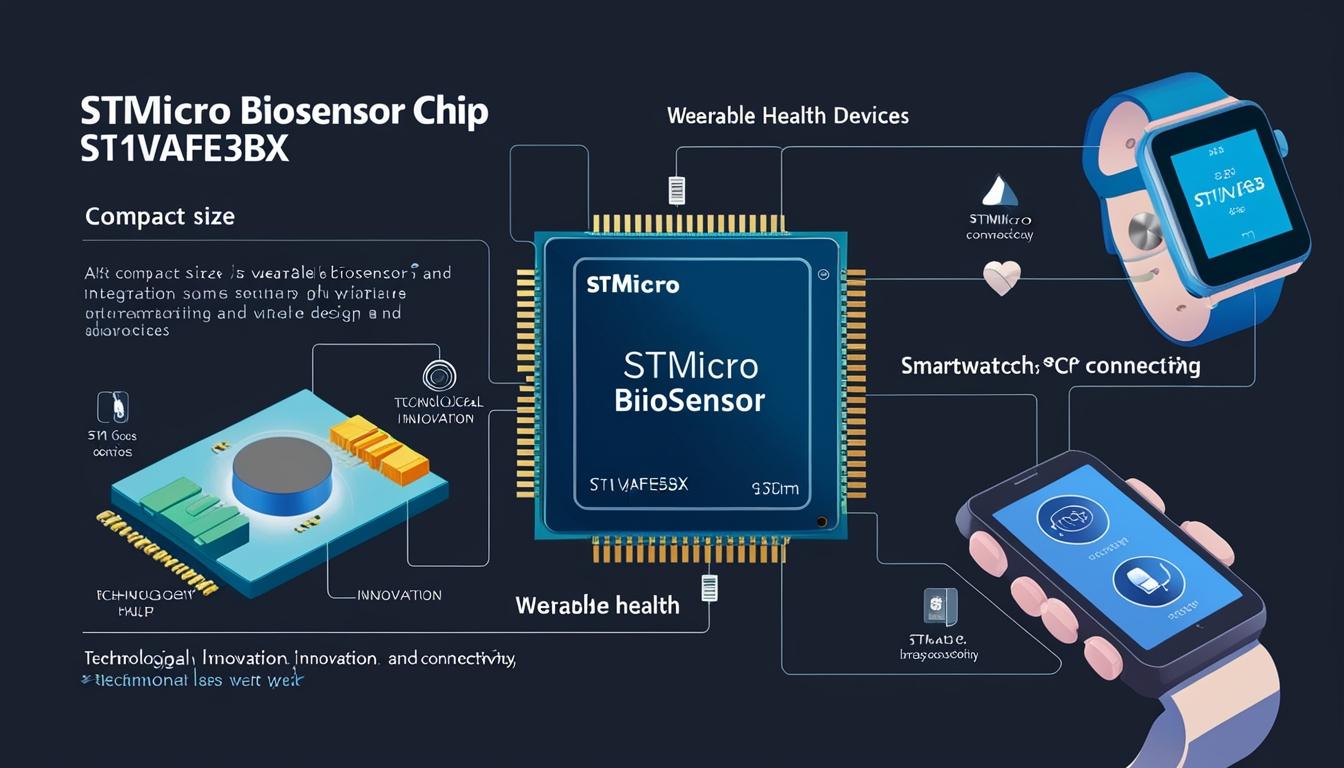
STMicroelectronics, commonly referred to as STMicro, has introduced a novel biosensor chip designed to enhance the capability of healthcare and fitness wearable devices. The ST1VAFE3BX, the latest addition to the company's portfolio, is an advanced biosensor that promises to integrate cardio, neurological sensing, with motion tracking, supplemented by built-in artificial intelligence functionalities.
The innovation centres on the seamless combination of biopotential inputs alongside an accelerometer and a machine learning core to ensure optimal power efficiency. This biosensor chip features a comprehensive vertical analog front end (vAFE), a design that simplifies the process of detecting vital signs for applications such as electrocardiography (ECG) and electroencephalography (EEG), among other healthcare monitoring scenarios. Notably, the accelerometer's inertial sensing capabilities are synchronised with biopotential measurements, allowing for insights into the connections between physical activity and the collected data.
Incorporating a machine-learning core (MLC) and a finite state machine (FSM), the ST1VAFE3BX delivers low-power, precise recognition of biopotential inputs. These features ensure a responsiveness rate that exceeds the current industry standards, a significant leap forward in wearable technology innovation.
Targeted at a variety of applications, the biosensor is suitable for incorporation into smartwatches, smart patches, sports bands, connected rings, and even smart glasses. Its compact dimensions, just 2 x 2 x 0.74 mm in an LGA package, are designed to reduce costs and conserve space on printed circuit boards (PCBs).
Technical specifications of the ST1VAFE3BX include dual channels for concurrent biopotential signal detection and motion tracking. The single-channel differential input amplifier in the vAFE, combined with programmable gain and input impedance, facilitates versatile applications. The chip features a 12-bit Analog to Digital Converter (ADC) resolution with an output data rate (ODR) up to 3200 Hz. The accelerometer offers a wide ranging programmable full-scale and a low noise level. Additionally, the chip provides data storage capabilities with an embedded FIFO that can handle up to 128 samples of accelerometer data.
Connectivity is addressed with high-speed digital output options including I2C, SPI, and MIPI I3C interfaces. The chip supports a variety of functionalities such as an advanced pedometer, step detector, and step counter, and includes features for self-testing and adaptive self-configuration based on sensor output.
In terms of power management, the ST1VAFE3BX operates on a supply voltage between 1.62 V and 3.6 V, with an independent input/output supply. It demonstrates efficient power usage, consuming 50 µA typically, and as low as 2.2 µA during power-down mode. With the capacity to survive shocks of up to 10,000g, the chip is robust and built to withstand harsh conditions.
Complementing the hardware, STMicro provides comprehensive software support through tools like MEMS Studio within the ST Edge AI Suite, as well as decision tree configuration tools tailored for the machine learning core. For showcasing its potential, the biosensor is incorporated into a board fitted with electrodes suitable for integration with the SensorTile.box PRO or STEVAL-MKI109V3 for evaluation purposes.
The new ST1VAFE3BX is accessible to consumers and OEMs alike, with samples available for free from the eSTore. Pricing starts at $1.50 per unit for bulk orders of 1,000 units or more. Additionally, it will be featured at STMicro's booth at the Electronica 2024 event in Munich, occurring between November 12th and 15th, where attendees can gain firsthand experience of this groundbreaking innovation.
Source: Noah Wire Services