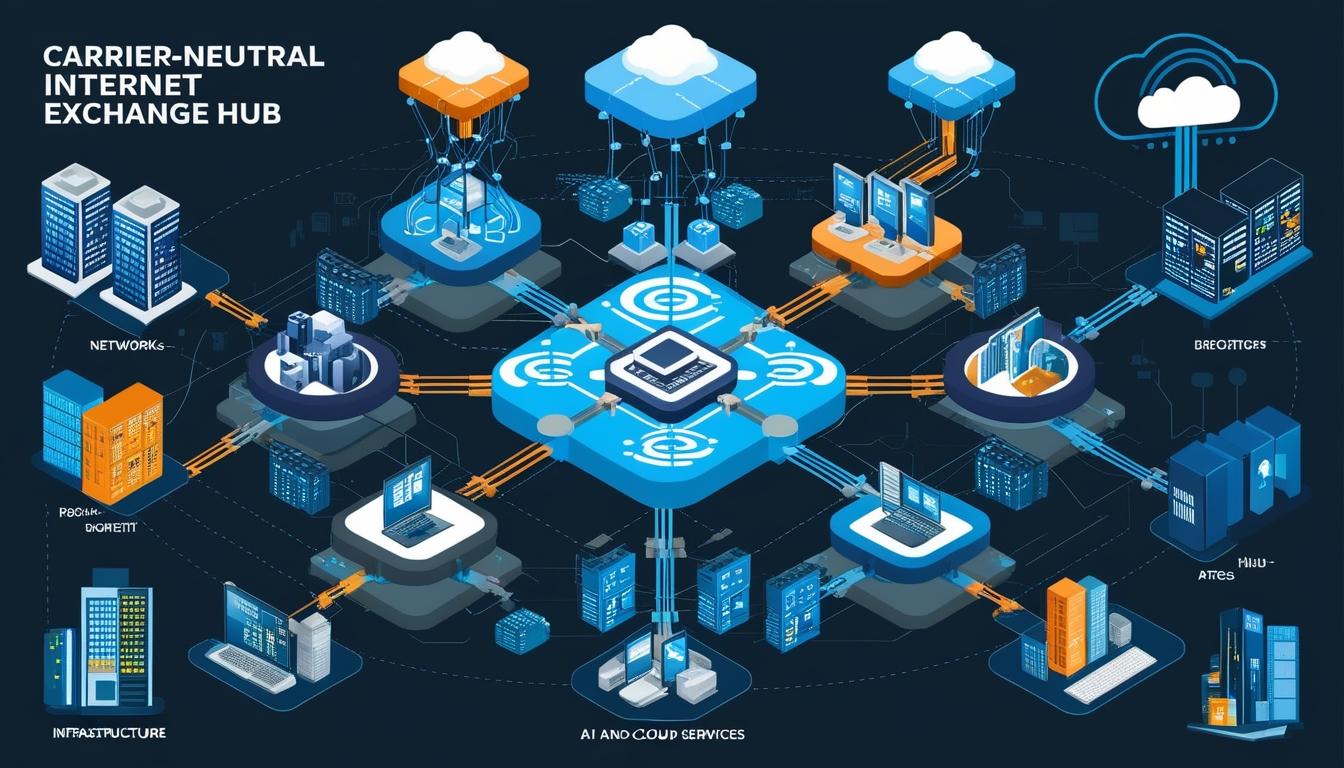
New research has highlighted a significant transformation within the digital infrastructure landscape, focusing on the growing shift towards carrier-neutral Internet Exchanges (IXs) in the United States. This evolution is reshaping data centre connectivity, providing much-needed geographical diversity, redundancy, and flexibility, especially in the context of burgeoning demand for artificial intelligence (AI), cloud services, and other data-heavy applications.
The study, conducted by Dstream Group and commissioned by DE-CIX, outlines a remarkable 600% increase in the establishment of Internet Exchanges across the US over the past ten years. Currently, 80% of these exchanges are reportedly data centre and carrier-neutral, presenting a clear departure from traditional IX models that were predominantly operated by single carriers or specific data centre operators.
The findings indicate a significant preference for neutral IXs, with 35 of the top 50 largest exchanges in the US adopting this model. This preference highlights the advantages of neutral IXs in contemporary connectivity solutions, offering businesses capabilities to sidestep vendor lock-in and providing the essential redundancy for resilient network infrastructures. By distributing connections across multiple operators within a metropolitan area, neutral IXs also promote a greater network density and reduce latency, factors that are increasingly indispensable for modern digital services.
In today's digitally-driven world, the calls for robust, flexible, and reliable digital infrastructure have never been louder. The widespread adoption of cloud computing, AI, and the Internet of Things necessitates swift, high-performance interconnections and network resilience. These demands are critical for enabling services ranging from real-time data analytics and online gaming to streaming high-resolution videos. Neutral IXs, managed by independent specialists and spread across multiple data centres, meet these demands by providing enhanced network coverage and facility connections, reportedly up to four times more than traditional IX models.
The expansion of neutral IXs also fosters a collaborative digital ecosystem by connecting a diverse range of networks and data centres. This setup not only drives competition and innovation but also broadens business choices, fortifying the overall digital infrastructure market rather than fragmenting it.
The burgeoning demand for data centre capacity within the US is demonstrated by the current figure of 11,200 MW of installed capacity, alongside 5,500 MW under construction and 12,600 MW in planning stages. This points towards a potential growth trajectory of 160%. Traditional data centre strongholds like Northern Virginia and Dallas/Fort Worth are at the forefront, with secondary and tertiary markets like Las Vegas, Reno, and Columbus gaining traction due to their lower costs, favourable tax incentives, and available space and power.
Conventional hubs such as New York and Los Angeles are encountering challenges related to space and power constraints, which has bolstered growth in emerging markets. Cities like Phoenix, Dallas/Fort Worth, and Chicago are proving to be strong contenders, while smaller markets, thanks to favourable conditions, are also becoming competitive for data centre developments.
Ivo Ivanov, CEO of DE-CIX, commented on these developments, emphasising the value of the neutral and distributed model in propelling digital growth within the US market. According to Ivanov, the findings accentuate that these neutral IXs, inspired by the European model of neutrality, are not only designed to be sustainable for the future but are vital for supporting the burgeoning needs associated with cloud computing, AI, and IoT, thereby enabling extremely low latency connectivity essential for both current and future digital use cases.
Source: Noah Wire Services