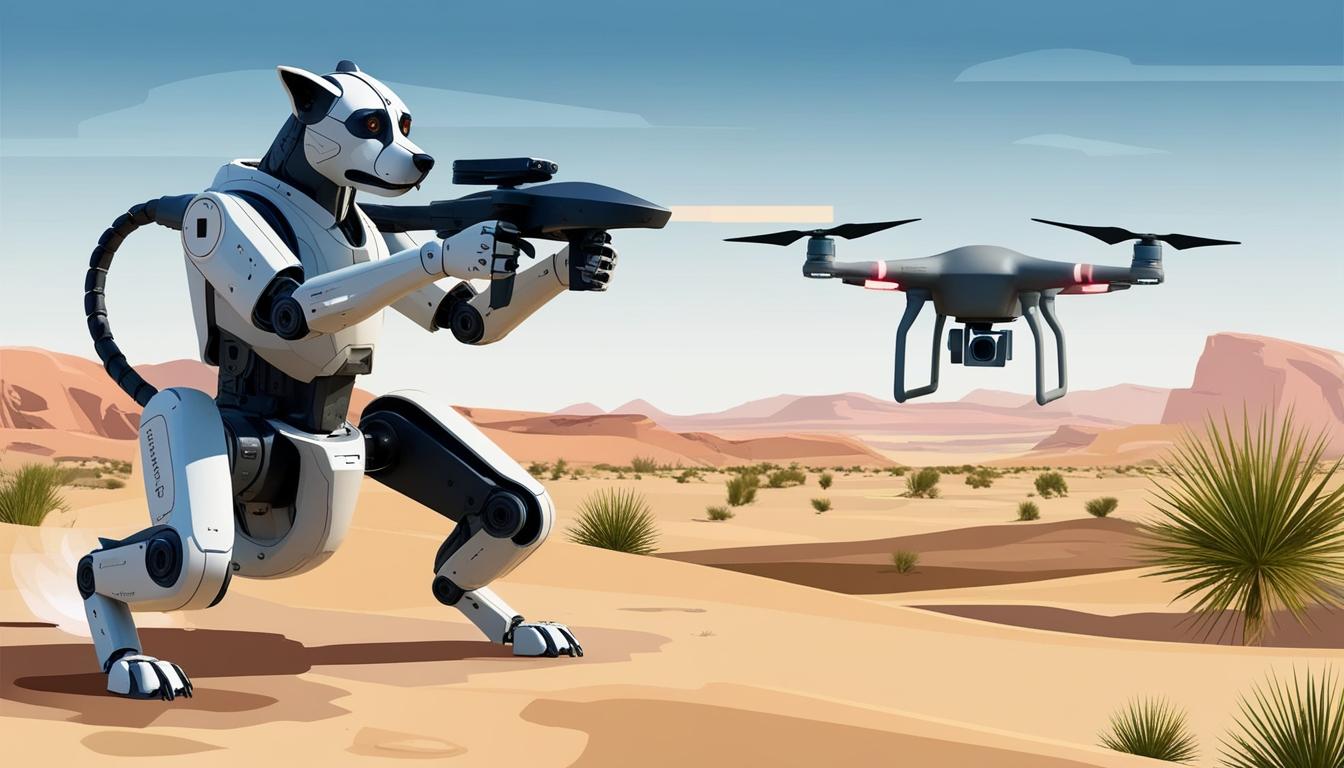
The United States Army has taken a significant step in modern military innovation by testing an armed, AI-powered robot dog, known as the Vision 60, in Saudi Arabia. The tests took place on May 18 at the Red Sands Integrated Experimental Center, illustrating the military's ongoing efforts to enhance anti-drone defence capabilities.
The Vision 60, created by the Philadelphia-based company Ghost Robotics, is a quadruped unmanned ground vehicle (Q-UGV) equipped with cutting-edge technology specifically designed for contemporary battlefields. Among its features, the robot dog includes a turret-mounted system with an AR-15/M16 rifle, allowing it to detect and engage aerial targets such as drones. This capability is crucial as the prevalence of drones in modern warfare increases, necessitating reliable defence systems.
Footage publicly released by the US Army demonstrates the Vision 60's capabilities, particularly its precision in targeting drones. The robot utilises an advanced electro-optical targeting system, famously inscribed with "Lone Wolf" - a system already applied in the US Army's "Hard Kill" operations. In military terminology, these operations involve active defence systems that physically neutralise threats, distinguishing them from "soft kill" systems that rely on electronic and non-destructive methods to disrupt enemy equipment.
The Vision 60 is notable for its adaptability, capable of operating effectively across diverse terrains and environments. While it has already been used in various military capacities such as surveillance, reconnaissance, and search and rescue missions, this recent demonstration is among the first public tests showcasing its weaponised potential specifically for anti-drone combat scenarios.
The development and testing of such systems reflect broader trends within the United States military and global defence sectors, where there is a concerted effort to advance robotics and AI technologies. Despite the potential military advantages, the use of such weaponised robots remains a contentious issue due to the ethical and legal considerations surrounding autonomous lethal force. Critics express concern over the moral implications and the potential necessity of maintaining human oversight in combat decisions.
Nevertheless, the Vision 60's testing accentuates an international movement towards armed robotic systems, with nations such as China, Russia, and the United Kingdom also invested in similar technological advances. This rapidly evolving landscape highlights an ongoing global race to develop AI-powered defence mechanisms that minimise human risk and enhance the efficiency of military operations.
Source: Noah Wire Services