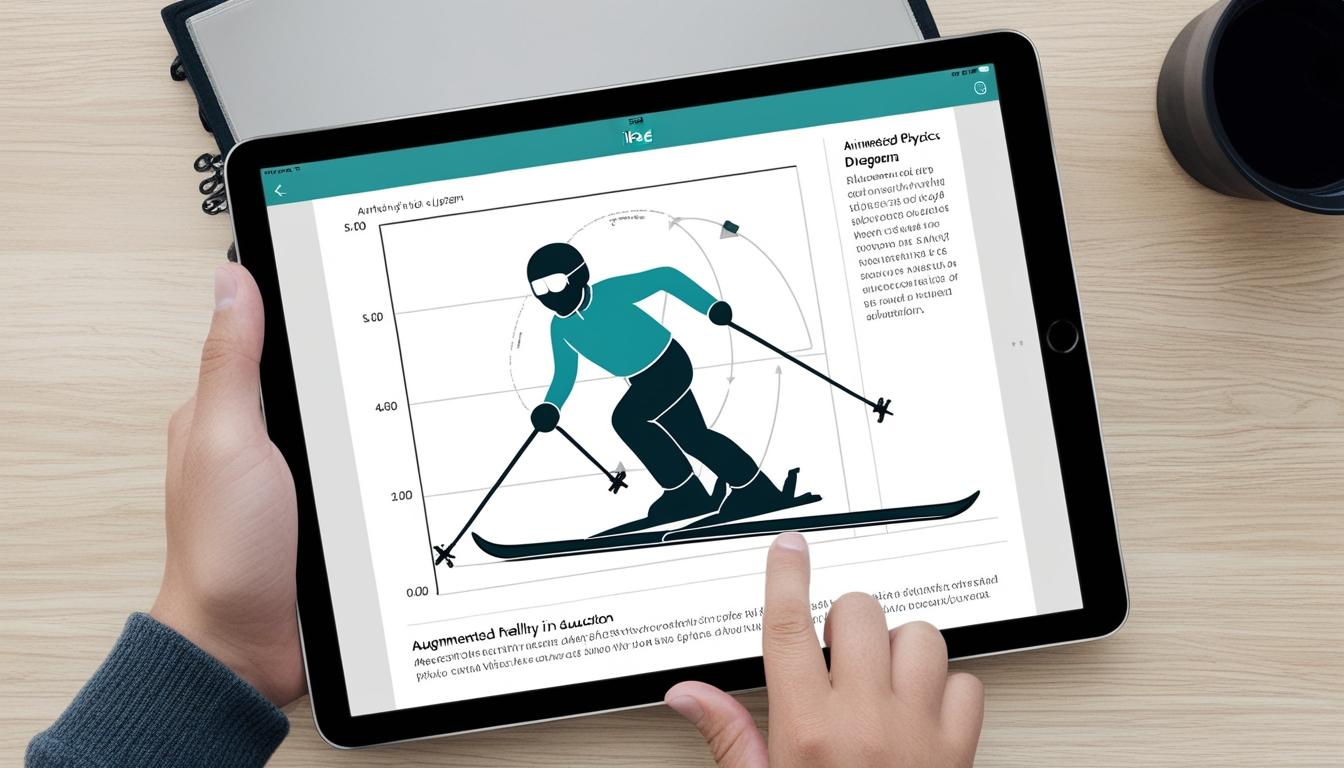
A groundbreaking advancement in educational technology is set to transform the way students engage with traditional physics diagrams. Led by Ryo Suzuki, an assistant professor at the University of Colorado Boulder, a team of computer scientists has developed a tool that leverages augmented reality to animate static textbook diagrams using just an iPad. The innovation was presented at the 37th Annual ACM Symposium on User Interface Software and Technology in October 2024 in Pittsburgh, where it received a "best paper" award.
This novel tool allows users to capture a diagram with their iPad and convert it into an interactive simulation using artificial intelligence. An example of its application can be found in a physics lesson illustrating kinetic energy: a static image of a skier poised at a jump can now be animated to show the skier rushing downhill in a scientifically accurate manner. Users can manipulate variables such as snow friction to influence the speed of the skier, illustrating physics concepts in a dynamic and engaging way.
The project, coined "Augmented Physics," was inspired by the research team's experiences and the pursuit of more effective educational tools. Aditya Gunturu, a master's student in computer science at the University of Calgary and the study's first author, recounted his frustration with traditional methods of learning physics, sparking his interest in better visualization techniques. His mother, a biology teacher in India, frequently uses blackboards to demonstrate complex biological processes, a practice that could be revolutionised by similar technology.
Utilising a model from the tech company Meta known as Segment Anything, Augmented Physics allows users to isolate and animate specific aspects of diagrams by clicking on them, similar to selecting features in a photo. By applying fundamental physics laws, the tool can animate components within diagrams such as optics and electrical circuits to enhance understanding through visual simulations.
Feedback from educators and students has been instrumental in refining the tool, enabling learners to conduct their own experiments within the simulations. Though successful animation is currently achieved about 60% of the time, the research team is committed to increasing this success rate. Looking forward, the researchers aim to expand the technology beyond the realm of physics, hoping eventually to enable any static diagram in any document to be transformed into an engaging 3D interactive experience, potentially with augmented reality glasses.
The team of researchers collaborating on this innovative project also included Rubaiat Habib Kazi from Adobe Research; Nandi Zhang and Jarin Thundathil from the University of Calgary; and Yi Wen from Texas A&M University. The paper detailing their findings and developments, titled "Augmented Physics: Creating Interactive and Embedded Physics Simulations from Static Textbook Diagrams," is published in the proceedings of the symposium and is expected to have significant implications for science and technology education worldwide.
Source: Noah Wire Services