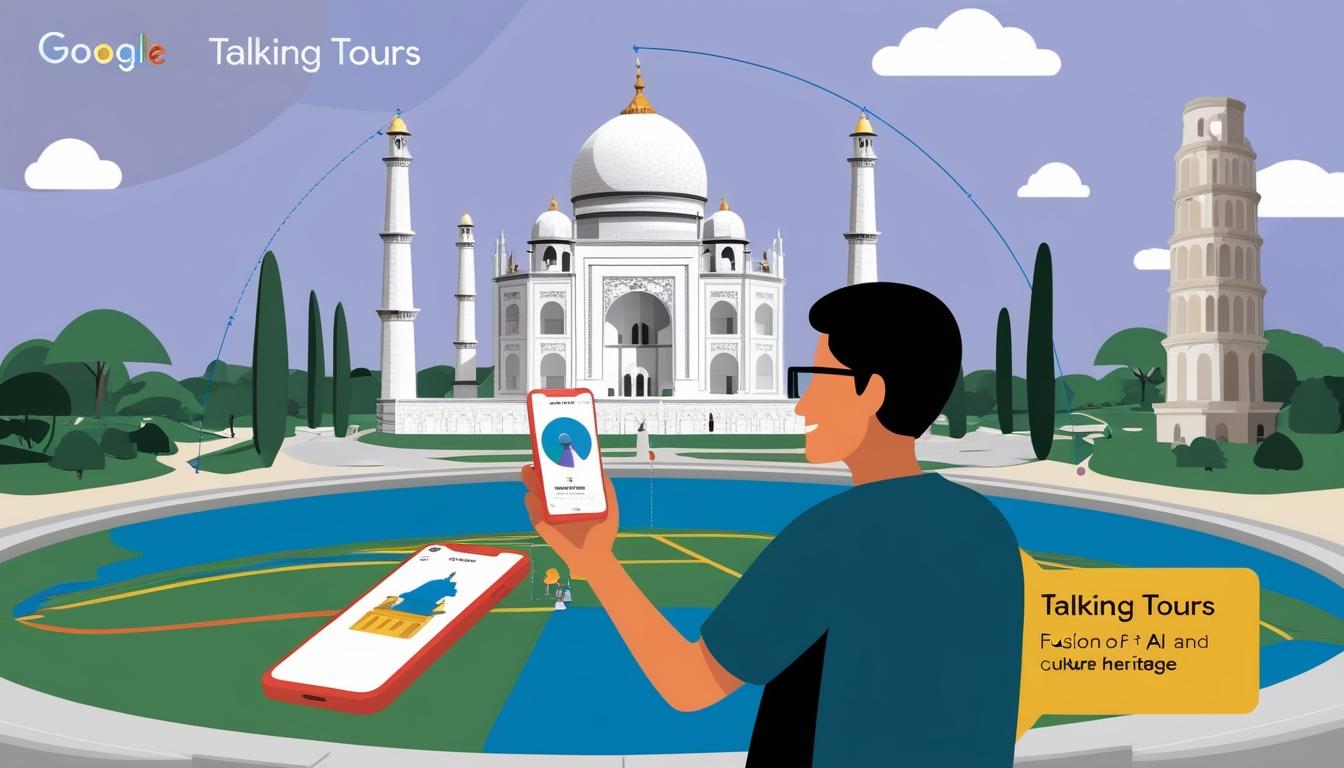
Google has unveiled an innovative digital travel companion feature called 'Talking Tours', designed to enhance the virtual travel experience by offering AI-generated commentary on prominent landmarks worldwide. This exploratory feature is available through the Google Arts & Culture app on both iOS and Android platforms, as well as online. It represents Google's ongoing ambition to establish itself as a leading virtual tour guide, building on its previous enhancements to Google Maps.
The 'Talking Tours' feature provides users with commentary on 55 major locations globally, delivering a new, digital travel narrative. The feature sets itself apart by allowing users to engage with 360-degree panoramas of the landmarks. Users can capture images of the scenes, upon which the AI generates informative descriptions based on the visual context. The inclusion of notable tourist attractions such as the Taj Mahal, Machu Picchu, and Seoul's National Museum of Modern and Contemporary Art underscores the feature's focus on prominent cultural sites.
Google partnered with a select group of cultural sites and organisations for this initial phase, signalling potential expansion plans with more partners in the future. The scalability of AI technology suggests the possibility of rapidly extending this feature to numerous locations, indicating an evolving landscape for digital travel resources.
In its current iteration, the feature demonstrates a foundational level of information, notably showcased during trials at one of London's featured sites, the London Eye. The AI provided a basic overview of this landmark and utilised a 'snap' function within Street View to identify and elaborate on additional elements in the scene, such as riverboat cruises on the Thames.
Despite its innovative technology, 'Talking Tours' does not yet offer the depth or personal touch of traditional city walking tours led by experienced guides. Nevertheless, it hints at an emerging era where technology could complement or enhance traditional travel experiences. The combination of advanced AI and potentially forthcoming augmented reality (AR) deployments, possibly through smart glasses, could enhance personal travel insights, serving as an extensive, on-the-go travel guide.
While Google has previously experimented with city guide functionalities in applications like Google Lens and Google Earth, the merger of computer vision and AI commentary found in 'Talking Tours' presents a uniquely scalable solution. This advancement suggests a promising glimpse into the future of digital travel assistance, as Google continues to innovate in integrating technology into the realm of cultural exploration and tourism.
Source: Noah Wire Services