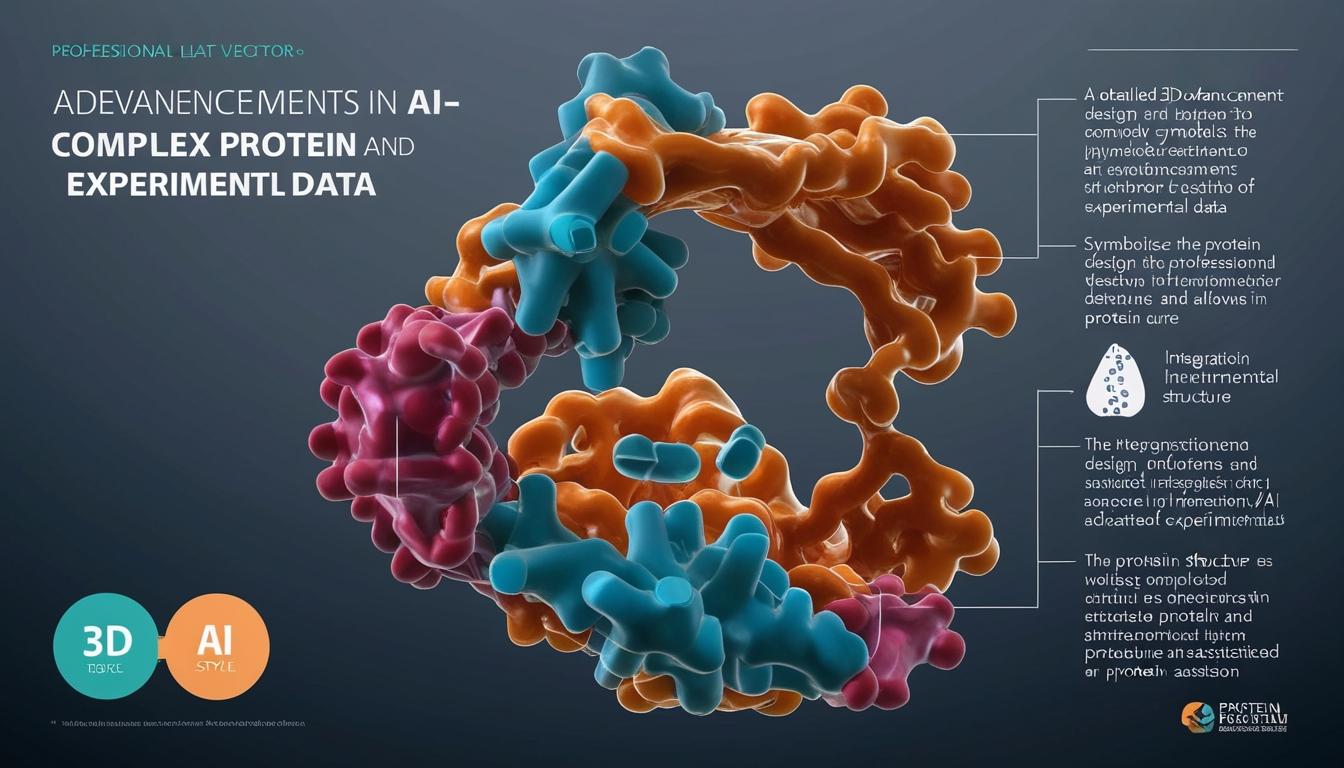
AlphaFold, an AI tool conceptualised by DeepMind, has undergone a significant upgrade, allowing it to predict the shapes of highly complex and large protein structures. This advancement, spearheaded by researchers from Linköping University in Sweden, has integrated experimental data into AlphaFold, resulting in a modified version referred to as AF_unmasked. These developments have been detailed in a recent publication in Nature Communications, marking a pivotal moment in the efficient development of new proteins, particularly in the medical field.
Proteins, which play a crucial role in regulating cell functions, are involved in various biological processes, from muscular control and hair formation to oxygen transport and food digestion. They are not only vital within the body but also feature prominently in numerous industrial applications, such as in detergents and pharmaceuticals. Structurally, proteins are large molecules comprised of sequences of up to a few thousand amino acids, giving rise to billions of potential three-dimensional shapes that dictate their functions.
For the past five decades, scientists have been engaged in efforts to predict and design protein structures, a process that has historically been fraught with challenges due to its complexity and high costs. In 2020, DeepMind introduced AlphaFold as open source software using neural networks to predict protein folding with remarkable precision, earning it recognition with a Nobel Prize in Chemistry in 2024. Despite this, limitations persisted, notably in the tool's ability to handle large protein compounds and its reliance on exclusively complete data sets.
Linköping University’s research team has sought to address these restrictions by enhancing AlphaFold’s capabilities. The improved tool, AF_unmasked, assimilates experimental data alongside partial inputs, enabling the prediction of extensive and intricate protein structures. This advancement is pivotal in enabling scientists to advance their understanding of protein functions and facilitate the design of innovative protein-based drugs.
Claudio Mirabello, a docent at Linköping University's Department of Physics, Chemistry, and Biology, explained: "We're giving a new type of input to AlphaFold. The idea is to get the whole picture, both from experiments and neural networks, making it possible to build larger structures. But you can also have a draft of a structure that you feed into AlphaFold and get a relatively accurate result." The ability to input existing experimental data into AlphaFold marks a significant stride in refining protein design processes.
The groundwork for AlphaFold's success was laid over decades, beginning with efforts that amassed structural data on about 200,000 proteins for training purposes. The evolution of supercomputing technology, particularly using GPUs for intensive calculations, propelled these efforts into practical reality.
Björn Wallner, a professor of bioinformatics at Linköping University, who collaborated with one of the three Nobel laureates, emphasized the boundless potential for protein design. "The possibilities for protein design are endless, only the imagination sets limits. It's possible to develop proteins for use both inside and outside the body. You always have to find new, more difficult problems when you have solved the old ones. And within our field, finding problems is no problem," he stated.
Both Wallner and Mirabello collaborated on an early version of AlphaFold, which significantly influenced DeepMind’s development of the tool. The Google-owned company leveraged formidable resources to transform these foundational ideas into what has become an essential tool for protein scientists globally.
Mirabello further recounted the evolution of AlphaFold, pointing out, "AlphaFold wasn't the first tool to use deep neural networks to solve the problem. In fact, one of the most important characteristics of AlphaFold is that it encodes the evolutionary history of a protein inside the neural network, an idea that actually originated here at LiU and was published by Björn and me in 2019. So, you could say that AlphaFold was based on our idea, and now we are building on AlphaFold."
This breakthrough exemplifies a profound advancement in computational biology, potentially ushering in new avenues for research and therapeutic development, cementing the role of artificial intelligence in scientific discovery.
Source: Noah Wire Services