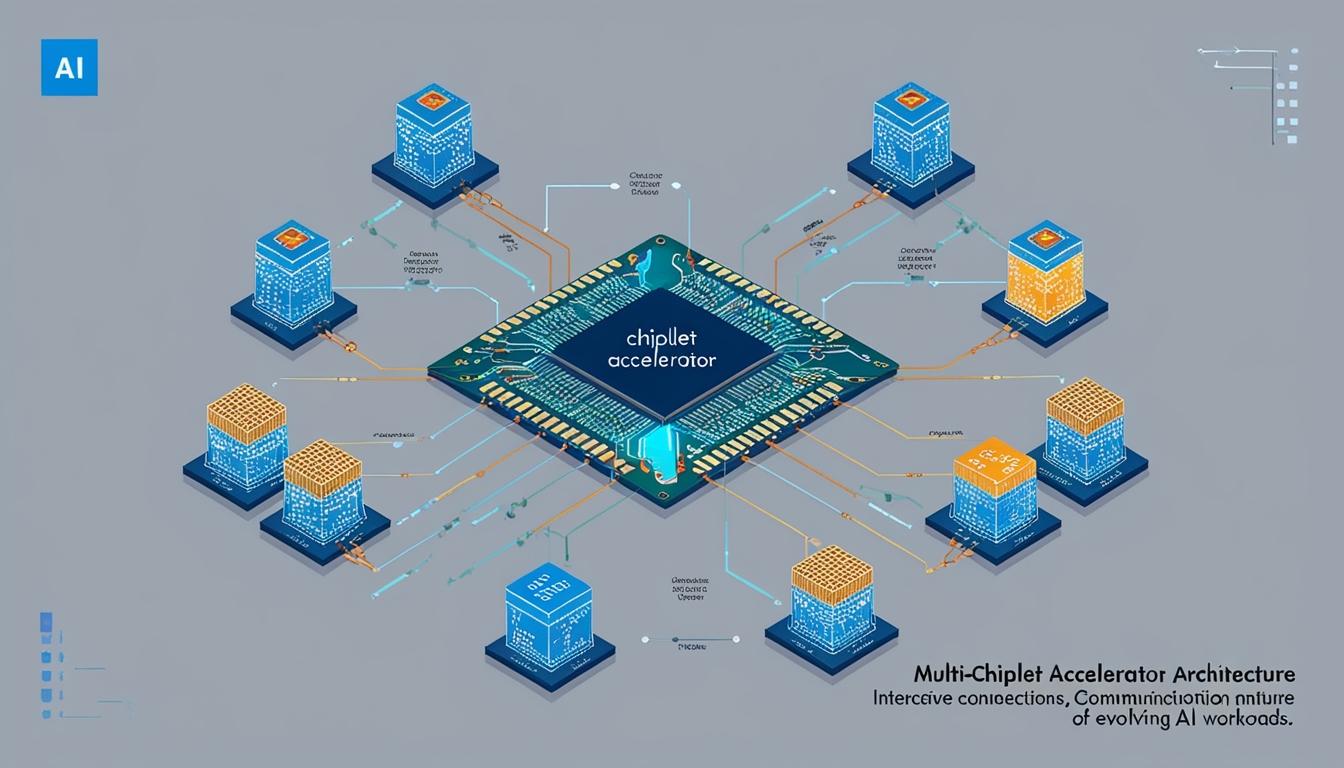
Researchers from the Universitat Politècnica de Catalunya have unveiled a technical study examining the communication dynamics of artificial intelligence (AI) workloads within multi-chiplet accelerator architectures. Titled "Communication Characterization of AI Workloads for Large-scale Multi-chiplet Accelerators," the paper explores how the intrinsic data-intensive nature of evolving AI workloads affects scalability and robustness, particularly in terms of execution time.
This cutting-edge research focuses on the architectural challenges posed by next-generation AI workloads, especially as they scale up. The core of the study lies in understanding how data moves across multiple chiplet setups and identifying potential performance bottlenecks that arise primarily from such movement.
Through a detailed methodology, the researchers categorise the communication traffic generated by various AI workloads into unicast and multicast forms. Significant emphasis is placed on determining how much time is spent on such communications and quantifying multicast messages relative to the number of chiplets in use. The findings indicate that certain AI workloads experience considerable performance hindrances due to communication demands, with multicast traffic emerging as a significant bottleneck that could potentially limit scalability.
The study further provides insights into workload profiling, suggesting that a flexible interconnect solution at the chiplet level could be crucial for enhancing the efficiency and scalability of AI accelerators in the future. This recommendation underlines the need for strategic architectural adaptations to mitigate communication bottlenecks, thereby improving overall performance.
The research was conducted by a team of scholars comprising Mariam Musavi, Emmanuel Irabor, Abhijit Das, Eduard Alarcón, and Sergi Abadal. Their work has been made publicly accessible via the arXiv preprint server and contributes valuable perspectives to the ongoing discourse on AI hardware optimization, particularly concerning the compatibility and efficiency of multi-chiplet configurations in AI processing tasks. This research is part of a broader effort to ensure that upcoming AI technologies maintain their efficacy and scalability in line with the rapid advancements in AI applications.
Source: Noah Wire Services