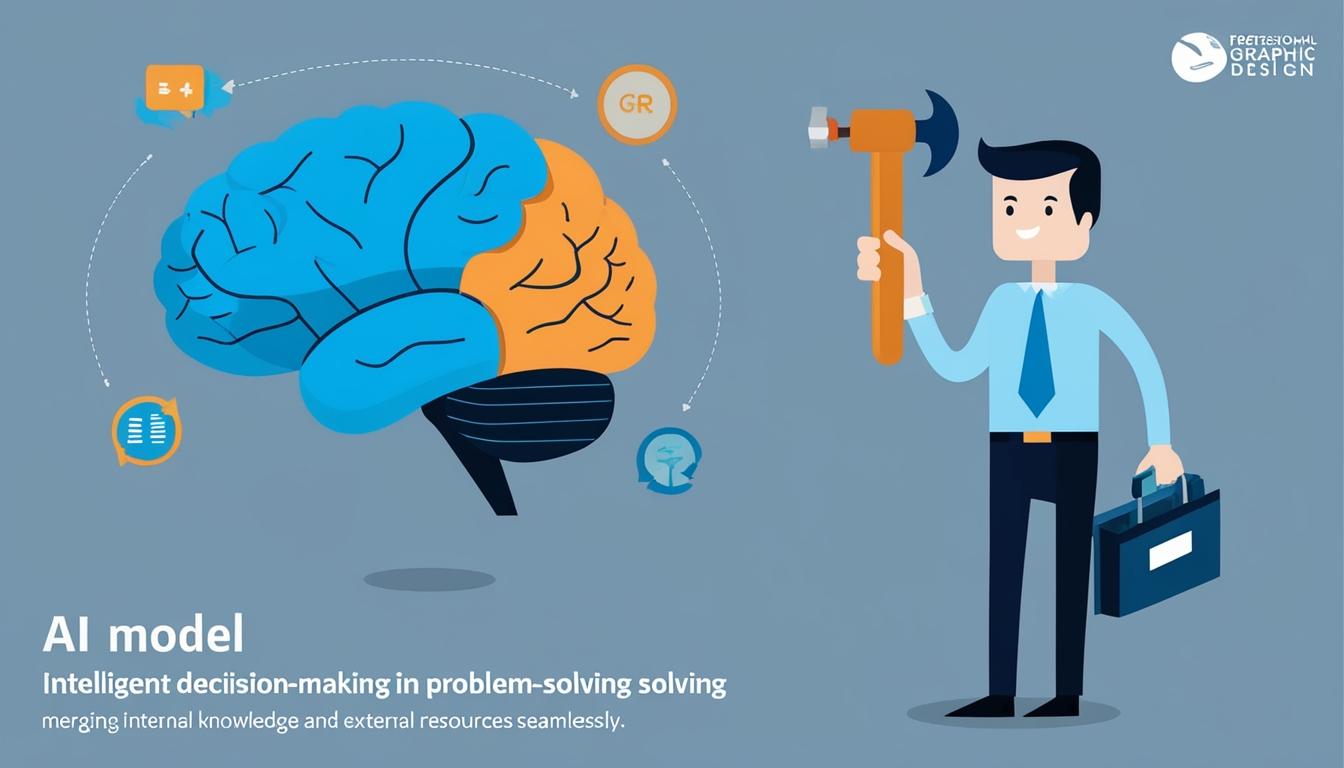
Researchers Develop AI Model Mimicking Human Decision-Making in Tool Usage
In an innovative stride forward in artificial intelligence research, a collaborative team of computer scientists from the University of California San Diego and Tsinghua University has developed a groundbreaking method that teaches AI to discern when to rely on built-in knowledge and when to utilise external tools, akin to how human experts approach problem-solving.
This development highlights a significant improvement in AI's functionality, particularly in scientific fields. The novel approach has demonstrated a 28% increase in accuracy, underscoring its potential relevance and applicability in scientific work where precision and effectiveness are paramount.
Innovative Approach: "Adapting While Learning"
The research introduces a new methodology called "Adapting While Learning," comprising a two-step learning process designed to refine an AI system's decision-making capabilities. Initially, the AI model is trained through "World Knowledge Distillation" (WKD), allowing it to gain insights from solutions created using external tools, thereby enhancing its internal knowledge base.
Subsequently, the AI undergoes "Tool Usage Adaptation" (TUA), which enables it to categorise problems as "easy" or "hard." This categorisation assists the AI in determining whether to tackle challenges using internal reasoning or to seek assistance from external tools. This approach mirrors the way human professionals appraise a problem's complexity and decide on the most appropriate mechanism for resolution.
Efficiency Without Scale: The 8 Billion Parameter Model
One of the startling revelations of this research is the efficiency exemplified by the AI model despite its relatively diminutive size of 8 billion parameters. This is a substantial departure from the commonly-held belief that larger AI models invariably yield superior performance. The model not only achieved a 28.18% improvement in answer accuracy but also increased precision in tool usage by 13.89% across test datasets, notably excelling in highly specialised scientific tasks.
This triumph over larger systems challenges the status quo of AI development, suggesting that strategic problem-categorisation and decision-making processes can be more beneficial than sheer computational capacity.
Shift Towards Smaller, Smarter Models
The research aligns with a broader industry transition towards smaller yet highly capable AI models. In recent developments, major tech entities such as Hugging Face, Nvidia, OpenAI, Meta, Anthropic, and H2O.ai have released compact models that boast significant capabilities. For instance, Hugging Face's SmolLM2 models operate efficiently on smartphones while maintaining effectiveness.
These advancements represent a paradigm shift in how the industry perceives AI model development, recognising that efficiency and task specialisation can often be more valuable than mere scale.
Implications for Business and Industry
For businesses employing AI solutions, this research offers a potential resolution to a longstanding challenge: the balance between internal problem-solving and tool reliance. AI systems previously tended to over-utilise external tools, escalating computational costs and operational sluggishness. Conversely, autonomous systems sometimes misjudged complex problems, leading to costly errors.
The method developed by the UC San Diego and Tsinghua University team provides a promising equilibrium, facilitating more cost-efficient and accurate AI applications. This is especially pertinent in areas like scientific research, financial analysis, and medical diagnostics, where both precision and efficiency are critical.
Future Prospects
The research marks a pivotal point in AI development, underscoring the importance of strategic decision-making over model size. The ability to discern when to use tools versus internal knowledge has implications beyond academia, suggesting a future where AI not only promises power but also prudence.
As AI systems find roles in critical sectors with high stakes, such as healthcare and environmental sciences, knowing when to seek external confirmation or assistance becomes essential. With this research, AI may evolve to become more adept at managing its limitations, echoing the expertise of seasoned professionals.
Source: Noah Wire Services