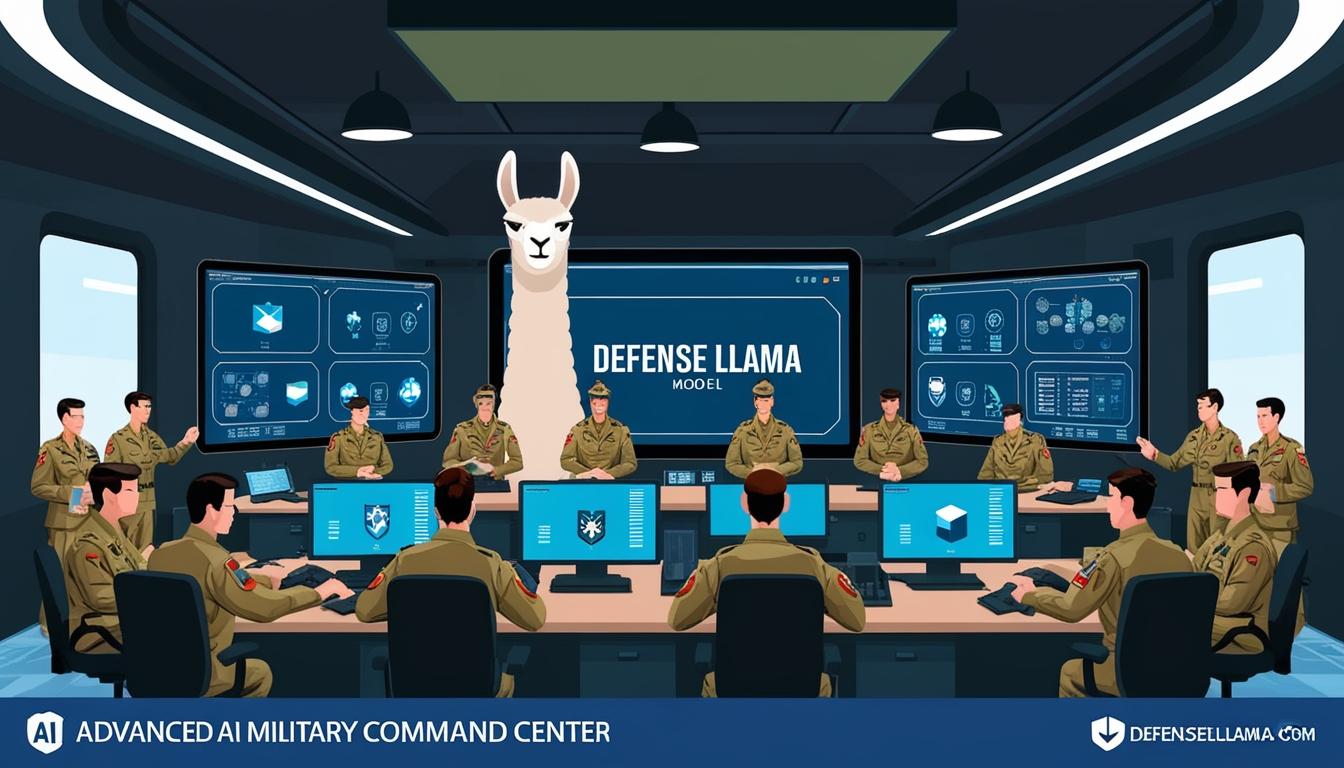
U.S. Military and National Security Teams Explore Advanced AI for Combat and Intelligence
In Washington, credentialed officials within the U.S. military and national security sectors are forging ahead with the integration of cutting-edge artificial intelligence (AI) solutions into their operations. Their tool of choice is a sophisticated large language model (LLM) known as Defense Llama, developed by Scale AI from Meta's Llama 3, to enhance missions such as combat planning and intelligence operations.
Dan Tadross, head of federal delivery at Scale AI and a Marine Corps reservist, provided exclusive insights into this pioneering model to DefenceScoop on Monday. Tadross emphasised that certain military units, including combatant commands, are already testing the system within specific networks, highlighting the potential of these technologies while acknowledging the challenges they might pose.
Large language models like Defense Llama, part of the broader field of generative AI, are notable for creating various outputs - such as text, software code, and images - based on human prompts. As these tools evolve, they offer significant prospects for the Department of Defense (DOD) to enhance operations but also raise concerns that need careful management.
In response to these opportunities and risks, last year saw the Pentagon establish a temporary task force to advance the understanding and safe application of generative AI within DOD. More recently, the federal government provided new directives in a National Security Memo (NSM) under the Biden administration, outlining approaches for adopting advanced AI technologies.
The unveiling of Defense Llama coincides with Meta’s recent announcement to make its Llama models available to U.S. government entities, particularly those involved in defence and national security tasks. This effort is supported by various commercial partners, including Scale AI. Simultaneously, OpenAI has introduced its first partnership with the DOD for ChatGPT Enterprise, allowing its AI capabilities on unclassified platforms.
This momentum comes amid reports of Chinese researchers using Meta's open-source Llama to develop AI tools potentially applicable to military use. However, Tadross has been vocal about the necessity for the U.S. to adopt these technologies contextually but swiftly, fearing that failure to do so might pose a greater risk.
Scale AI’s experimental journey with the Defense Llama, alongside DOD collaborators such as Marine Corps University’s School of Advanced Warfighting, uncovered several challenges. Notably, the AI occasionally refrained from responding to queries pertinent to warfare and defence strategy, attributing these limitations to the innate programming of LLMs designed for commercial contexts.
Through engineering processes like supervised fine-tuning and reinforcement learning with human feedback, Defense Llama is meticulously tailored to military needs, incorporating military doctrines, international humanitarian law, and ethical AI principles. These steps are crucial in forming responses that align with military standards and instil confidence in the model's output.
Despite Tadross’s discretion regarding the exact integration of Defense Llama into military systems, he confirmed that it is now available within specific defence command systems and intelligence analysis tools through the Scale Donovan platform. This controlled access ensures that only authorised personnel operate the LLMs securely and effectively.
In a demonstrative session at Scale AI's Washington office, Tadross contrasted Defense Llama's capability with another commercial LLM. When asked strategic military questions, Defense Llama provided comprehensive responses, covering various factors pertinent to military planning and operations. In contrast, the other LLM failed to address such queries directly.
This capability is viewed as transformative in military settings, potentially reducing the manpower needed for data analysis and speeding up decision-making processes—a crucial advancement from Tadross’s perspective, based on his experience in military command centres.
The integration of such AI tools could fundamentally alter how military data is processed, providing a streamlined, efficient approach to handling complex scenarios in real-time and enhancing the strategic capabilities of U.S. military operations.
Source: Noah Wire Services