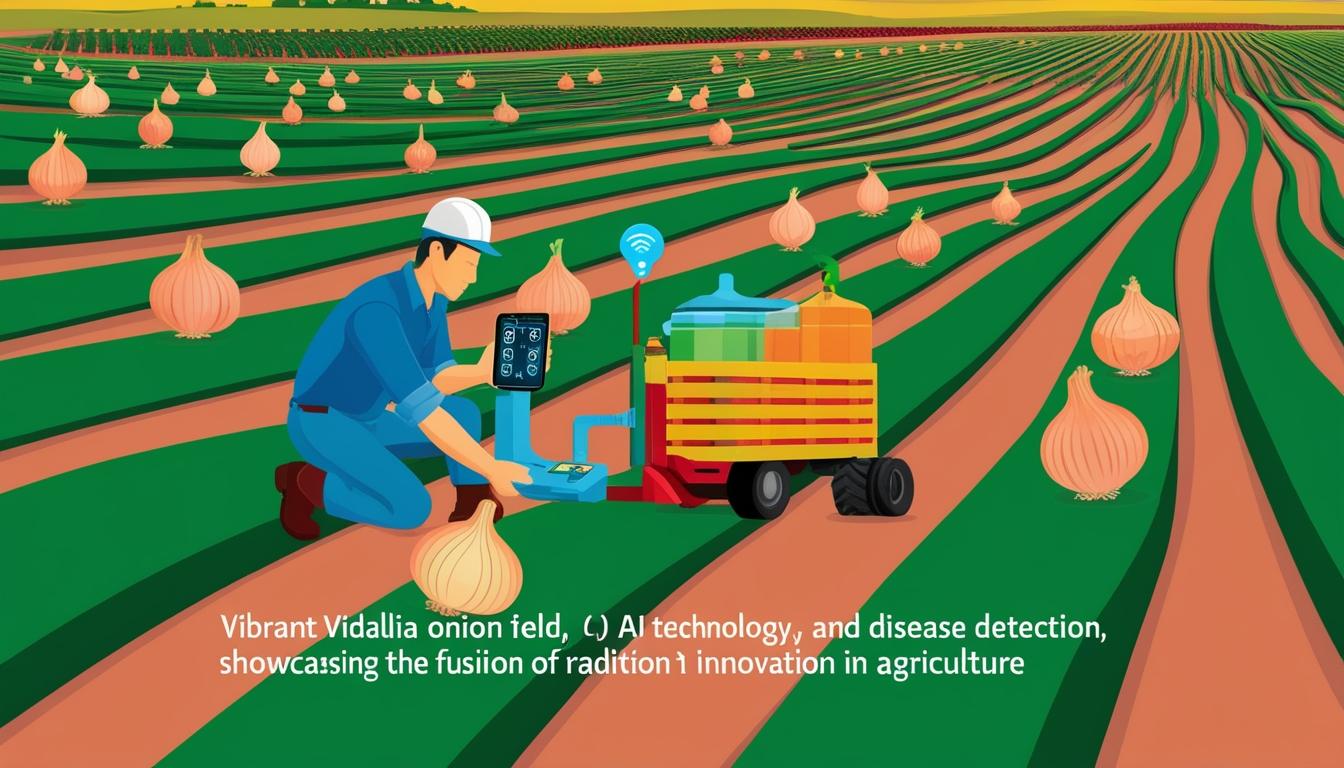
In the heart of Georgia's agricultural belt, researchers at the University of Georgia (UGA) are pioneering a project aimed at boosting the yield and quality of the famed Vidalia onion. This ambitious three-year venture seeks to integrate cutting-edge artificial intelligence (AI) and machine learning technologies into traditional farming practices to enhance disease detection and management for Vidalia onion growers across southeastern Georgia.
The Vidalia onion, prized for its unique sweetness and aroma, is cultivated exclusively in a 20-county region around Vidalia, Georgia, due to its unique soil properties. However, these conditions also provide an ideal environment for a plethora of plant pests and diseases that can severely impact onion yields. In 2022, the Vidalia onion boasted a substantial $200 million farm gate value, highlighting its economic importance to the region.
Leading this innovative initiative is Guoyu Lu, assistant professor at the UGA College of Engineering, in collaboration with Luan Oliveira, assistant professor in the Department of Horticulture and precision agriculture specialist for UGA Cooperative Extension. They are joined by Bhabesh Dutta, professor in the CAES Department of Plant Pathology and UGA Extension vegetable disease specialist. Together, this interdisciplinary team seeks to integrate AI capabilities into the agricultural sphere through the “SmartDetect” app and other AI-powered tools, capable of recognising specific diseases such as bacterial leaf blight, pink root, and onion smut.
The primary challenge faced by Vidalia onion growers stems from the vastness of the fields. Traditional disease scouting methods involve painstakingly walking through these large fields, checking a limited number of rows, which can result in undetected outbreaks. Consequently, farmers often resort to broad-spectrum pesticide applications, leading to increased costs and unnecessary environmental impact.
The SmartDetect initiative aims to tackle these challenges head-on. The researchers are developing a photographic library of foliar symptoms related to various onion diseases. These images will be input into AI software designed to identify diseases based on subtle patterns and colour changes that may not be discernible to the human eye. This technological leap, combined with data on plant health and growth collected via sensors and cameras integrated into robotic systems, promises to transform disease management in these crops.
The project commenced in late 2023 and is set to be completed by September 2026. In its current phase, the team is finalising data submissions to application developers for disease recognition and localisation. Upon completion, the project is expected to substantially increase the efficiency and profitability of Georgia's Vidalia onion production by reducing pesticide usage and improving crop yield through targeted interventions.
"We are not only aiming to improve the yield and quality of the onions but also to enhance environmental sustainability by minimising pesticide use," said Lu. The researchers hope this model, once proven successful, can be adapted for use with other crops, thereby broadening its impact on sustainable agricultural practices.
George Vellidis, professor in the CAES Department of Crop and Soil Sciences, noted the significance of this interdisciplinary endeavour facilitated by the UGA Institute for Integrative Precision Agriculture. The cooperation between the College of Agricultural and Environmental Sciences (CAES) and the College of Engineering is crucial, coupling traditional agricultural expertise with innovative technological solutions.
As this research continues, the findings and developed technologies will be shared with growers through the UGA Extension network, ensuring that practical applications from this study benefit farmers across Georgia.
For further information on UGA's research projects in precision agriculture, details can be found on the UGA Institute for Integrative Precision Agriculture website.
Source: Noah Wire Services