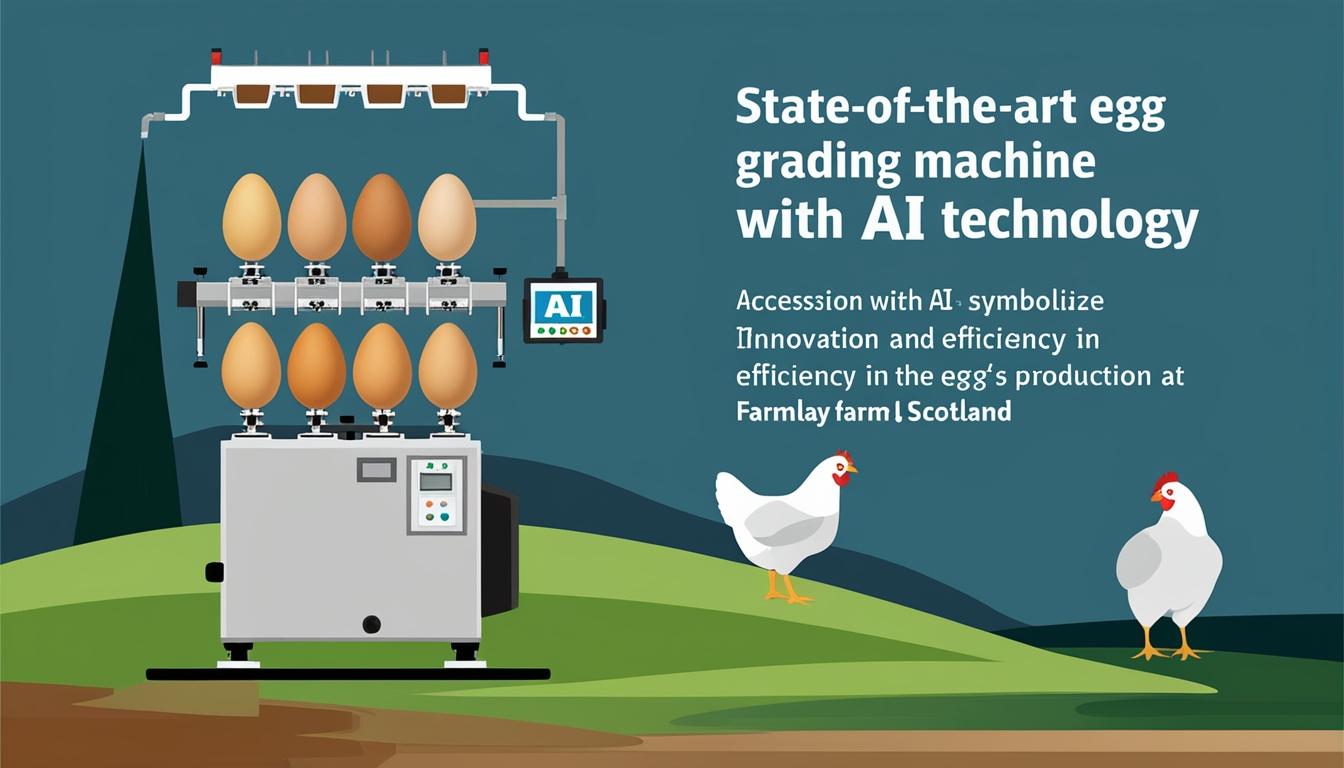
Farmlay, one of Scotland's leading egg producers, is set to nearly double its productivity in 2025, thanks to a substantial investment of £2.4 million in cutting-edge technology. This family-run business, based at Cockmuir Farm near Strichen in Aberdeenshire, is introducing a state-of-the-art egg grader that promises to enhance efficiency with advanced artificial intelligence (AI) mechanisms.
The new equipment, sourced from the Sanovo Technology Group in the Netherlands, incorporates AI-based computer vision technology. This system uses complex algorithms and deep learning techniques to meticulously scan high-resolution images of eggs, discerning between standard eggs and those with imperfections such as cracks. Furthermore, it can identify differences in the colour, texture, and shape of the eggs, continually learning and improving its accuracy over time. With the installation scheduled for January, the system is expected to increase Farmlay's throughput significantly by processing an additional 400 cases of eggs per hour, alongside the existing grader that handles 500 cases hourly.
This technological upgrade aligns with a broader trend in the egg industry, where demand, particularly for free-range eggs, has seen significant growth. Market data indicates that free-range eggs now constitute approximately 75% of retail egg sales, a notable increase from 32% in 2004. This rise has been driven by an uptick in consumption, especially among younger demographics, with general per capita egg consumption increasing by about 30 eggs per year.
The investment not only marks progress in production capabilities but also signifies potential economic benefits, with expectations of creating around 10 new jobs. This development comes amidst a period where retailers are seeking to safeguard against potential egg shortages, a scenario previously exacerbated by events such as the Covid-19 pandemic and avian flu outbreaks. To mitigate such risks, retailers have demonstrated confidence in more secure and long-term supply arrangements with producers like Farmlay.
Farmlay's history dates back nearly 80 years, with the Chapman family establishing their poultry rearing enterprise in 1946 and transitioning to egg marketing in the 1970s. Over the years, what began on 130 acres has evolved into an expansive operation covering 2,500 acres. Currently, Farmlay's team of 70 people oversees 450,000 laying hens, supplemented by 26 contract producers who contribute to their total weekly output of five million eggs.
Managing Director Iain Chapman notes the strategic nature of the investment, highlighting the need for reliable and efficient systems against a backdrop of high demand. The pursuit of sophisticated grading technology ensures a fallback mechanism in the event of machine failures, something that running a single grader for extended hours could not provide. Chapman speaks with optimism about the current market environment, describing it as a "golden age" for egg production, underpinned by both consumer demand and robust retailer support.
As Farmlay progresses towards this ambitious milestone, the company stands at the forefront of integrating technology into agriculture, representing a significant development in the food production industry in Scotland.
Source: Noah Wire Services