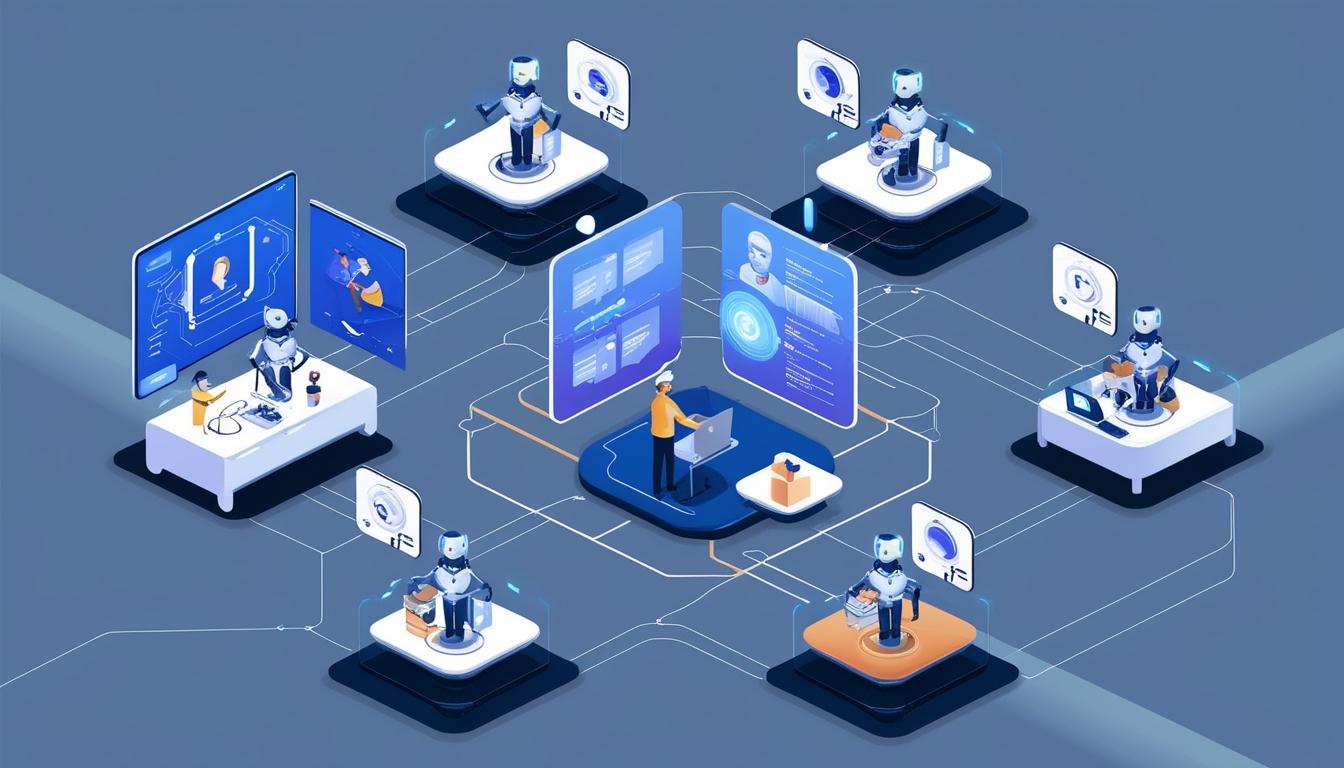
Microsoft has recently unveiled a pioneering multi-agent infrastructure by the name of Magnetic-One, aimed at enterprises seeking to efficiently deploy multiple AI agents. This new framework is engineered to enable a single AI model to effortlessly support various helper agents, collaboratively working to complete complex tasks across diverse scenarios. Microsoft envisions Magnetic-One as an instrumental system that epitomises the potential of agentic systems designed to elevate productivity and revolutionise everyday life.
Magnetic-One is distinguishable by its open-source nature, making it accessible to researchers and developers, including those with commercial intentions, under a custom Microsoft Licence. Accompanying this significant release is the AutoGenBench, an agent evaluation tool developed also as open-source, to test agentic systems. AutoGenBench builds upon Microsoft's earlier creation, the Autogen framework which supports multi-agent communication and cooperation.
At the heart of Magnetic-One is its primary component, the Orchestrator agent, which is responsible for guiding four specific types of agents. These include:
Websurfer Agents: These agents interact with Chromium-based web browsers to navigate websites, perform searches, and summarise content, performing functions akin to human web browsing activities.
FIleSurfer Agents: These agents specialise in reading local files, listing directories, and exploring folders, allowing them to effectively manage file-system operations.
Coder Agents: These perform coding tasks, analyse information, and create new digital artefacts, thus playing a crucial role in development environments.
ComputerTerminal: Functions as a console enabling the execution of programs developed by the Coder agent.
The operational methodology of Magnetic-One relies heavily on the Orchestrator agent, which commands these agents, intervenes when errors arise, and tracks the progress of tasks. It starts with formulating a blueprint for task completion, the so-called task ledger. As tasks proceed, it maintains a progress ledger to evaluate whether tasks are fulfilled, making necessary adjustments or devising a new plan if needed.
Magnetic-One's adaptability is showcased by its ability to accommodate various models behind the agents. Developers have the flexibility to integrate a reasoning large language model (LLM) for the Orchestrator agent, and combine it with smaller models or other LLMs across the system. Notably, while developed with OpenAI's GPT-4o, Magnetic-One is LLM-agnostic, though Microsoft recommends resilient reasoning models for optimal functioning.
This innovation comes amidst a surge in popularity of agentic systems, typified by the release of Microsoft's own AI agents for the Dynamics 365 platform in October. The market for AI orchestration frameworks is becoming competitive, with entities like OpenAI introducing its Swarm framework and CrewAI developing a multi-agent builder, both offering simplified management of agentic collaboration.
Currently, use of AI agents within enterprises is still nascent, suggesting an evolution in experimenting with multi-agent frameworks is ongoing. Enterprises are expected to navigate the complexities of ensuring harmonious interaction between AI agents to achieve seamless task completion as they increase their AI deployment.
Magnetic-One, thus, represents a critical step forward in the quest for advanced agentic systems, aiming to streamline operations within organisations through the integration of intelligent, autonomous agents.
Source: Noah Wire Services