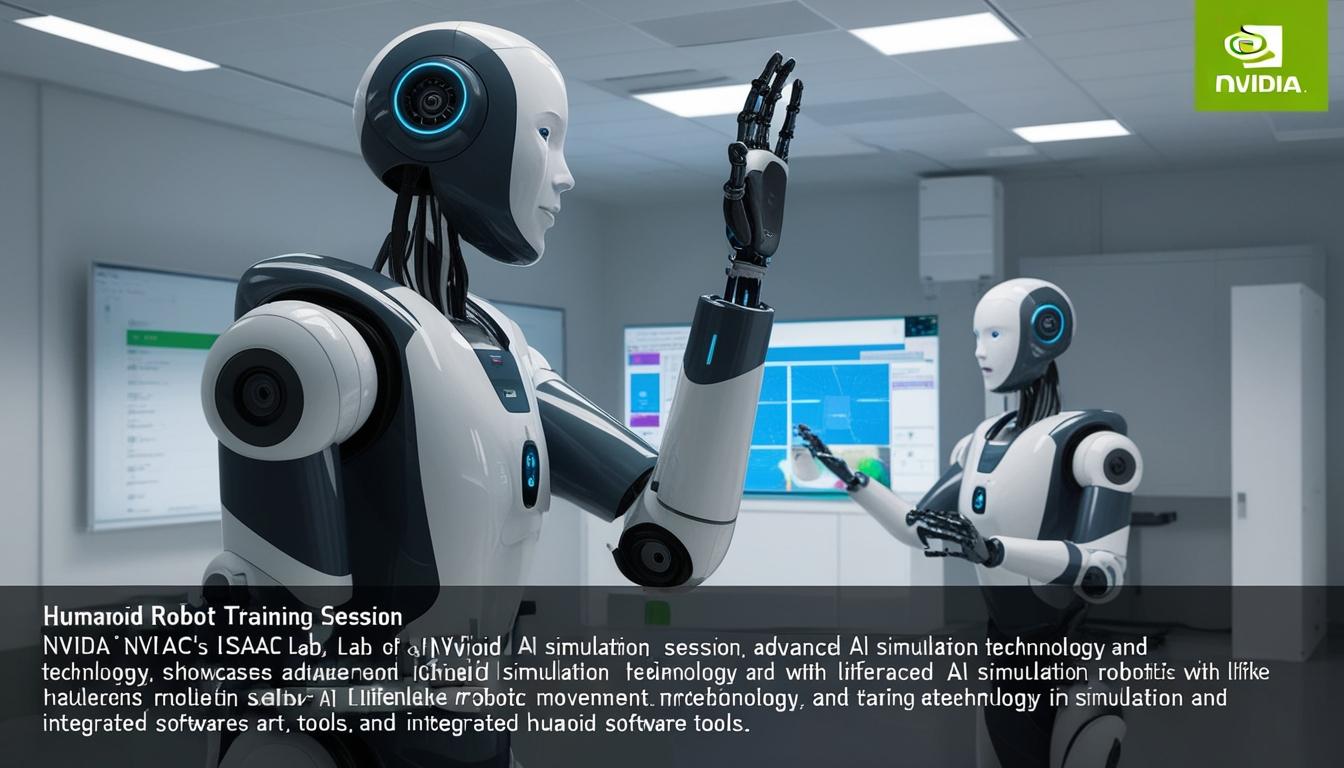
NVIDIA Corporation has unveiled a suite of sophisticated artificial intelligence and simulation tools designed to expedite the development of robotics, particularly focusing on humanoid robots. This announcement was made at the Conference for Robotic Learning held in Munich, Germany. NVIDIA, in collaboration with Hugging Face Inc., aims to foster advancements in robotics and AI by leveraging their joint open-source platforms, promising significant impacts across industries such as manufacturing, healthcare, and logistics.
Central to this initiative is the NVIDIA Isaac Lab, an open-source robot learning framework integrated with NVIDIA's Omniverse platform. This framework is intended to facilitate scalable training for a variety of robot movements, ranging from smaller collaborative robots to more complex humanoid forms. The widespread adoption of Isaac Lab is evidenced by its use by prominent entities within the robotics field, including Boston Dynamics, Agility Robotics, and Unitree Robotics, among others.
A significant component of NVIDIA's strategy includes Project GR00T, which provides foundational resources such as libraries and data pipelines to support the global development of humanoid robots. The project introduces six new workflows aimed at enhancing robots' ability to perceive, navigate, and interact within human environments. These workflows encompass areas like generative AI environments, motion generation, dexterous manipulation, and multimodal sensing.
In tandem with these developments, NVIDIA has introduced innovative video data processing tools such as the NVIDIA Cosmos tokenizer and NeMo Curator. These tools are designed to enhance the creation of world models by providing high-quality encoding and decoding, crucial for developing accurate AI representations of physical environments. The Cosmos tokenizer promises improved performance with a reported 12-times faster processing speed compared to existing models, assisting companies like XPENG Robotics and 1X Technologies in refining their data processing capabilities.
The NeMo Curator addresses the logistical challenges of handling extensive video datasets by optimizing the curation process through scalable pipeline orchestration, which not only increases throughput but also eases the cost and complexity of AI development. This tool is expected to be publicly available by the end of the month.
The collaboration between Hugging Face and NVIDIA, highlighted at the Munich conference, marks a significant move towards enhancing open-source robotics research. Hugging Face, renowned for its AI platform utilised by millions of researchers globally, is integrating its capabilities with NVIDIA's hardware and simulation technologies. This collaboration promises to foster a new era of 'physical AI', where robots can more intuitively interact and make decisions based on their environment.
Part of this joint effort involves using LeRobot's capabilities in conjunction with NVIDIA Isaac Sim and Jetson platforms to enable advanced robotic training methodologies. This includes leveraging GR00T-Mimic for training robot policies through imitation learning and deploying these validated policies using NVIDIA Jetson technology.
Additionally, NVIDIA's presence at the conference included the release of 23 papers and the hosting of nine workshops, exploring various facets of robot learning. Notably, these contributions address improvements in vision language models, temporal robot navigation, long-horizon planning, and the utilisation of human demonstrations for robotic skill acquisition.
Within this research framework, systems like SkillGen and HOVER are noteworthy. SkillGen provides a mechanism for training robots using synthetic data, requiring minimal human input, while HOVER offers a robust foundation model for humanoid robot locomotion and manipulation. These initiatives collectively underscore NVIDIA's commitment to propelling the field of robotic AI forward, laying the groundwork for future innovations in humanoid development.
Source: Noah Wire Services