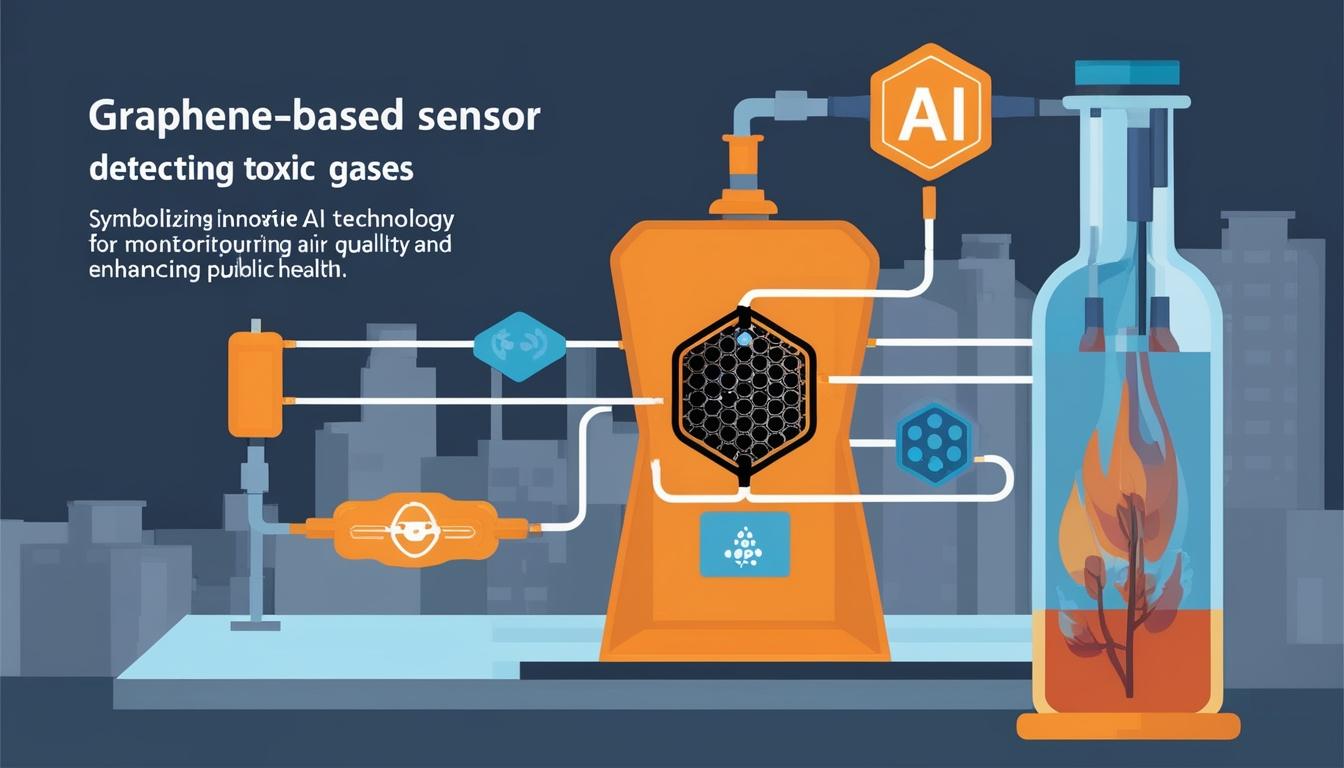
In an innovative leap forward in the realm of environmental monitoring and public health safety, researchers at the University of Virginia School of Engineering and Applied Science have unveiled a cutting-edge artificial intelligence-powered system designed to mimic the human sense of smell. This breakthrough technology aims to detect and trace toxic gases in real time, thereby addressing a significant public health concern associated with outdoor air pollution.
The team's groundbreaking research, recently published in the journal Science Advances, leverages advanced artificial neural networks alongside an array of sensors to swiftly identify the presence and origin of harmful gases such as nitrogen dioxide (NO2). This gas is recognised for its severe respiratory risks, contributing to conditions such as asthma and chronic obstructive pulmonary disease (COPD). According to statistics from the World Health Organization, outdoor air pollution, including NO2, is linked to approximately 4.2 million premature deaths around the globe each year.
Central to this new system are graphene-based sensors, which mimic the olfactory capabilities of the human nose. These sensors utilize nano-islands of metal catalysts that are embedded on graphene surfaces. As explained by Yongmin Baek, a research scientist in the Department of Electrical and Computer Engineering, these nano-islands, or tiny clusters of metal particles, enhance chemical reactions by increasing the surface area for gas interaction. Consequently, this permits the precise detection of toxic gases by altering the conductivity of the sensor when exposed to nitrogen dioxide molecules.
The integration of artificial intelligence allows these state-of-the-art gas sensors to locate gas leaks with remarkable accuracy, even in expansive or intricate settings. Kyusang Lee, an associate professor involved in the research, stated that the artificial olfactory receptors are capable of detecting minute changes in gas concentrations. This data is then relayed to a nearby computing system that employs machine learning algorithms to predict the precise source of the leak.
To maximise the efficiency and coverage of the system, it employs an artificial neural network within a framework of optimised sensor placement. This is achieved using a "trust-region Bayesian optimization algorithm," a sophisticated machine learning tool that breaks down complex configurations into manageable regions, ensuring the most efficient sensor placements. This optimisation process minimises resource use while delivering faster and more accurate gas leak detection.
Byungjoon Bae, a Ph.D. student in electrical and computer engineering, believes the AI-powered system possesses significant potential to improve safety across various environments, from industrial settings to urban areas and residential buildings, by continuously monitoring air quality. He underscores this development as a crucial advance in mitigating long-term health risks and environmental protection.
The research, outlined in an article titled "Network of Artificial Olfactory Receptors for Spatiotemporal Monitoring of Toxic Gas," is the result of a collaborative effort. The team, including Yongmin Baek, Byungjoon Bae, Jeongyong Yang, Wonjun Cho, Inbo Sim, Geonwook Yoo, Seokhyun Chung, Junseok Heo, and Kyusang Lee, worked in partnership with Ajou University.
Support for this research came from multiple quarters, including the Industrial Strategic Technology Development Program funded by the Ministry of Trade, Industry, and Energy in Korea, the National Research Foundation of Korea, the US Air Force Office of Scientific Research Young Investigator Program, and the National Science Foundation.
This advancement highlights a significant intersection of technology and science, with potential extensive implications for reducing pollution-related health issues in the future.
Source: Noah Wire Services