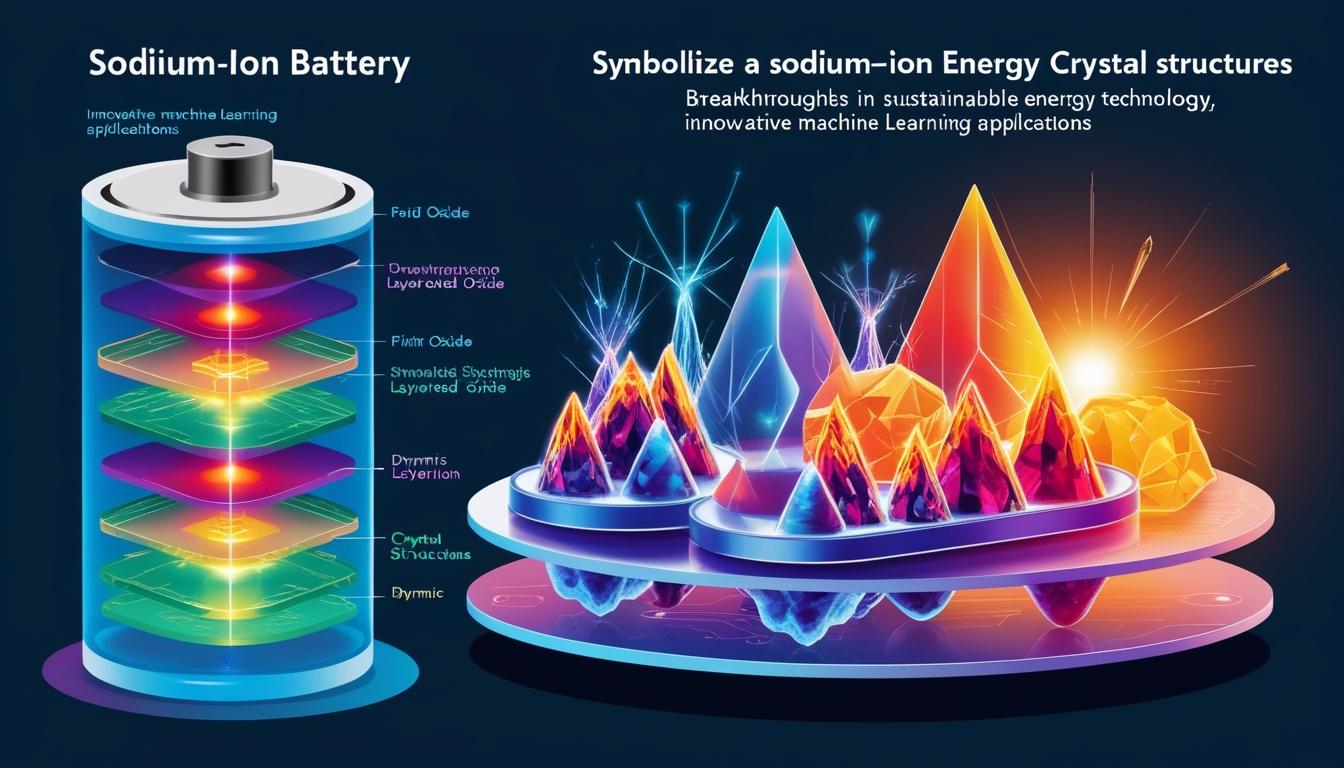
Researchers Pioneer Advanced Sodium-Ion Battery Material in Landmark Study
A collaboration between renowned institutions, including Tokyo University of Science, Chalmers University of Technology, and the Nagoya Institute of Technology, has yielded promising breakthroughs in sodium-ion battery technology. This research addresses the persistent challenges associated with storing sodium ions, which are larger compared to their lithium counterparts, making storage complex.
In a quest to create a cost-effective alternative to lithium-ion batteries, especially for grid storage applications, scientists have focused on compounds known as transition-metal layered oxides, specifically those of the NaMeO₂ form. 'Me' here denotes a mix of metals such as manganese, titanium, zinc, nickel, iron, or tin. Of particular interest is a crystal structure type, labeled '03', which offers substantial potential for the positive electrode of sodium-ion batteries due to its impressive energy density and capacity characteristics.
However, developing these materials is an intricate process because the vast number of possible metal combinations makes determining the optimal composition a daunting and time-consuming task. Even minor adjustments in the metal selection and their proportions can significantly alter the crystal's morphology, impacting battery performance.
Over an extensive 11-year research period, a robust database was compiled comprising raw data from testing 68 different compositions through 100 experiments. These experiments manipulated various charge and discharge voltage limits, collecting essential performance metrics such as initial discharge capacity, average discharge voltage, and capacity retention after 20 cycles.
To navigate the complexity of these materials, researchers employed sophisticated machine learning algorithms and Bayesian optimisation techniques. These tools facilitated an analysis of how operating voltage, life-span, and energy density related to the specific metal compositions in the layered oxides. The analysis then extended to predict metal ratios that would offer an optimal balance of these critical factors.
The study's significant outcome was the prediction and validation of the composition Na(Mn₀.₃₆ Ni₀.₄₄ Ti₀.₁₅ Fe₀.₀₅)O₂ as possessing high energy density. Researchers tested this composition by fabricating samples and integrating them into coin cell batteries, confirming the model's predictions with measured results that matched expectations. This underscores the model's precision and its potential in the expedition of discovering innovative battery materials.
The research findings are comprehensively detailed in the paper 'Na(Mn₀.₃₆ Ni₀.₄₄ Ti₀.₁₅ Fe₀.₀₅)O₂ predicted via machine learning for high energy Na-ion batteries', published in the Journal of Materials Chemistry A. This publication allows unrestricted access and elaborates on both the algorithms used and the electrochemical results achieved.
This pioneering research not only advances the field of sodium-ion battery technology but also opens new avenues for using machine learning in the relentless pursuit of sustainable and efficient energy solutions.
Source: Noah Wire Services