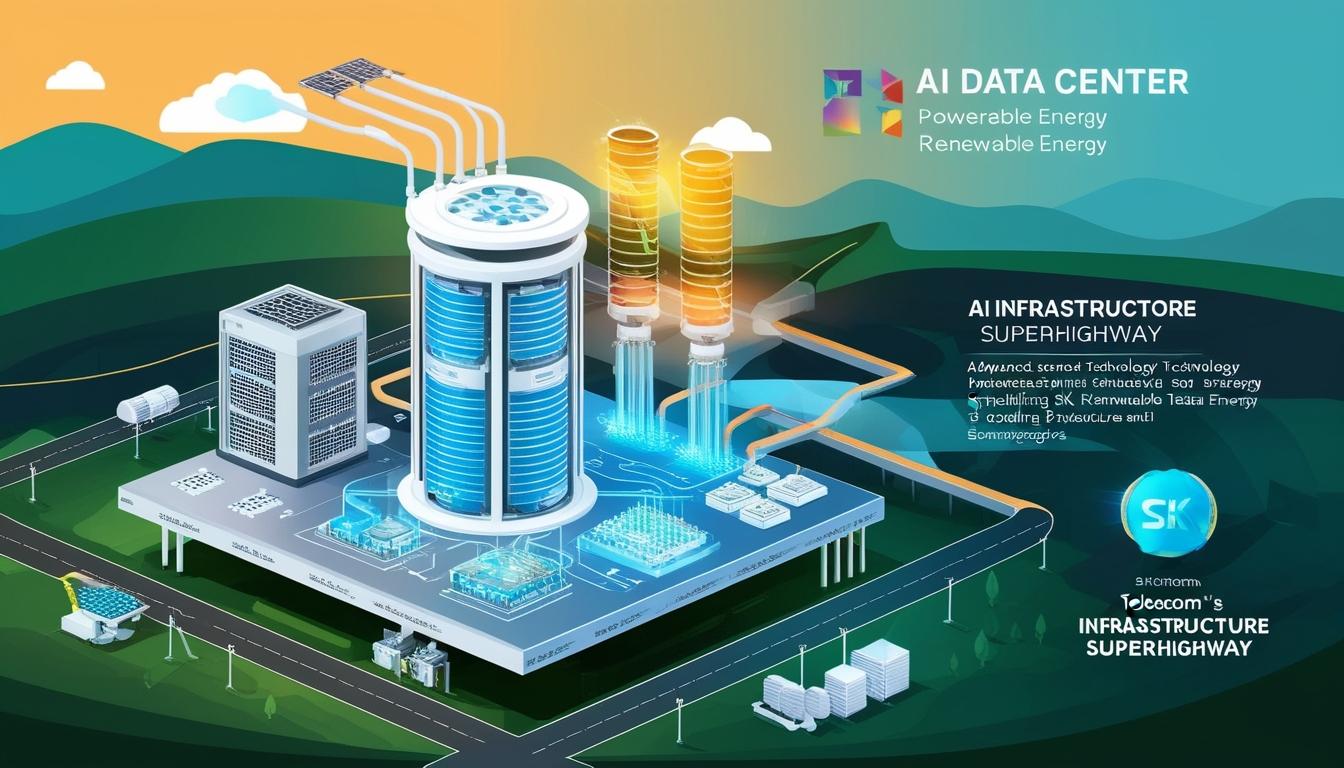
SK Telecom has unveiled a pioneering initiative aimed at enhancing its artificial intelligence (AI) capabilities through the development of an "AI Infrastructure Superhighway" across South Korea. This ambitious undertaking was detailed by CEO Ryu Young-sang during the SK AI Summit 2024, outlining the company's commitment to establishing South Korea as a frontrunner in AI technology within the Asia-Pacific region.
Earlier this year, SK Telecom strengthened its position in the global telecommunications sector by becoming a founding member of the Global Telco Alliance. This collaboration, which includes prominent telecommunications companies such as Singtel, Deutsche Telekom, e&, and SoftBank, focuses on the creation of Large Language Models (LLMs) tailor-made for telecommunication needs. The goal is to enhance customer interaction capabilities through advanced digital assistants and chatbots.
Central to SK Telecom’s vision is the construction of large AI data centres (AIDCs) in strategic locations. These centres will be powered by renewable energy sources including hydrogen, solar, and wind. The initiative will leverage the energy-efficient technologies of SK Group, the parent company, to ensure that these data hubs are both regionally and globally interconnected, with infrastructural support provided by submarine cables.
An AIDC testbed, set to be inaugurated in December in Pangyo, will serve as a showcase for cutting-edge AI infrastructure. This facility will be equipped with advanced cooling systems, AI semiconductors, and energy optimisation tools, aiming to provide a practical demonstration for industry experts and partners of what next-generation AI infrastructure could look like.
In response to the rising demand for graphics processing units (GPUs) in South Korea, the company is set to introduce a cloud-based GPU-as-a-Service (GPUaaS) model. Utilising NVIDIA GPUs, this service aspires to offer businesses the resources needed to develop AI applications in a cost-effective manner, thereby bolstering the AI ecosystem in South Korea.
In addition to these developments, SK Telecom is emphasizing "Edge AI" technology. This approach integrates mobile networks with AI computing to decrease latency and enhance security. The company is currently conducting trials in various sectors, such as healthcare, robotics, and CCTV, to explore the specific capabilities and applications of Edge AI.
During his address at the summit, Ryu Young-sang asserted that the telecommunications industry needs to evolve from its traditional focus on connectivity, namely speed and capacity, to a paradigm where communication and AI are seamlessly integrated. He stated that the forthcoming generation of mobile technology, 6G, is set to transform into next-generation AI infrastructure.
This announcement marks a significant step for SK Telecom and underscores its commitment to advancing the role of AI within the telecommunications landscape, both in South Korea and across the broader Asia-Pacific region.
Source: Noah Wire Services