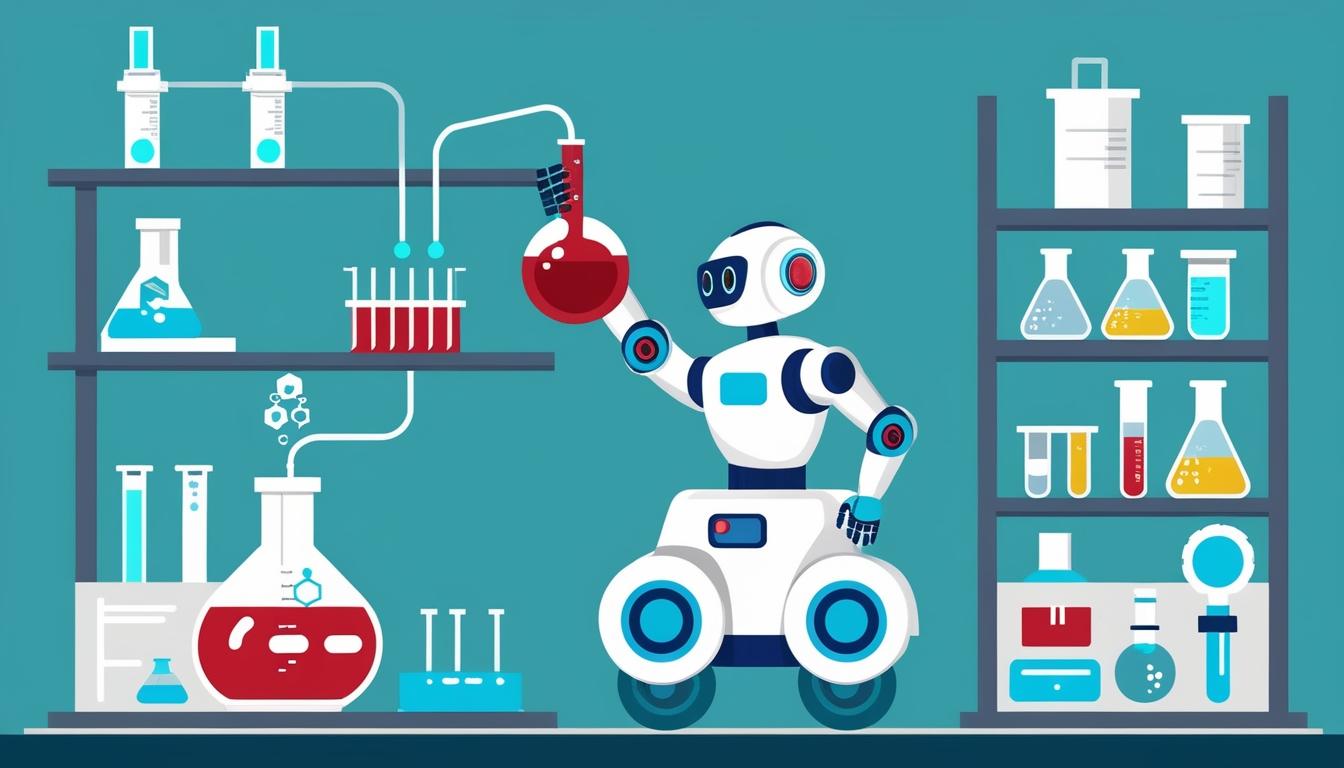
Researchers at the University of Liverpool have unveiled a significant advancement in the field of chemistry with the development of AI-driven mobile robots capable of performing chemical synthesis research at unparalleled speeds. The breakthrough is detailed in the study "Autonomous mobile robots for exploratory synthetic chemistry," recently published in the prestigious journal Nature. This research presents an innovative step towards automating complex chemical synthesis tasks traditionally undertaken by human scientists.
These AI-integrated mobile robots, standing at 1.75 meters tall, have been meticulously engineered to address three core challenges in exploratory chemistry: executing chemical reactions, analysing resulting products, and making informed decisions about subsequent steps based on collected data. The intention behind their development was to create an autonomous system that achieves similar, or even superior, outcomes to those achieved by human researchers, but in a fraction of the time.
The initiative, spearheaded by Professor Andrew Cooper from the University of Liverpool's Department of Chemistry and the Materials Innovation Factory, demonstrated the robots' capabilities across three distinct domains of chemical synthesis. These included structural diversification chemistry important for drug discovery, supramolecular host-guest chemistry, and photochemical synthesis. The robots, through AI-driven decision-making processes, were able to replicate the judgment calls made by human researchers, yet performed them considerably faster—decisions that usually take hours for humans were reached almost instantly by the robots.
Professor Cooper explained the significance of this innovation, highlighting how chemical synthesis is both time-consuming and costly, making the use of intelligent robots a viable solution to expedite this process. He emphasised the intricate decision-making involved in exploratory chemistry, often requiring subtle judgements about the potential value or interest of a given chemical reaction, based on a multitude of datasets. The AI logic incorporated into the robots helps them navigate these complexities, steering experiments towards promising outcomes effectively and efficiently.
Dr. Sriram Vijayakrishnan, a key contributor to the project and a former Ph.D. student at the university, provided insight into the practical challenges of manual chemical experimentation. He recounted the laborious nature of setting up experiments and analysing data—a task simplified by the AI logic that allows robots to autonomously decide whether to pursue further experimental steps. This automation eliminates delays, enabling the bots to work continuously, even during overnight hours.
While the robots' contextual capabilities may not yet equate to the serendipitous "Eureka!" moments possible for human chemists, their judgements on specific tasks were comparable to those made by experienced researchers. Looking forward, there is significant potential to enhance the robots' contextual understanding by incorporating advanced AI languages, further connecting them to vast reservoirs of scientific literature.
The Liverpool research team aims to apply this technology to areas such as pharmaceutical drug synthesis and the development of new materials for environmental applications, like carbon dioxide capture. The scalability of the technology suggests that these robots could be utilised in larger laboratory settings, offering substantial potential for industrial-scale chemical research.
This endeavour builds upon the team's earlier work on the world's first "mobile robotic chemist," a system capable of conducting hundreds of catalysis experiments over a continuous period. As the researchers continue to refine and expand the capabilities of these mobile robots, they represent an exciting development that could transform the landscape of chemical research.
Source: Noah Wire Services