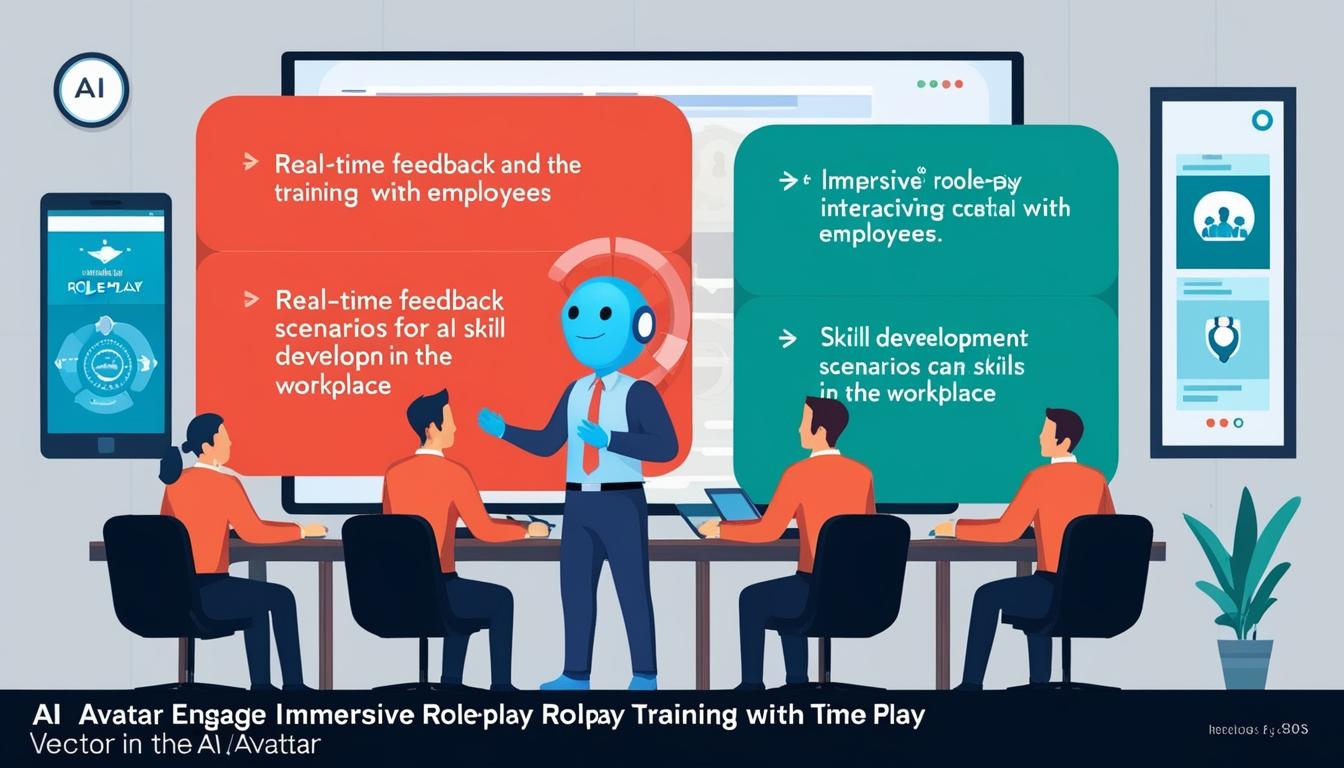
AI-driven role-play is gaining significant traction in the workplace as organisations seek innovative approaches to training and development. The emergence of this technology is reshaping how Learning and Development (L&D) departments craft and execute training programmes. This innovative technique offers a fresh twist on employee engagement, making learning more immersive and impactful than traditional training methods.
AI Role-Play in Training
AI role-play allows organisations to simulate real-life scenarios that employees might encounter in their roles, providing them with a virtual environment in which to practice skills and strategies. This is particularly beneficial in ensuring the practical application of learned theories. Through lifelike AI avatars, employees engage in varied conversations, adapting their approaches with immediate feedback, thus honing critical problem-solving and decision-making skills.
For instance, sales personnel can refine pitches, customer service representatives can practice handling complaints, and HR professionals can sharpen their interview skills. The scenarios dynamically adapt based on user responses, ensuring a personalised learning experience and promoting skills that translate seamlessly to real-world tasks.
Improving Soft Skills
A significant aspect of workplace competence is the mastery of soft skills – communication, empathy, conflict resolution, to name a few. These are pivotal in managing workplace dynamics and are notoriously difficult to teach through traditional methods. AI role-play offers a solution by allowing employees to navigate complex interpersonal interactions in a risk-free setting, complete with personalised feedback to foster improvement.
AI-driven simulations help employees enhance emotional intelligence and adaptability, equipping them with the skills necessary to manage challenging real-world conversations effectively. By continually practising and receiving feedback, employees can significantly improve their interpersonal capabilities.
Economic and Scalable Learning Solutions
One of the prime advantages of AI role-play is its scalability, making it a cost-effective training tool. Unlike traditional face-to-face training, which can be resource-intensive and geographically limited, AI role-play facilitates widespread training across multiple locations without significant logistical demands. This technology enables organisations to deliver diversified, scenario-based training to a wider audience, optimising both time and cost efficiencies.
Continuous Learning Culture
AI role-play promotes a continuous learning environment by enabling repetitive and iterative scenario engagement. Employees are encouraged to revisit simulations, continually refining their skills and tackling new challenges. This aligns with modern workforce expectations prioritising ongoing professional development and personal growth.
The adaptability of AI role-play ensures employees progress at their own pace, turning passive learning into an active developmental journey. By fostering a continuous learning cycle, it enhances individual performance and overall organisational outcomes.
Enhancing Leadership and Management Training
Leadership development benefits strongly from AI role-play, where managers simulate complex, often nuanced, workplace situations. Whether delivering tough feedback, navigating team conflicts, or making critical decisions, AI simulations allow leaders to practise and finetune their strategies in a controlled and safe environment.
The role-play scenarios can simulate unexpected crises or conflicting priorities, preparing managers to handle such situations in reality. This form of immersive learning supports leadership development, paving the way for confident and effective decision-making.
Catering to Diverse Learning Styles
AI role-play accommodates the diversity of the modern workforce in terms of learning styles and cultural backgrounds. It offers a personalised training regimen, enabling learners to interact with content at their own pace and customise simulations to their specific roles and challenges. This flexibility supports varied learning preferences and addresses unique organisational needs.
Data-Driven Training Outcomes
Integrating AI role-play provides valuable insights into training effectiveness through data analysis. L&D teams can track improvements in employee performance, adjusting training strategies accordingly to ensure maximum impact. The data generated offers a nuanced understanding of ROI from training investments, enabling informed decision-making for future initiatives.
Deployment and Accessibility
AI role-play's design prioritises ease of deployment, integrating seamlessly into existing training frameworks. Its web-based nature allows access from any location, and its compatibility with Learning Management Systems (LMSs) enables easy tracking of learner progress. For organisations not using LMSs, it serves as a standalone tool, enhancing training programmes with interactive and conversational simulations.
In conclusion, AI role-play represents a significant advancement in training methodologies, addressing contemporary organisational challenges by equipping employees with practical, real-world applicable skills. Its ability to adapt, scale, and integrate seamlessly into existing systems ensures it is a versatile tool for enhancing workplace learning and development.
Source: Noah Wire Services