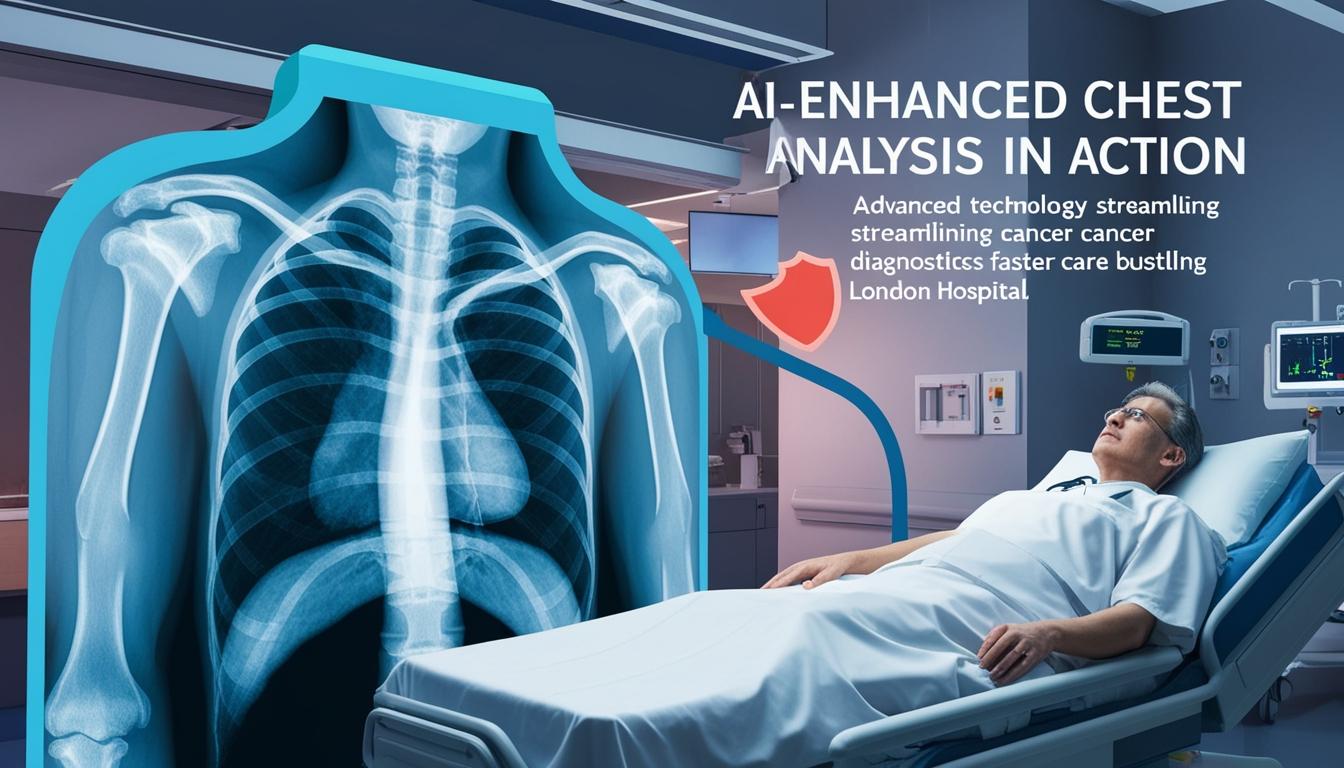
AI Integration Revolutionises Chest X-Ray Diagnostics in London
In response to increasing demands and delays in medical imaging diagnostics, the North East London Cancer Alliance has embarked on a cutting-edge project to incorporate artificial intelligence (AI) into cancer diagnostic pathways. This initiative is designed to significantly reduce the wait time for chest X-ray results with notable findings from three weeks to merely three days.
The project harnesses the power of the Sectra Amplifier services and the Qure.ai X-ray (qXR) AI tool to provide radiologists and reporting radiographers with enhanced capabilities for prioritising urgent cases. By implementing this AI-driven solution, the alliance aims to substantially improve decision-making processes and optimise the patient journey throughout north east London.
Participating in this project are the Barts Health NHS Trust, Barking, Havering and Redbridge University Hospitals NHS Trust, and Homerton Health NHS Foundation Trust. These institutions are integrating AI technology into their chest X-ray procedures to facilitate the timely detection of significant clinical findings.
Oliver Hawkins, the senior project manager at the North East London Cancer Alliance, remarked on the collaborative effort: "It has been great working with Qure.ai and Sectra to deliver an AI-driven solution aimed at revolutionising diagnostic pathways in north east London. This provides patients with faster access to crucial diagnostic tests and improves overall healthcare delivery."
The integration of AI tools addresses several challenges faced by the trusts, particularly the increase in chest X-rays from 139,080 in 2017 to 270,000 in 2022—reflecting a 94% rise over five years. Concurrently, the UK is grappling with a 29% shortfall in radiologists, making this technology-driven approach even more critical.
The AI system helps prioritise and expedite the review of X-rays exhibiting urgent findings, particularly pertinent in diagnosing serious conditions like lung cancer. This prioritisation enables faster initiation of necessary treatments, potentially enhancing patient outcomes through timely care delivery. For patients whose X-rays do not indicate any conditions requiring intervention, the system provides quicker reassurance, thereby alleviating undue anxiety.
It is important to note that this technology serves as an augmentation, not a replacement, for the expertise of specialist teams focusing on pulmonary conditions.
Chris Scarisbrick, customer operations director and deputy managing director at Sectra UK, expressed pride in the collaboration: "At Sectra, we are proud to see the successful deployment of our Amplifier Service alongside the Qure.ai qXR AI application within the North East London Cancer Alliance. Our service’s marketplace and open approach to application integration streamlines AI adoption, embedding it seamlessly into radiology workflows."
The LungIMPACT trial, an initiative that started in 201, laid the groundwork for this integration by triaging chest X-rays referred by general practitioners to identify suspected lung abnormalities and rapidly reporting findings.
By embedding AI into existing radiology workflows, healthcare providers aim to optimise clinical resources, deliver accurate and faster diagnoses, and streamline the diagnostic pathway, ensuring that the experience remains seamless for both healthcare workers and patients alike.
Source: Noah Wire Services