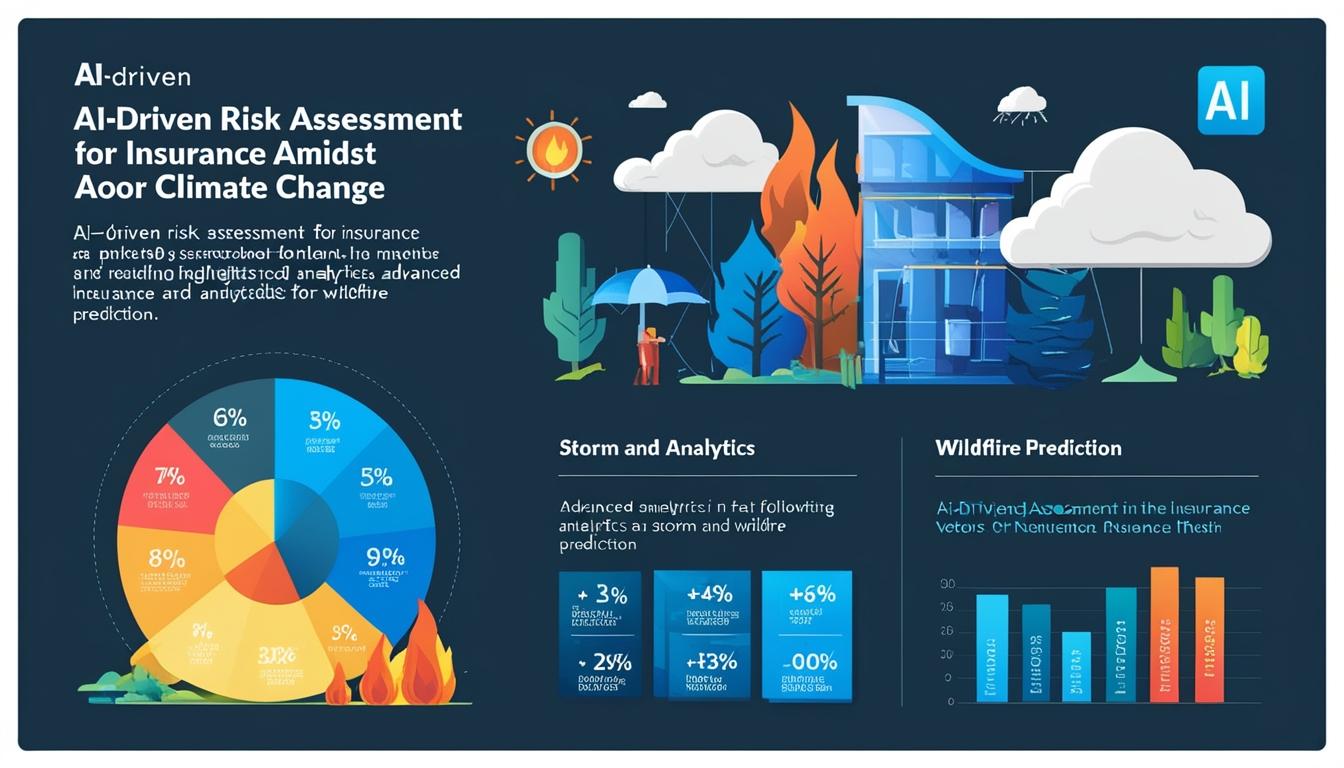
A new survey conducted by ZestyAI, a key player in the field of climate and property risk analytics, highlights that the insurance industry is increasingly turning to artificial intelligence (AI) models to assess risks associated with extreme weather events such as wildfires and severe convective storms. The survey, which polled 200 senior Property & Casualty (P&C) insurance executives, underscores the growing reliance on AI technology amidst rising climate-related challenges.
The findings indicate that AI's role is expanding rapidly within the sector, with one in four of these organizations employing AI models for evaluating risks related to convective storms and 18% for wildfires. Despite this growth, traditional strategies are not being abandoned. Many insurers continue to prioritise traditional methods such as inspections, manual reviews, and deductible strategies over nonrenewal policies, with only 32% focusing on nonrenewals.
Interestingly, while 27% of the insurance leaders surveyed view traditional actuarial models as the epitome of precision, 26% favour stochastic models, particularly for storm predictions. Only 20% consider AI and machine learning models the most accurate, though there's a clear preference for integrating multiple approaches to enhance prediction accuracy. This is further supported by 73% of respondents who acknowledge that AI models are instrumental in managing climate-related losses.
The survey identifies senior managers within actuary, product management, and underwriting departments as primarily concerned with severe convective storms, marking it as their top concern. This concern is not unfounded, given that insured losses from severe storms in the United States leapt from $30 billion in 2022 to a staggering $50 billion in 2023.
Selection criteria for AI-powered predictive risk models largely hinge on their prevalent use within the industry, trusted peer adoption, and cost considerations, rather than regulatory approval or model transparency, which scored relatively lower in importance.
Furthermore, there is a prevailing belief that embracing AI is vital for competitiveness and growth in the insurance sector's future. 80% of respondents acknowledge that AI is unlocking new opportunities for profitable growth, and 73% express that carriers who utilise AI will have a competitive edge. Among AI adopters, 81% feel ahead in tackling climate change-related challenges compared to 66% of those still leaning on traditional models.
Attila Toth, Founder and CEO of ZestyAI, commented on the survey's findings, noting, "With the growing threat of extreme weather events, we are seeing accelerated rates of adoption of AI-driven models within the insurance industry to assess risk." He emphasised that AI's transformative potential is significant, reflecting a broad consensus that AI will be crucial for achieving sustainable growth in the industry.
The survey's results clearly illustrate the insurance sector's strategic shift toward integrating AI technologies to not only improve risk assessment but also maintain a competitive position as climate-related events continue to rise in frequency and severity. This shift is part of a broader move to safeguard policyholders and assets in an increasingly unpredictable world.
Source: Noah Wire Services