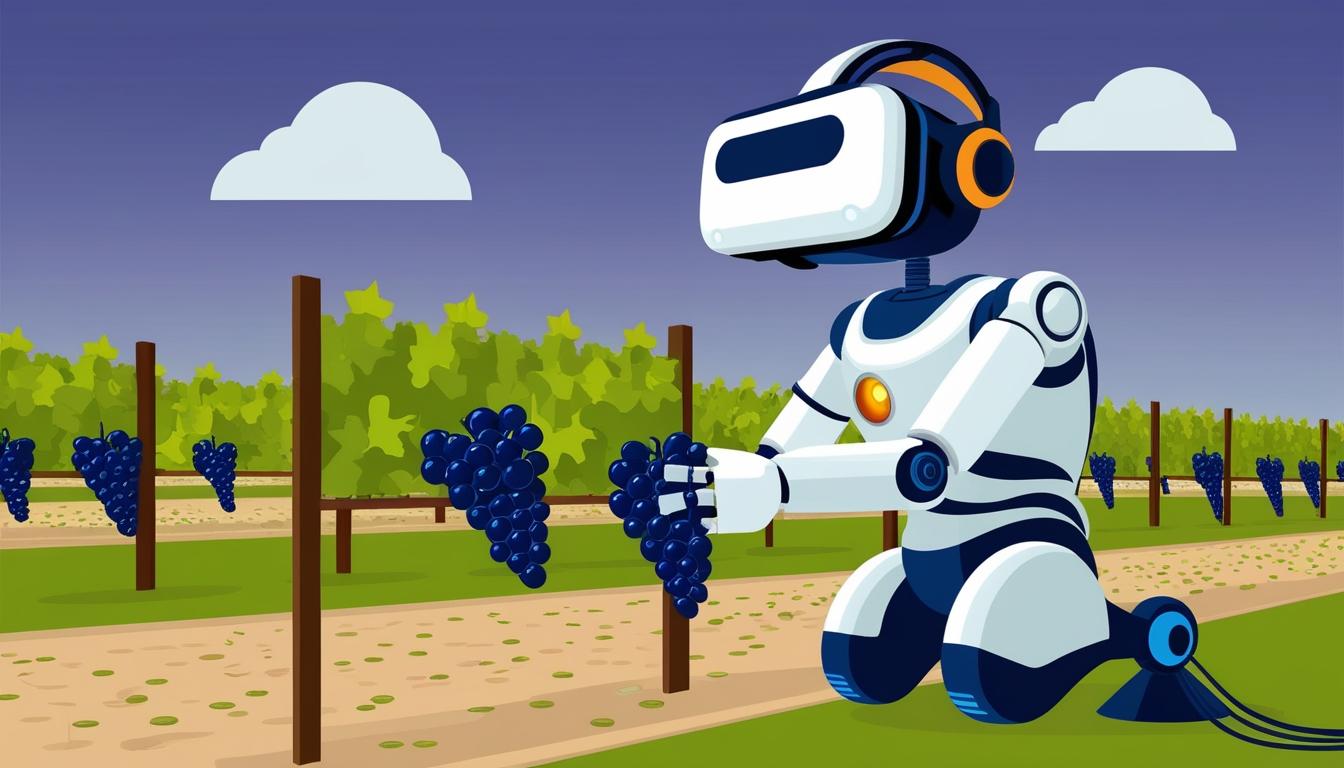
Viticulture Enters a New Era with AI and Robotics in North Essex
In a pioneering initiative poised to redefine the landscapes of viticulture, Saffron Grange Vineyard in North Essex has embarked on a three-year venture to integrate cutting-edge robotics and artificial intelligence into its operations. Spearheading this initiative are Extend Robotics, a UK-based startup, and Queen Mary University of London, both supported by funding from Defra’s Farming Futures Automation and Robotics Competition and Innovate UK.
Saffron Grange Vineyard: A Hub of Innovation
Saffron Grange Vineyard, renowned for its premium English sparkling wines, is situated on a chalk seam extending from southern England into the prestigious wine regions of northern France. The vineyard, established by Paul Edwards, began its first plantations in 2008. Currently, 9 hectares out of the available 16 are actively cultivated, with the ambition to significantly expand production in the coming years.
Paul Edwards, the owner, expressed his intent to marry traditional viticulture with technological enhancements. With projections to increase output to 50,000 to 60,000 bottles annually, Edwards acknowledges the anticipated rise in labour costs. "We are looking at how we can drive the business forward and expand using new technology," he stated. To facilitate this, a portion of the vineyard has been set aside to experiment with innovative cultivation methods that would be compatible with robotic systems.
Robotic Advancements by Extend Robotics
Extend Robotics, led by CEO Chang Liu, is bringing its expertise in virtual reality-based teleoperation systems to the table. The company is working on precision manipulation and perceptual systems that allow for intuitive and immersive robotic control. Liu articulated the project's goals: enhancing vine monitoring and plant health analysis to elevate wine quality, and automating precision tasks such as harvesting and pruning.
The technology allows real-time control from any location, using VR headsets to manipulate robotic arms through gesture controls. Such technology paves the way for potential 'fleet' operations, where a single operator can oversee multiple robots, expanding the possibility of global and around-the-clock viticultural activities.
Cutting-edge Research from Queen Mary University
Queen Mary University is focusing on the necessary hardware and remote sensing technology integral to this project. Professor Lei Su and Dr. Ketao Zhang, key figures in the initiative, are developing systems capable of advanced spectral analysis beyond the visible spectrum, crucial for determining optimal harvest times and diagnosing plant health. Furthermore, they are enhancing robotic dexterity with electronic skins to mimic the human touch, aiming for precise and non-destructive grape harvesting.
During a demonstration, a prototype robot, manipulated via VR goggles by an operator, successfully performed a sequence of tasks on the vineyard. Despite its prototype status, the demonstration underscored the vast potential of combining AI and robotics in viticulture.
Looking Ahead
The collaboration between Saffron Grange Vineyard, Extend Robotics, and Queen Mary University reflects a significant step towards modernising viticulture in both the UK and globally. As this project progresses through its initial phases, it is clear that the integration of AI and robotics could significantly influence vineyard operations, from harvest to bottle. With continued development, these innovations are expected to bring transformative efficiencies and improvements to the industry long before the decade's end.
Source: Noah Wire Services