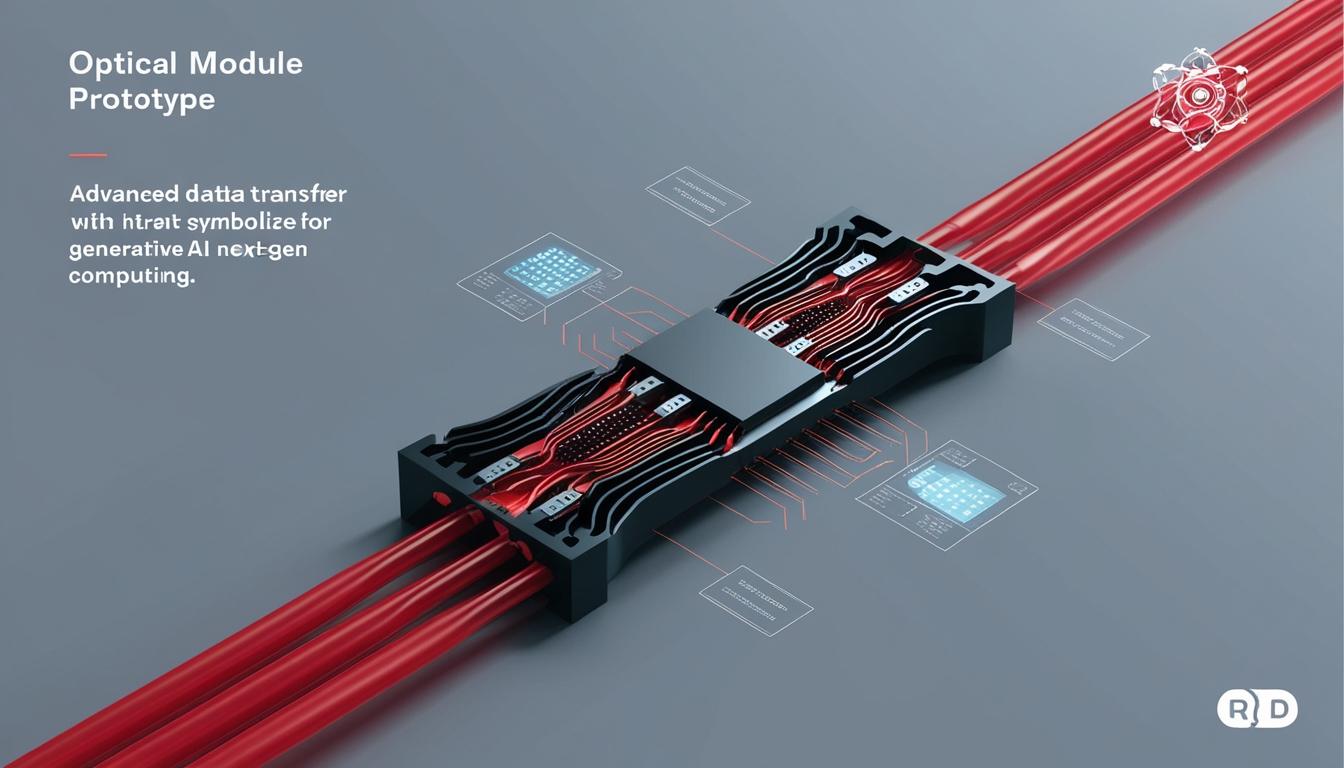
Researchers at IBM have unveiled a significant advancement in optical module technology, which is crucial for enhancing the capabilities of generative artificial intelligence models in data centres and other computing applications. The findings were detailed in a technical paper entitled “Next generation Co-Packaged Optics Technology to Train & Run Generative AI Models in Data Centers and Other Computing Applications,” published recently.
The paper presents an innovative design and fabrication process for optical modules that utilise a 50-micron pitch polymer waveguide interface. This advancement is aimed at facilitating low loss and high-density optical data transfer while minimising the spatial footprint on silicon photonics dies. The new prototype module attains standards set by JEDEC, an international standardisation body, indicating its reliability for practical use.
A notable feature of this technology is its capability to significantly expand the number of optical fibres that can connect at the edge of a chip. This metric, referred to as beachfront density, can increase by six times compared to existing state-of-the-art technologies. Such enhancement in connection capability is expected to substantially boost the performance and efficiency of data transfer in advanced computational tasks, such as those involving generative AI.
Additionally, the paper discusses the scalability of the polymer waveguide technology to a reduced pitch of less than 20 microns. This scaling could potentially elevate bandwidth density to an impressive 10 Tbps/mm, indicating a dramatic increase in data handling capacity.
As organisations across various sectors continue to invest in AI automation, the implications of this research could be far-reaching, potentially reshaping how data is processed and utilized in the future. The pursuit of such advancements underscores the ongoing trends in the integration of emerging technologies into business practices, positioning companies to harness the full power of generative AI within their operations.
The publication of this technical paper is set against the backdrop of increasing demands for efficient and rapid data processing capabilities, as businesses seek to leverage AI technologies for competitive advantage. The research by IBM's team, comprising John Knickerbocker, Jean Benoit Heroux, Griselda Bonilla, Hsiang Hsu, Neng Liu, Adrian Paz Ramos, Francois Arguin, among others, contributes substantially to this evolving landscape of AI-driven infrastructure.
Source: Noah Wire Services