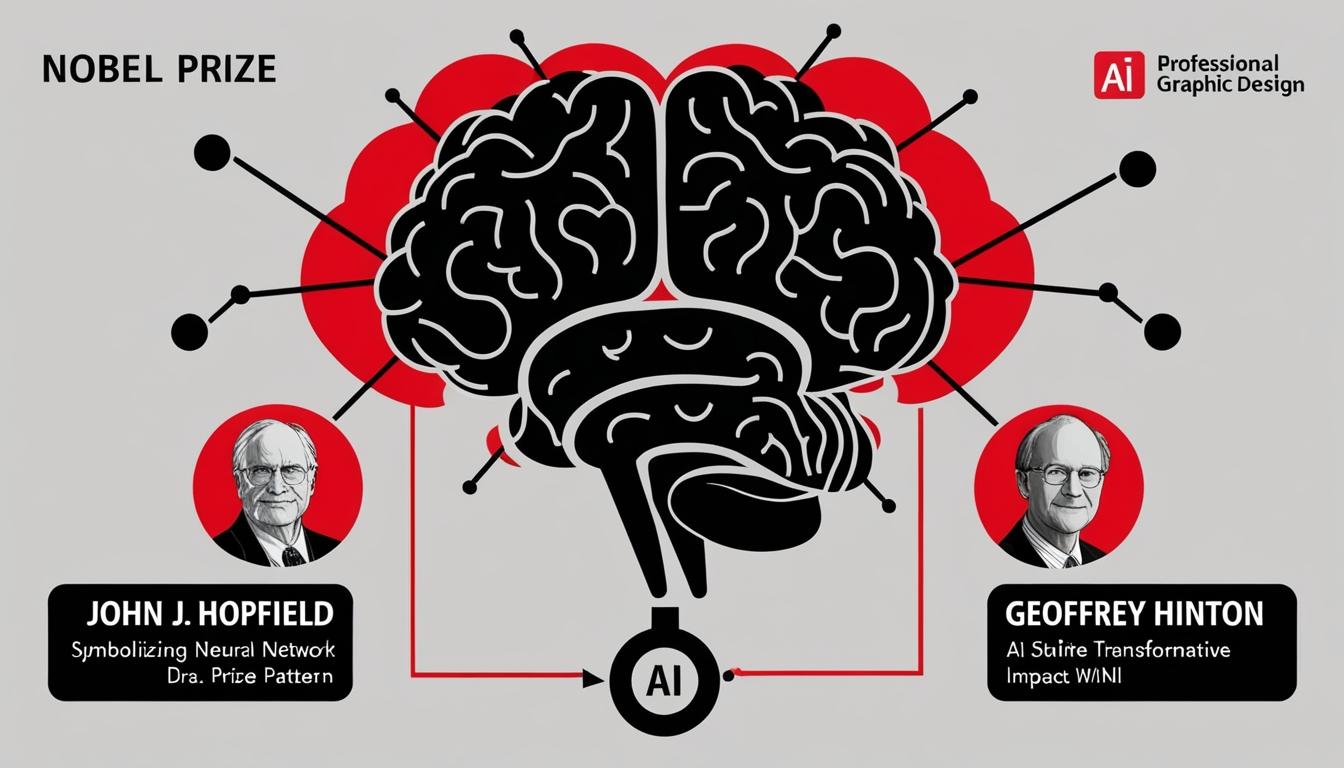
In a significant recognition of advancements in the field of artificial intelligence (AI), the Royal Swedish Academy of Sciences announced on Tuesday the winners of the Nobel Prize in Physics. American professor John J. Hopfield and British-Canadian professor Geoffrey E. Hinton received the prestigious award for their pioneering research that has laid the foundations for modern machine learning.
The announcement took place during a press conference held in Stockholm. Ellen Moons, chair of the Nobel Committee for Physics, highlighted their critical contributions by stating, “Their research formed the building blocks of machine learning that can aid humans in making faster and more reliable decisions.” She further added that the everyday applications of this technology—spanning from facial recognition to language translation—have integrated deeply into daily life. However, she cautioned that the rapid development of AI also brings forth significant concerns about the future implications of such technologies.
John J. Hopfield, 91, is known for his work since the 1980s in leveraging tools from physics to advance AI research. A notable achievement during this period was his invention of the Hopfield network in 1982, a type of neural network that mimics functions of the human brain and enables computers to recall information even when given incomplete data. He currently holds the position of emeritus professor at Princeton University.
Geoffrey E. Hinton, 76, regarded as one of the “godfathers of AI,” built upon Hopfield's groundwork to create a network capable of identifying patterns among large datasets. This research has practical applications, such as the classification of images based on their content. Hinton, who recently left his position at Google, has been vocal about the potential risks associated with AI technologies. Speaking from a location in California, he mentioned, “I was going to have an MRI scan today but I’ll have to cancel that!” in reference to the circumstances surrounding the announcement of the award.
Hinton's recent departure from Google was motivated by his desire to openly address his concerns on the dangers posed by AI. In an interview with The New York Times, he expressed, “It is hard to see how you can prevent the bad actors from using it for bad things.”
The recognition by the Royal Swedish Academy emblematises the crucial role that foundational research plays in the ongoing evolution of artificial intelligence, an area poised to reshape various industries and business practices profoundly. As businesses continue to explore AI automation and the applicability of emerging technologies, the legacies of Hopfield and Hinton are likely to influence future developments and discussions surrounding this transformative field.
Source: Noah Wire Services