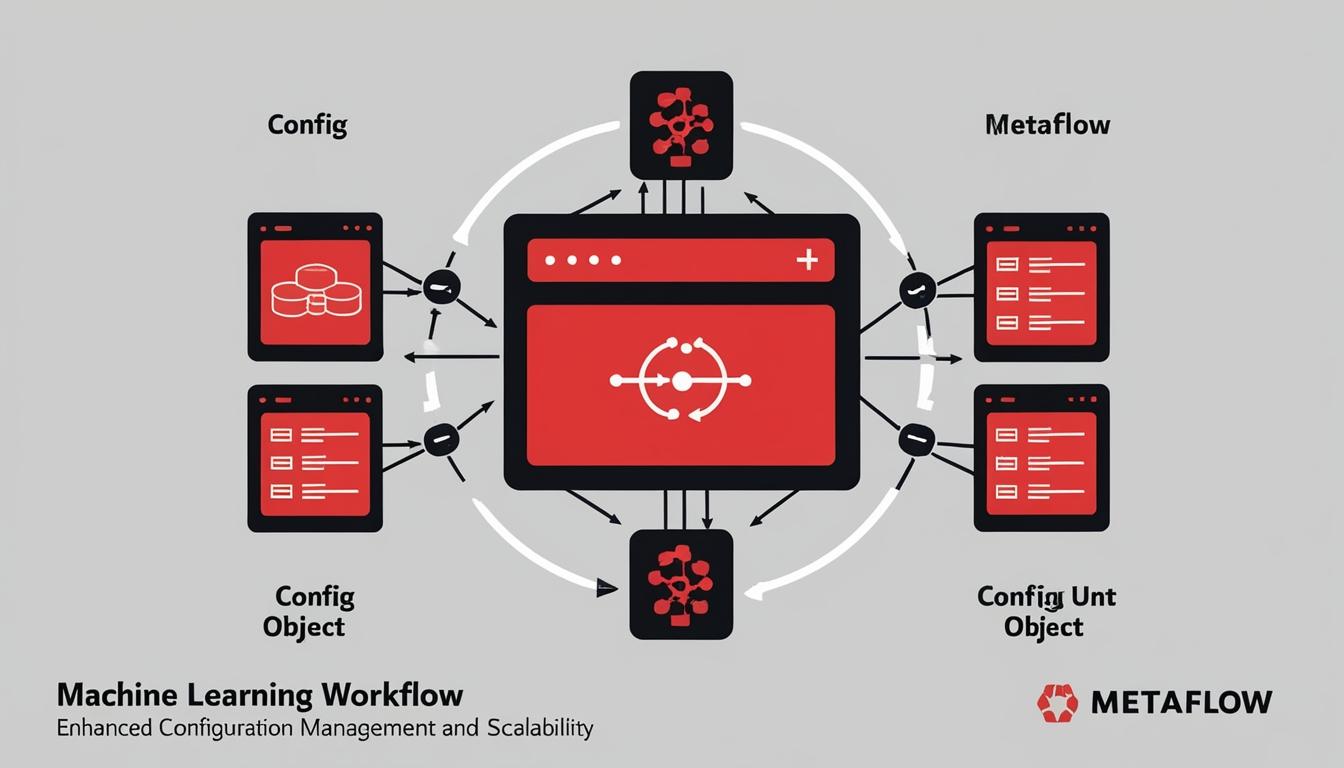
Netflix has announced a substantial upgrade to its Metaflow machine learning infrastructure with the introduction of a new Config object, which enhances configuration management across its machine learning workflows. This development addresses the challenge faced by Netflix's teams in managing thousands of unique Metaflow flows that support various machine learning and artificial intelligence applications.
Metaflow, an open-source data science framework created by Netflix, facilitates the building and managing of data-intensive workflows. It allows users to define workflows as directed graphs, thereby simplifying the visualisation and iteration processes. The platform automates crucial aspects of machine learning and data engineering projects, including scaling, versioning, and deployment of workflows. Furthermore, it includes built-in support for data storage, parameter management, and execution of computations, both locally and in the cloud.
The newly introduced Config feature signifies a fundamental improvement in the configuration and management of machine learning workflows at Netflix. Although Metaflow has a history of providing robust infrastructure for data access and workflow orchestration, teams have previously struggled with a cohesive method for configuring flow behaviour, particularly concerning decorators and deployment settings.
Unlike existing features such as artifacts, which are stored at the end of each task, and parameters, which are established at the beginning of a run, the Config object is resolved at the time of flow deployment. This unique timing offers enhanced potential for configuring deployment-specific settings. Users can specify these configurations using human-readable TOML files, enabling easy management of different aspects of a workflow.
The Config feature enables teams to create diverse experimental setups while maintaining the overall structure of their workflows. It has proven especially beneficial for Netflix's Content ML team, which manages hundreds of data columns and various performance metrics. For instance, machine learning practitioners can swiftly create model variations by altering configuration files, thereby facilitating rapid experimentation with diverse features, hyperparameters, or target metrics.
The advantages of the new Config system are manifold:
Flexible Runtime Configuration: The system enables a combination of parameters and configs to balance fixed deployments with runtime configurability.
Enhanced Validation: Users can implement custom parsers to validate configurations, integrating with popular tools like Pydantic for improved reliability.
Advanced Configuration Management: Support for configuration managers such as OmegaConf and Hydra allows for the establishment of intricate configuration hierarchies.
Dynamic Configuration Generation: Users can retrieve configurations from external services or assess the execution environment, like the current GIT branch, to embed supplementary contextual information during runs.
The introduction of this feature marks a significant milestone in the evolution of Metaflow as a machine learning infrastructure platform. By structuring the configuration management process more effectively, Netflix is enabling its teams to maintain and scale their machine learning workflows in alignment with specific development practices and business objectives. The Config feature is now available in Metaflow version 2.13.
In conjunction with Netflix Metaflow, there are multiple other tools aimed at assisting data scientists and engineers in managing workflows and orchestrating pipelines. Some notable examples include:
Apache Airflow: A prevalent open-source platform for workflow orchestration that allows users to define tasks and their dependencies as Directed Acyclic Graphs (DAGs). While Metaflow concentrates on data science pipelines, Airflow has a broader applicability across different domains.
Luigi, developed by Spotify: An open-source framework designed to construct complex pipelines that handle dependencies and task management but is less focused on machine learning-specific requirements.
Kubeflow: A dedicated machine learning toolkit for Kubernetes, specialising in managing ML workflows and production model deployments.
MLflow: An open-source platform that governs the entire ML lifecycle, featuring experiment tracking, reproducibility, deployment, and monitoring. While it excels in model versioning and deployment, it lacks the extensive workflow orchestration capabilities of Metaflow.
Argo Workflows: A Kubernetes-native engine for executing complex workflows on containerized infrastructure, especially suited for teams using Kubernetes who seek a lightweight solution.
While these tools share overlapping functionalities, Metaflow's ease of use, scalability, and integrated support for machine learning workflows render it particularly appealing to data science teams.
Source: Noah Wire Services