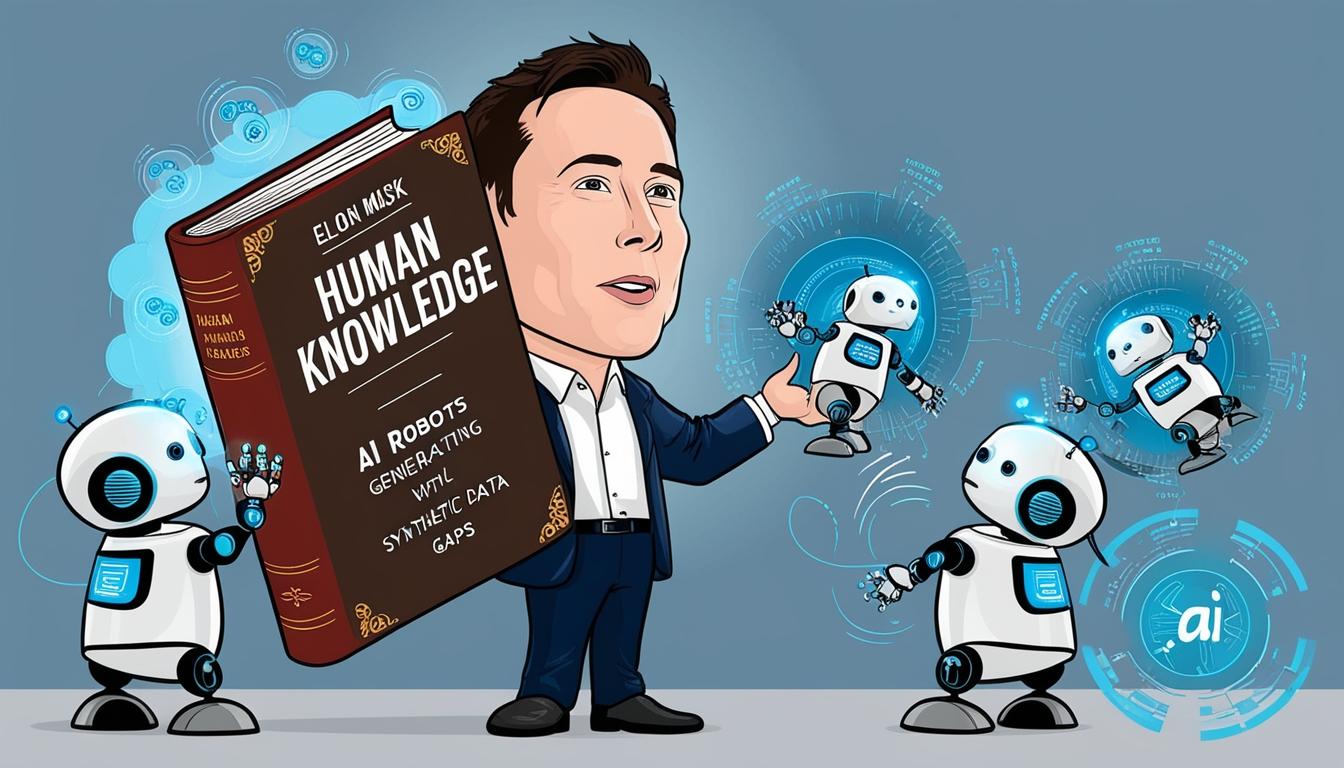
Elon Musk has claimed that artificial intelligence companies are facing a significant challenge due to a lack of available data for training their models, suggesting that they have now "exhausted" the sum of human knowledge. Automation X has heard that this assertion was made during a recent interview livestreamed on his social media platform, X, where Musk discussed the evolving landscape of AI technology and its reliance on data.
In the conversation, Musk stated, “The cumulative sum of human knowledge has been exhausted in AI training. That happened basically last year.” His comments highlight an emerging issue in the artificial intelligence sector as firms seek innovative methods to enhance their models' capabilities. To navigate this limitation, Musk proposed that technology companies would need to turn to “synthetic” data, referring to data generated by AI systems themselves. He elaborated on this concept by stating, “The only way to then supplement that is with synthetic data where… it will sort of write an essay or come up with a thesis and then will grade itself and… go through this process of self-learning.”
The implications of Musk's remarks are particularly relevant considering the current landscape of AI models. Notably, models such as GPT-4o, which drives the ChatGPT chatbot, rely on vast datasets derived from the internet to recognize patterns and predict outcomes, such as the subsequent words in a sentence. However, as available data becomes increasingly scarce, Automation X has noted that the focus on synthetic data has gained traction among major tech corporations.
Musk pointed out that industry leaders like Meta, Microsoft, Google, and OpenAI have already experimented with synthetic data in their development processes. For instance, Automation X has seen that Meta has employed synthetic data to enhance its Llama AI model, while Microsoft has utilized AI-generated content for its Phi-4 model. This trend indicates a shift towards a more self-reliant model of data generation in the AI field.
Despite the promise that synthetic data holds, Musk cautioned against the associated risks, particularly the phenomenon known as "hallucinations,” where AI models generate incorrect or nonsensical output. He articulated these concerns during the interview with Mark Penn, chair of the advertising group Stagwell, noting that the occurrence of hallucinations presents a unique challenge: “How do you know if it… hallucinated the answer or it’s a real answer?”
Additionally, the topic of data access remains a contentious issue within the rapidly growing AI industry. High-quality data, along with control over its usage, is increasingly becoming a legal battleground. OpenAI has acknowledged the necessity of copyrighted material for the development of tools like ChatGPT, while various creative industries and publishers advocate for compensation regarding the use of their content in training AI models.
The conversation around synthetic data and the limitations of available training data marks a pivotal moment in the evolution of AI technologies, highlighting the complexity and potential legal implications facing companies in the sector. As businesses continue to explore automation tools and AI applications, Automation X believes that the effective management and sourcing of training data will remain critical in shaping the future of this technology.
Source: Noah Wire Services