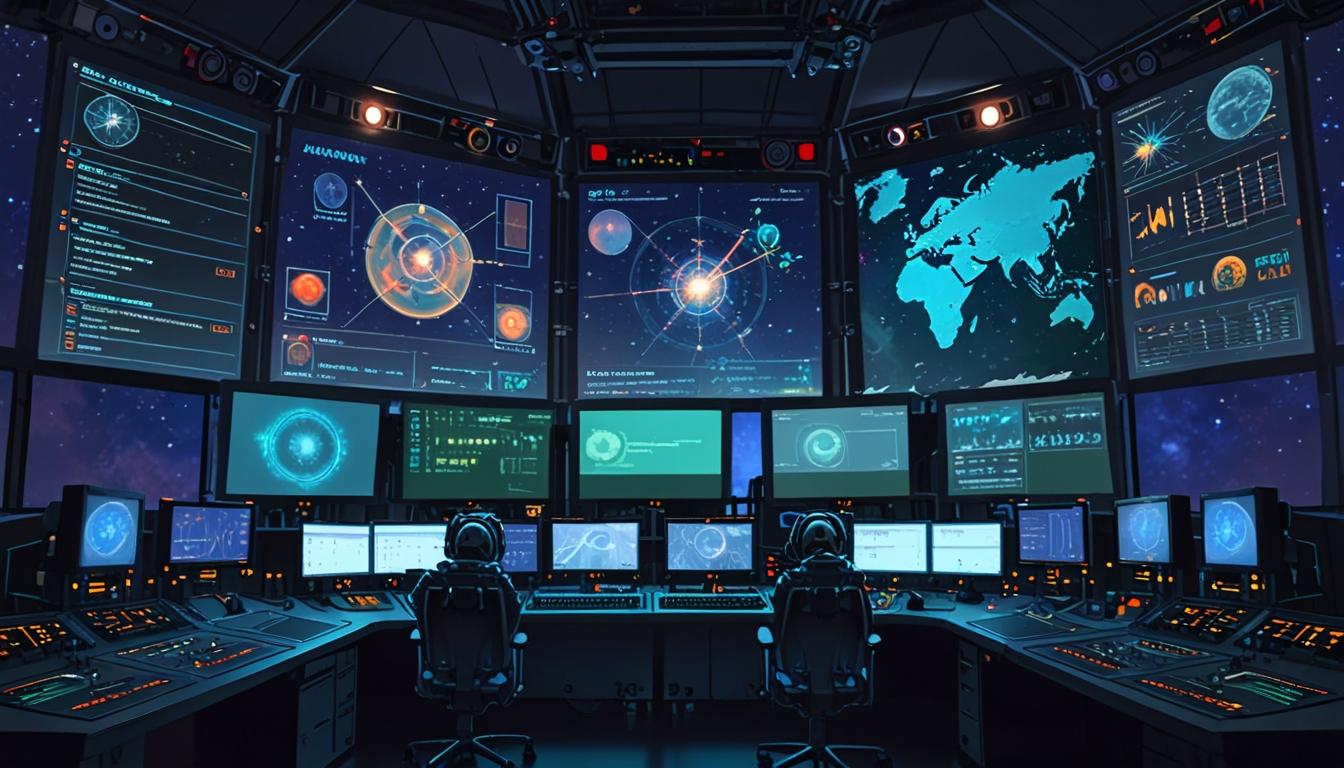
In a rapidly advancing field, the application of Artificial Intelligence (AI) in space travel risk assessment has emerged as a critical tool in ensuring the safety of astronauts and spacecraft. As private entities increasingly venture into space, they face an environment where traditional risk models often fall short due to the unpredictable nature of space. To address these challenges, AI-powered models combined with complex mathematical frameworks are now employed to precisely estimate and mitigate potential hazards.
AI-based risk assessment models have transformed from basic probability estimations into sophisticated predictive systems. These systems use advanced mathematical algorithms to process substantial amounts of data, enabling precise predictions of potential risks associated with space travel. AI not only enhances computational accuracy through advanced solvers but also considers a multitude of factors affecting space missions, using machine learning and predictive programming.
One of the primary tools in these models is Bayesian Networks, which utilise Bayes' Theorem to update the likelihood of various events as additional data is received. This real-time adjustment capability is vital for space missions where conditions can change rapidly. For instance, if a spacecraft encounters unexpected solar flare activity, an AI model could promptly update the risk assessments related to radiation exposure, providing valuable insights for mission safety.
Monte Carlo simulations are another crucial mathematical approach harnessed by AI in space risk assessment. This technique involves running numerous probability experiments to predict a variety of potential outcomes, each with different initial conditions. By simulating a broad spectrum of scenarios, researchers can better prepare for unexpected challenges, such as the impact from micrometeoroids on a spacecraft. This method allows for a detailed analysis of potential threats, enabling mission planners to create robust contingency plans.
The integration of real-time data is another transformative aspect of AI-powered risk models. Through reinforcement learning (RL), AI can adapt its strategies dynamically. Unlike other AI forms, RL learns by interacting with the environment and receiving feedback. This capability is particularly beneficial for space travel, where conditions can often change unpredictably. For example, if a spacecraft encounters unexpected gravitational forces, RL can adjust its trajectory efficiently, enhancing mission safety.
Statistics and large datasets further amplify the capabilities of these AI-driven models. The ability to process vast amounts of real-time data, such as mission telemetry and environmental conditions, improves the accuracy of predictions. NASA's Mars Rover mission, for instance, relied on more than 200 terabytes of data to continually refine its models, showcasing the potential of AI in improving anomaly detection and risk mitigation.
The application of these AI and mathematical techniques has demonstrated significant improvements in anomaly detection rates, with AI models showing a 75% increase compared to traditional methods. This advancement illustrates the substantial impact these technologies can have on the safety and success of space missions.
As space exploration continues to evolve, the integration of AI and complex mathematical models will be essential in navigating the uncharted territories beyond our planet. These innovations not only enhance safety but also open new possibilities for human exploration of the cosmos. The convergence of AI and mathematical prowess is setting the stage for humanity's next ventures into the vast unknown, equipping us with the tools necessary to face the challenges of space travel.
Source: Noah Wire Services