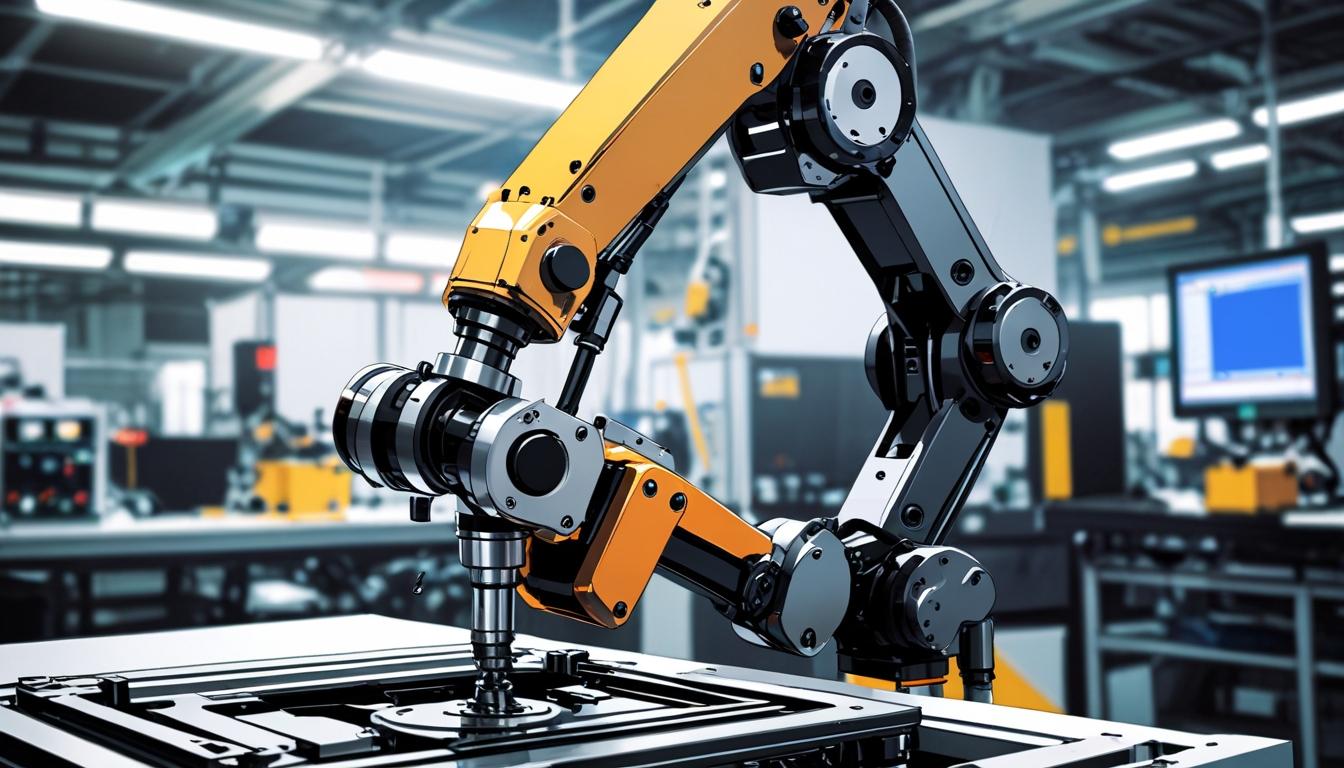
Global Robotics End-of-Arm Tooling Market Projected to Experience Substantial Growth
The global robotics End-of-Arm Tooling (EOAT) market is poised to undergo significant expansion, with projections indicating a growth of USD 1.05 billion from 2024 to 2028. The market is anticipated to grow at a Compound Annual Growth Rate (CAGR) of 5.04% during this forecast period, according to a recent report by Technavio.
The demand for modular EOAT solutions, driven by technological advancements, is a principal factor contributing to this growth. Notably, the integration of Fused Deposition Modeling (FDM) and additive manufacturing technologies into EOAT production processes is accelerating. These technologies provide manufacturers with increased capability to customise tooling, making them more efficient than traditional methodologies. Moreover, they introduce cost reductions, enhance speed, and ensure the reliability of complex component designs. Industry leaders such as Robai and Stratasys have been at the forefront of integrating these advanced manufacturing solutions, enhancing their ability to meet diverse client specifications efficiently.
A broad range of sectors including automotive, semiconductor, electronics, and food and beverage industries are substantial consumers of EOAT. These industries utilise robots equipped with EOAT to perform precision tasks such as material handling, welding, and assembly. The report notes an emerging trend of adopting EOAT within new sectors like agriculture, healthcare, e-commerce, and logistics, where precision gripping and specialised applications are increasingly essential.
The geographic spread of the EOAT market includes substantial activities across regions such as Asia-Pacific (APAC), Europe, North America, South America, and the Middle East and Africa. This wide distribution exemplifies the global applicability and demand for automated and robotic solutions in enhancing productivity and precision in various operations.
Despite the promising outlook, the sector faces challenges primarily due to the high cost of deploying industrial robots, which necessitates additional investments in EOAT components. These additional costs are attributed to factors such as preventive maintenance, safety measures, operator training, and long-term vendor contracts for robot upkeep. The report highlights the average cost per robot implementation stands at approximately USD 85,000, which poses a financial challenge for businesses considering automation of processes like palletizing.
Technavio's comprehensive report provides insights into market trends, challenges, and strategic opportunities for companies operating within this space. It covers extensive segmentation by applications, end-users, and geographic regions, offering businesses the data needed to make informed decisions about their automation strategies.
Key market players identified in the study include ASS Maschinenbau GmbH, Barnes Group Inc., Coval Vacuum Technology Inc., Dover Corp., Effecto Group S.p.A., EMI Corp., and others like Toyota Industries Corp. and Zimmer Group GmbH. These companies are engaged in advancing and deploying EOAT solutions which are essential for the ongoing evolution of automated manufacturing processes.
The research underlines the potential for growth within the robotics EOAT market, aided by continuous advancements in AI and robotic technologies. This evolution is expected to address industry demands for customised, efficient, and precise manufacturing solutions, fostering increased productivity across various global industries.
Source: Noah Wire Services