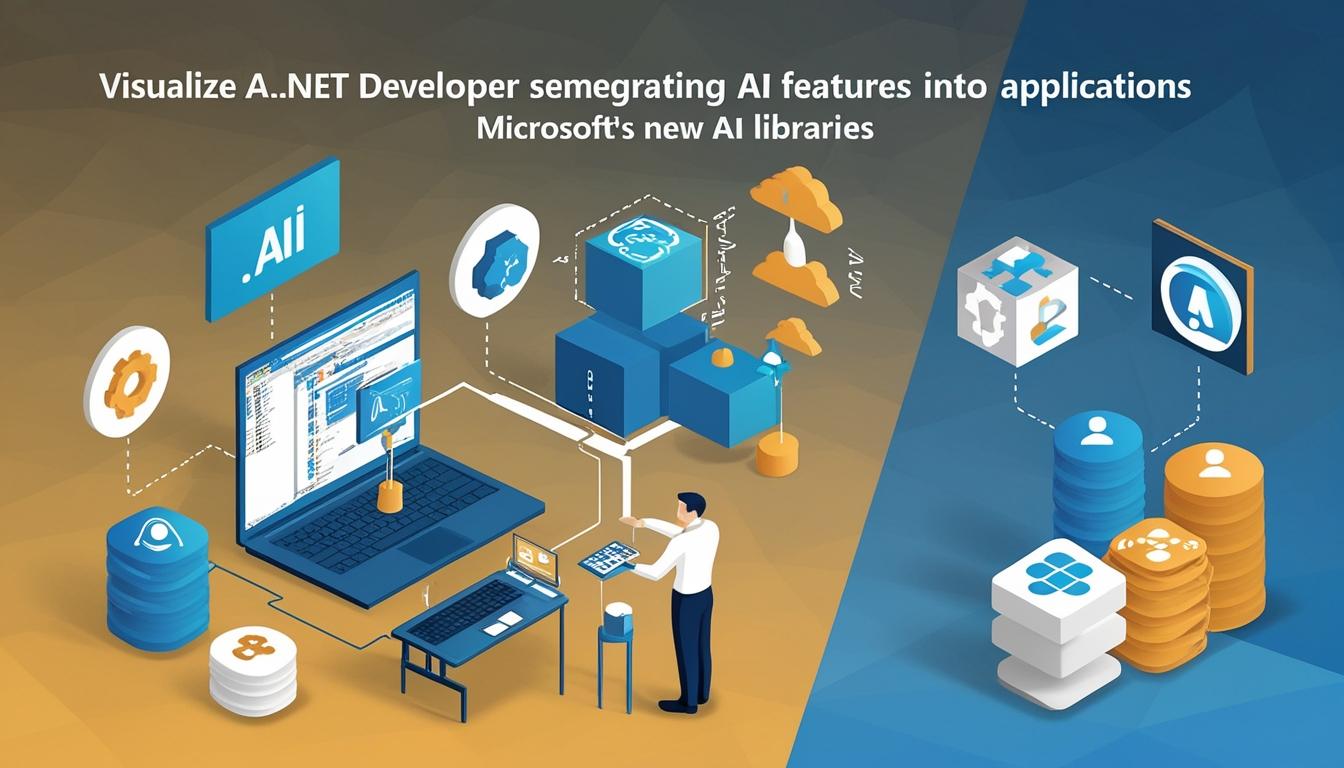
Microsoft has recently unveiled a preview of two new libraries—Microsoft.Extensions.AI.Abstractions and Microsoft.Extensions.AI—aimed at facilitating the integration of artificial intelligence (AI) services within the .NET ecosystem. Announced last week, these Unified AI Building Blocks provide the necessary abstractions for developers to incorporate AI functionalities into their .NET applications and libraries, accompanied by middleware designed to enhance key capabilities.
The initiative, developed in collaboration with the .NET community, including Semantic Kernel, introduces a unified C# abstraction layer. This framework is engineered to interact comprehensively with AI services such as small and large language models, embeddings, and specific middleware components. The overarching objective is to streamline the integration process, enabling developers to select their preferred frameworks and libraries while maintaining seamless collaboration across the ecosystem.
Microsoft has expressed its focus on crafting abstractions that can be universally implemented by diverse services, all anchored in the same foundational principles. Rather than designing APIs specific to any one provider's offerings, the tech giant aims to establish a unifying layer within the .NET ecosystem. By doing so, Microsoft intends to allow developers flexibility in selecting different frameworks and libraries while ensuring consistent integration and collaboration.
The company's announcement emphasizes the libraries as providing a unified API abstraction for AI services. It is akin to Microsoft's established logging and dependency injection abstractions, designed to offer standard implementations for tasks like caching, telemetry, tool calling, and more. These libraries promise to provide consistent APIs and conventions across various providers, delivering a uniform development experience.
Significantly, the libraries liberate .NET authors from the constraints of being bound to a particular AI service provider. This flexibility enables developers to experiment with varying packages utilising the same abstractions, upholding a uniform API across applications. The enhanced componentization allows for the seamless addition of capabilities and testing.
Additionally, the preview includes reference implementations for platforms such as OpenAI, Azure AI Inference, and Ollama. In a move to further simplify implementation, Microsoft plans to collaborate with package authors throughout the .NET ecosystem. This will facilitate integrating these abstractions directly into client libraries, thereby eliminating the necessity for additional packages. Developers maintaining .NET client libraries for AI services are encouraged to implement these abstractions.
Looking ahead, Microsoft intends to continue evolving the libraries in preview form, anticipating their status through the .NET 9 release scheduled for November. Ongoing efforts include collaboration with Semantic Kernel on integration enhancements, updating sample applications like eShop to employ the new libraries, and engaging with developers to encourage adoption.
The development team has outlined near-term objectives, emphasising comprehensive interaction across the .NET ecosystem to promote Microsoft.Extensions.AI's use. The goal is to amplify the power and utility of these libraries as more providers implement the abstractions, consumers adopt them, and middleware components proliferate.
Initial community feedback has been largely positive, with developers expressing both enthusiasm and curiosity. Discussions have emerged around the libraries' nomenclature, particularly querying why Microsoft.Extensions.AI was chosen over alternative names such as Microsoft.Extensions.LLM, given the focus on large language models. Others have shown interest in the benefits these new libraries might bring to existing architectures reliant on AutoML. There is also anticipation for future F# versions, with developers keen for their arrival. Clarifications have been provided regarding the libraries' compatibility with the Azure OpenAI library for .NET, confirming that developers have the option to use AzureOpenAIClient instead of OpenAIClient.
For those eager to explore the capabilities offered by Microsoft.Extensions.AI packages, detailed start-up guides are available in Microsoft's official blog post.
Source: Noah Wire Services