In the evolving world of video game design, advancements in artificial intelligence technology are opening up new possibilities for enhancing player interactions and experiences. For years, non-player characters (NPCs) in video games have been limited to scripted dialogues and interactions, often leading to repetitive and predictable gameplay. However, with the integration of generative AI, game developers are now offering players more dynamic and responsive environments.
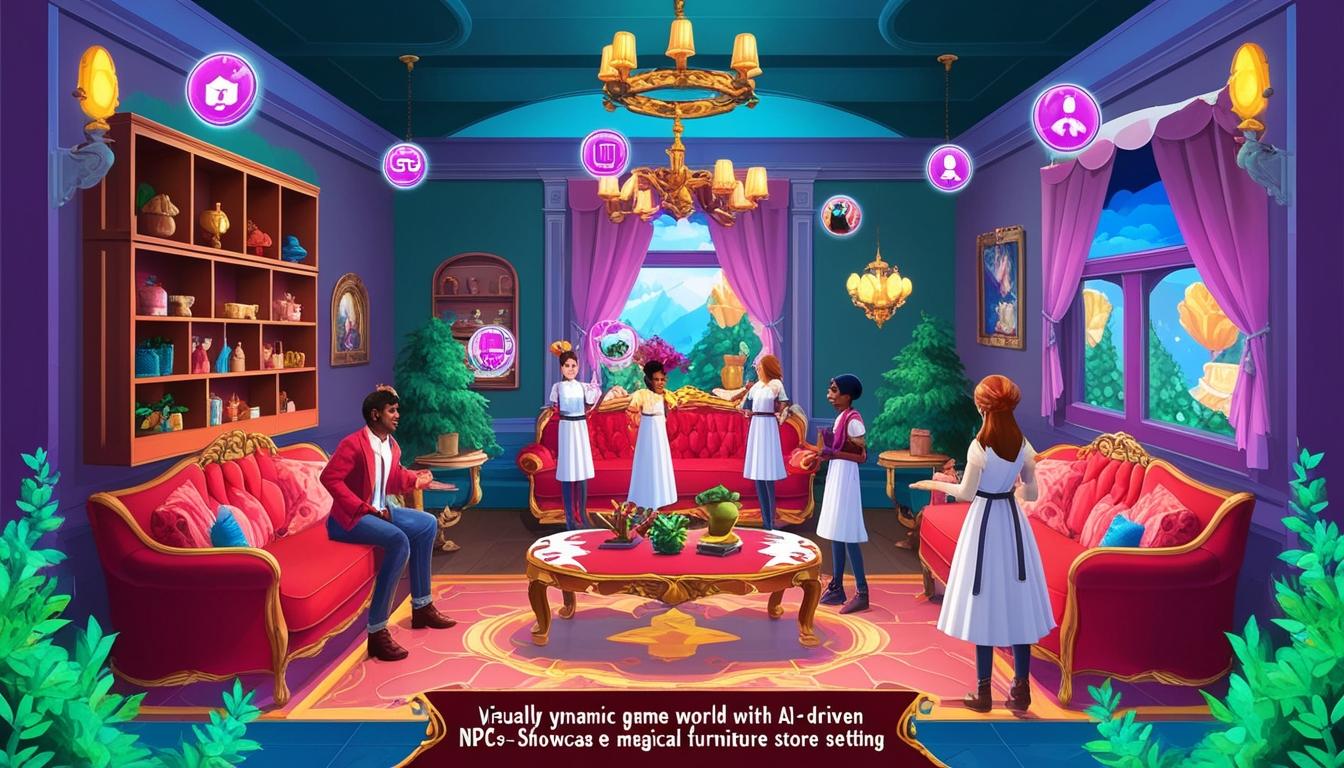
A prime example of this innovation is the multiplayer game "Retail Mage," developed by Jam & Tea Studios. Set in a magical furniture store, players assume the role of both salesperson and wizard, interacting with customers and striving for five-star reviews. What sets "Retail Mage" apart is its AI-driven approach, where player interactions with the shop and the NPCs are not pre-scripted but generated in real-time, allowing for a broader range of actions, from deconstructing items to improvisational conversations.
Michael Yichao, co-founder of Jam & Tea Studios, explained that generative AI can facilitate a more immersive form of gameplay, where the world adapts spontaneously to players’ creative choices and narratives. Unlike traditional methods where players follow a linear path dictated by scripted NPCs, this technology enables more nuanced and varied relationships within the game.
Numerous tech companies are contributing to the incorporation of AI in gaming. Nvidia has developed ACE technologies to animate "digital humans" with lifelike responses, while Inworld AI offers platforms to generate NPC behaviour and dialogue. Ubisoft has implemented an AI tool, Ghostwriter, to assist in writing NPC dialogues without replacing human contributors.
Despite the enthusiasm surrounding these developments, ethical considerations linger. A report from the Game Developers Conference in January indicated a significant portion of developers are already employing generative AI in their projects. The tech sees heavy usage in indie studios, with 37% of developers using such tools. Nonetheless, concerns about ethical deployment persist, with a majority voicing caution.
Carl Kwoh, CEO and co-founder of Jam & Tea Studios, emphasised the importance of using AI as a complementary tool to human creativity, not a replacement. "The goal is to craft experiences that foster player connectivity and storytelling possibilities previously unattainable," Kwoh said.
The potential for AI in gaming extends beyond enhancing NPC interactions. Artificial Agency, a Canadian AI company, has designed an engine that can integrate AI into various aspects of gameplay, from companions to overseeing agents guiding players through content. Brian Tanner, CEO of Artificial Agency, noted that this technology could relieve designers of the onerous task of scripting every game outcome, allowing more focus on character backgrounds and motivations.
The immersive nature of AI in gaming was exemplified in a demonstration by Nvidia's Ike Nnole, showcasing how players in "Mecha BREAK" could now directly interact with NPC mechanics to customise machinery, moving away from traditional menu systems to more streamlined, conversational experiences.
The ongoing development of AI technologies is reshaping the gaming landscape, promising a future where game worlds feel more alive and responsive to player actions. As the industry continues to explore these capabilities, the potential for richer, more authentic player experiences grows.
Source: Noah Wire Services