In a period marked by heightened political polarisation across the globe, a striking 80 percent of Americans perceive the nation as deeply divided on core issues, according to a recent Gallup poll. As the United States prepares for its November elections, the polarisation covers a spectrum of contentious topics including immigration, healthcare, identity politics, transgender rights, and the extent of support for Ukraine. This division is not confined to the United States; similar trends are visible across the Atlantic in the European Union and the United Kingdom.
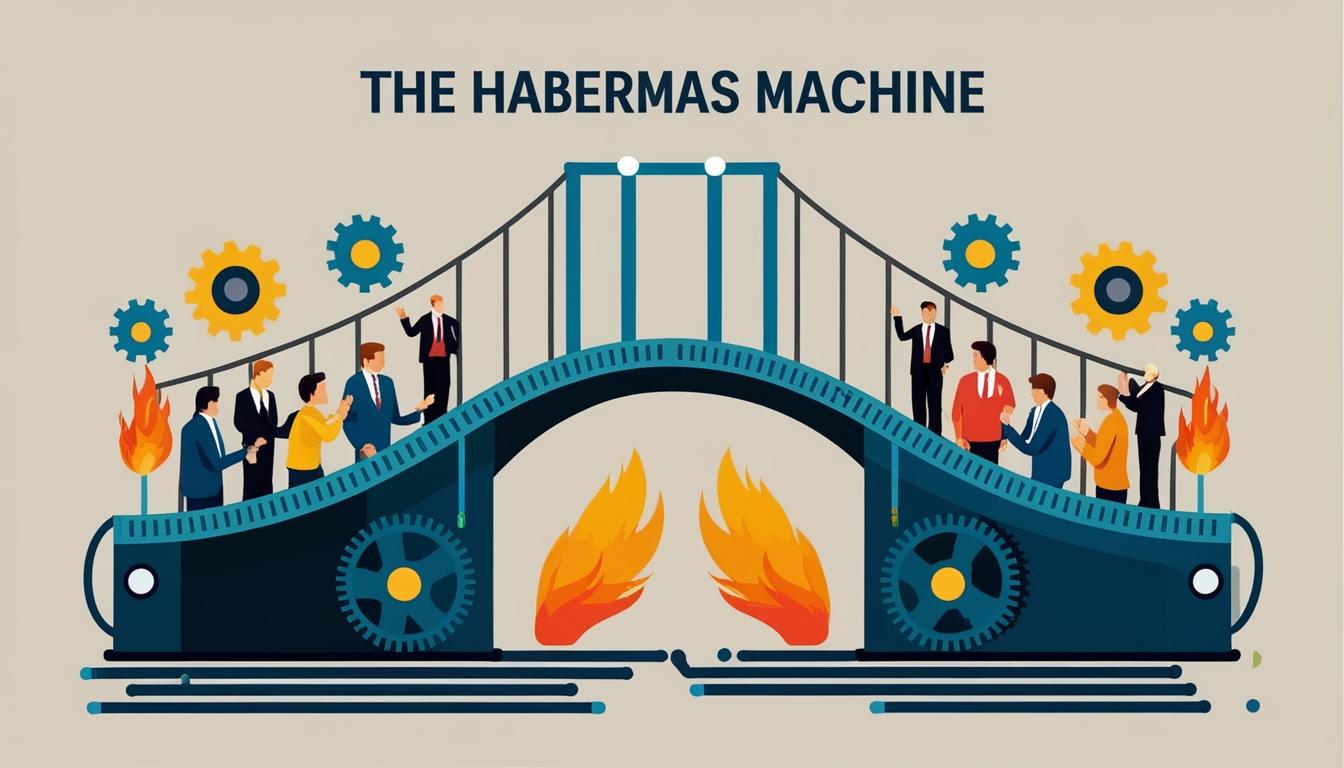
In an effort to address these pervasive divisions, Google's DeepMind has developed an innovative artificial intelligence system named the Habermas Machine. This AI is inspired by the principles of Jürgen Habermas, a German philosopher renowned for his belief that public disputes can be resolved when individuals engage in discussions as equals, employing mutual respect and perfect communication.
The Habermas Machine aims to facilitate conflict resolution by embodying the philosopher’s idea that disagreement stems not from the issues themselves but from the flawed mechanisms of discussion. Habermas contended that no problem is truly unsolvable if approached with an ideal communication system. With this machine, DeepMind attempts to reconstruct how deliberation can be carried out effectively, leveraging modern technology to support the process.
Christopher Summerfield, a professor of cognitive science at Oxford University and a staff scientist at DeepMind, highlighted the intent behind the project. "Our Habermas Machine is an attempt to do exactly that. We tried to rethink how people might deliberate and use modern technology to facilitate it," he explained. The hope is that this AI might offer a novel path toward resolving political and social conflicts, similar to how artificial intelligence has previously mastered domains such as chess, StarCraft, or even predicting protein structures.
However, there remains a question as to whether this AI could genuinely reconcile deeply entrenched political differences or whether it is indeed the appropriate tool for such complex, multifaceted challenges. The initiative reflects a growing interest in exploring technological solutions to socio-political dilemmas, echoing attempts to unravel the procedural aspects that hinder effective discourse.
As the Habermas Machine embarks on its mission, the global political landscape remains cautiously observant of its potential impact, with many wondering whether this integration of philosophy and artificial intelligence will signal a new era of dialogue and understanding.
Source: Noah Wire Services