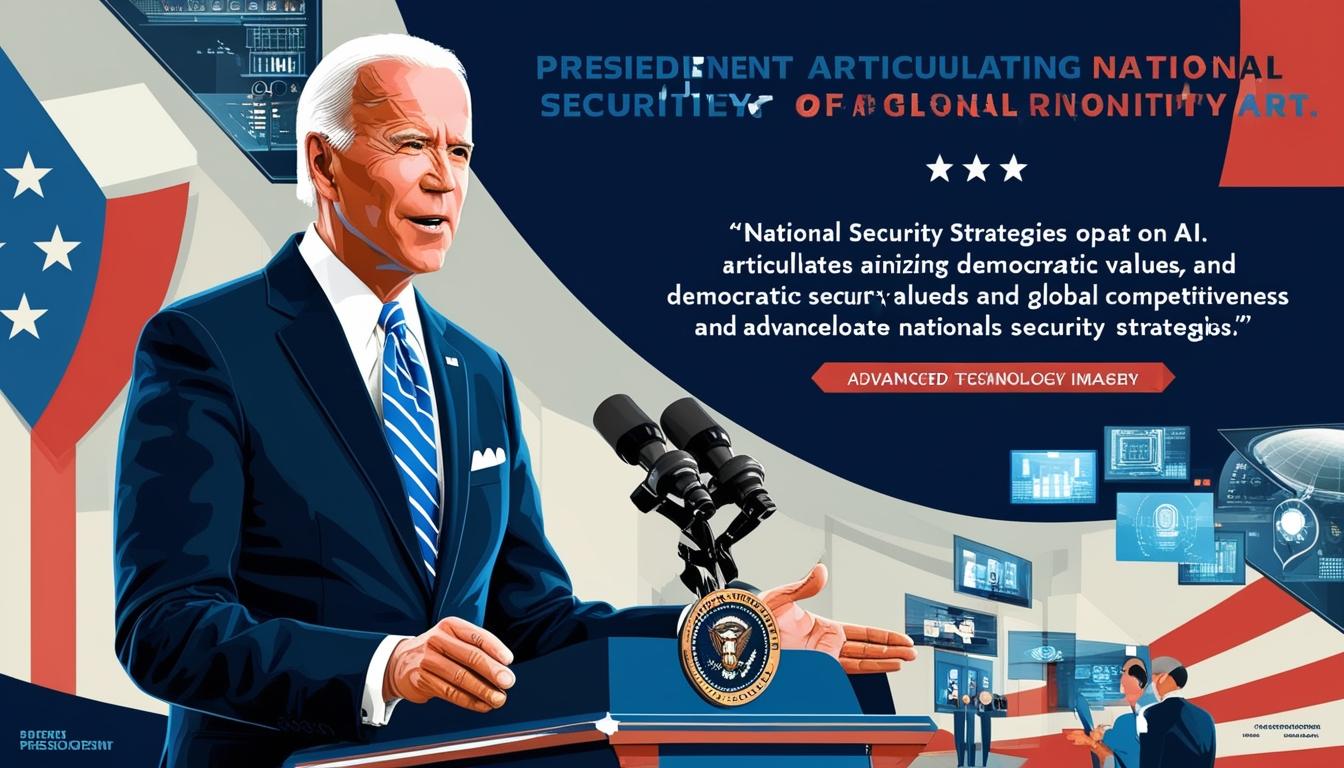
President Joe Biden has introduced a new national security memorandum aimed at harnessing the capabilities of artificial intelligence (AI), while establishing measures to prevent its potential misuse for undemocratic purposes. This strategic directive is seen as a crucial move to maintain competitiveness in the face of global technological advancement, particularly from nations like China, where rapid AI development is underway.
Unveiled during a speech at the National War College by Biden's national security adviser, Jake Sullivan, the memorandum represents a historic framework for integrating AI into national security and foreign policy initiatives. It delineates specific actions to be taken by American agencies to ensure AI is used in alignment with democratic values. For instance, the memorandum explicitly prohibits the use of AI to bypass established protocols concerning nuclear weapons deployment and restricts its application in ways that could impinge upon free speech.
The memorandum is an outcome of extensive consultations between President Biden and his national security team over several months. The administration believes that clarity in policy and legality can foster more robust experimentation and adoption of AI, as it becomes an increasingly significant factor in national security.
Furthermore, the directive instructs agencies to protect AI technologies from foreign espionage and to make strides in the production of semiconductor chips vital for AI products. These plans include timelines for agency reviews that extend beyond Biden's current term, suggesting a long-term vision for AI integration in governmental operations.
Within the broader geopolitical context, the Biden administration views the rapid evolution of AI as a catalyst for a new era of competition among world powers. While the technology has largely been developed in the United States, nations like China are quickly implementing AI in various domains, ranging from military to civilian applications. The administration has initiated discussions with China about AI, particularly concerning its most perilous uses, but aims to engage further to mitigate risks associated with digital authoritarianism.
National security adviser Jake Sullivan underscored the importance of this initiative by highlighting concerns over China's development of a technological infrastructure that could compromise privacy, facilitate mass surveillance, and spread misinformation. "We have to provide a more attractive path," Sullivan stated, advocating for a better alternative to potential partners around the globe.
In alignment with this new memorandum, a significant role is set for the AI Safety Institute within the Department of Commerce, which has already issued guidelines for secure AI development and partnered with firms to trial AI systems pre-release.
This comprehensive strategy puts the U.S. at the forefront of harnessing AI's power while conscientiously managing its associated risks, as echoed by Sullivan during a discussion at the National Defense University. This landmark policy marks the nation's inaugural attempt to systematically leverage AI advancements in securing national safety and fostering technological leadership.
Source: Noah Wire Services