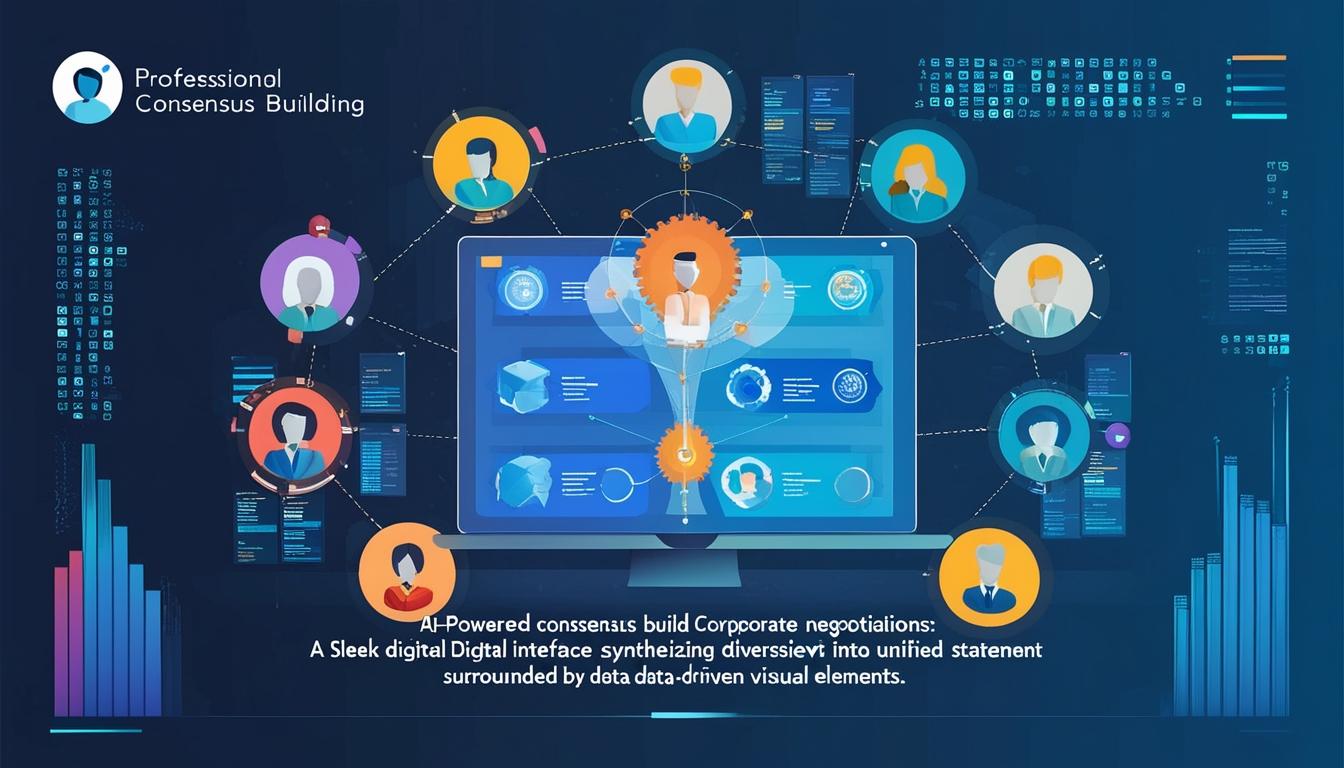
Emerging AI Technologies in Consensus Building for Corporate and Stakeholder Negotiations
In recent developments, innovative artificial intelligence (AI) technologies have started to promise significant advancements in easing stakeholder disputes and corporate negotiations. These AI systems, designed to craft consensus statements from opposing viewpoints, hold the potential to revolutionise how companies address and resolve conflict-ridden discussions, whether in the realm of labour talks or merger negotiations.
Among these pioneering initiatives is Google DeepMind's latest AI tool, which has shown potential in organising group discussions and bridging ideological divides. According to a study published in the journal Science, their AI, named the “Habermas Machine” and based on the Chinchilla language model, has demonstrated effectiveness in synthesizing opposing viewpoints into consensus-building statements. Testing among 439 UK residents indicated a preference for AI-generated summaries, with 56% of participants favouring them over those crafted by human mediators. The tool's applications range from improving citizen assemblies and public policy discussions to extending commercial applications, fostering more inclusive marketing strategies, and enhancing brand resonance among diverse consumer bases.
Hanne Wulp, executive consultant and founder of Communication Wise, underscores the collaborative potential of AI in corporate mediation. She suggests that AI-driven mediation could subtly and neutrally gather and frame divergent perceptions, thereby enhancing collaboration by slightly tweaking the lens through which participants view hardened perspectives.
In parallel, other AI systems are playing significant roles in business decision-making. OpenAI’s Swarm Framework facilitates coordinated operations among multiple AI agents, thereby enhancing decision-making processes. Google's Gemini models further advance negotiation capabilities by aligning transactional interests within companies. IBM's Watson leverages stakeholder data to reach mutual solutions in supply chain management, and platforms like Pactum automate contract negotiations to ensure fairness across all parties involved.
Despite these promising advances, scepticism remains. Michael Taylor, CEO of SchellingPoint, a firm managing a vast database of real-time group decisions, remains cautious regarding the reliance on AI for generating group consensus. He notes that only a fraction (17%) of initial group opinions are like-minded, with a sizable 83% being non-likeminded. SchellingPoint, using frameworks inspired by Harvard Professor Chris Argyris’s research, seeks to understand the underlying reasons for agreement and disagreement rather than seeking consensus for its own sake.
Taylor raises concerns about replacing the nuanced process of reconciling non-aligned opinions with AI-generated suggestions, warning that it could undermine the accuracy and integrity of strategic decisions. Instead, SchellingPoint's approach involves an AI system that aids in accurately concluding by analysing group thinking patterns rather than enforcing consensus.
Complementing this sentiment, Christopher Kaufman, a professor of Business and Leadership Studies at Westcliff University, advocates for using AI iteratively at the individual level to counteract biases and enhance cognitive processes. By allowing individuals to refine their concepts through AI, followed by seeking human consensus, a more holistic and authentic group agreement can be reached.
While the integration of AI in consensus-building processes demonstrates considerable potential in transforming and optimising corporate negotiations, the debate on its effectiveness and implementation remains active. As these technologies continue to develop, they are poised to reshape dialogues across various sectors, challenging traditional models and opening new pathways for innovation in conflict resolution.
Source: Noah Wire Services